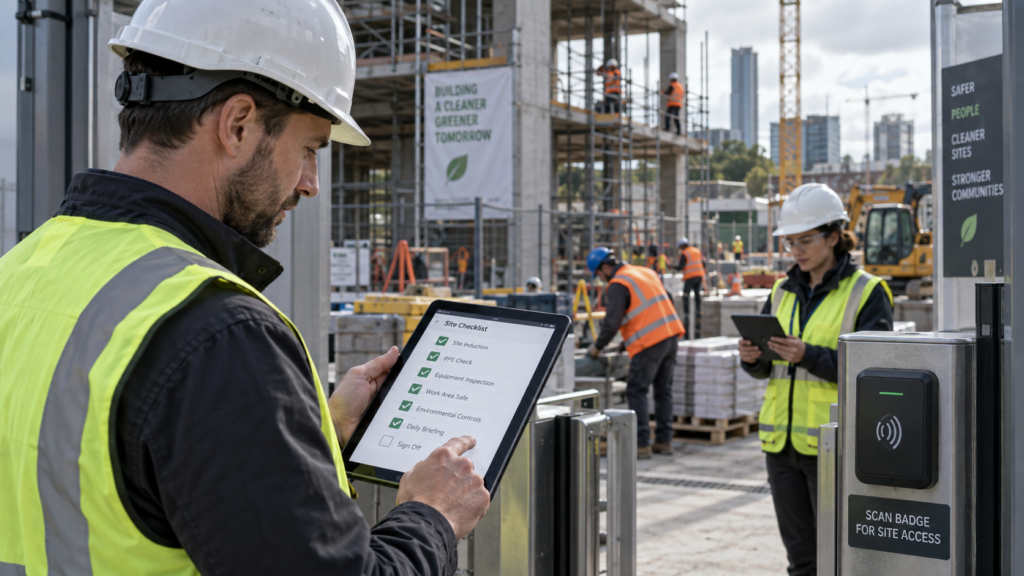
Some journeys are essential on a construction site. A site inspection, a technical check or coordination with the teams cannot be replaced by a screen.
Then there are the other journeys.
Those made to deliver a document, collect a signature, bring an updated copy of a drawing, check a checklist or ask the office which is the latest version available.
The same applies to paper. The problem is not printing when necessary. The problem arises when we continue printing because the process does not allow us to work differently.
This is where construction digitalisation becomes much more than a technology choice. It can become a practical way to eliminate unnecessary steps, reduce duplicated information and better connect the office, site, contractors and suppliers.
In this guide, we look at where to start, which mistakes to avoid and how to measure whether the change is producing a real benefit.
The hidden cost: it is not the paper, but everything that happens around it
The cost of an A4 sheet is negligible.
The cost of the process around it can be much higher.
A document is prepared in the office, printed, handed to the person in charge, used on site and then archived.
Then a revision arrives.
A new copy must be produced, the change communicated and the previous version kept from further use.
If the information has to be physically taken to the site, travel time, fuel and the availability of the person assigned to the task must also be added.
The real cost therefore consists of:
- preparation time;
- reprints;
- searching for the correct versions;
- avoidable journeys;
- verification phone calls;
- possible errors caused by outdated information.
Doing digitalisation well means eliminating these steps, not simply turning a sheet into a PDF.
The turning point: digital and sustainable start with the same problem
Operational efficiency and sustainability are often presented as two different projects.
In reality, many actions can address both.
Reducing reprints means using less paper and fewer consumables.
Avoiding a journey made solely to exchange documentation means recovering time while also avoiding travel.
The same direction is recognised at European level. The Construction Transition Pathway of the European Commission identifies the green and digital transitions as two central routes for making the construction sector more competitive, resilient and sustainable.
For an SME, however, the important point is to avoid slogans.
First measure paper, journeys and manual activities.
Then change the process.
Finally, measure again.
The first effective move: map what is still being printed
For one week, change nothing.
Count.
Note which documents are printed and why.
For example:
- drawings;
- checklists;
- daily reports;
- minutes;
- orders;
- documents to be signed;
- certifications;
- documentation used by the teams.
For every printout, ask yourself:
is it genuinely needed on paper, or are we printing it because a simple alternative does not yet exist?
The distinction is fundamental.
The second move: identify journeys that do not really require a person
Do the same exercise with journeys.
Do not include site inspections, coordination or activities that genuinely require a physical presence.
Focus on journeys made mainly to:
- collect documentation;
- deliver updated copies;
- obtain a signature;
- check information that could be available remotely;
- retrieve photographs or reports;
- transfer information between site and office.
The issue is also significant from an environmental standpoint. According to the European Environment Agency, in 2023 road transport accounted for approximately 73% of transport-sector greenhouse-gas emissions in the European Union.
A single company naturally accounts for only a very small part of that total.
But kilometres avoided are a simple, practical and measurable indicator.
The digital checklist: a small change that clearly demonstrates the principle
Let us take a very simple everyday activity.
An operational checklist is printed, completed, signed and stored.
Its digital version can instead be completed directly on a tablet or smartphone, optionally accompanied by photographs and other useful elements.
Once completed, it remains associated with the project and the correct date.
The benefit is not just eliminating the sheet.
It also eliminates:
- manual collection;
- transport to the office;
- physical filing when unnecessary;
- later searching through different folders.
This is the kind of digitalisation that should interest an SME: fewer steps to achieve the same result, or a better result.
Costly mistake no. 1: digitalising everything at once
If the company still uses a lot of paper, the temptation may be to eliminate everything within a few days.
That is rarely necessary.
I would start instead with the three processes that generate the most:
- printing;
- travel;
- requests for clarification;
- duplication.
Digitalise those.
Measure.
Then decide what to tackle next.
An inefficient procedure does not improve simply because it is transferred to a screen.
Costly mistake no. 2: replacing paper with five different applications
There is a form of fragmentation even worse than paper-based fragmentation: digital fragmentation.
One app for attendance.
A cloud folder for documents.
WhatsApp for communications.
Excel for the budget.
Another software tool for activities.
Each tool may work perfectly.
But someone still has to move information from one to another.
This is precisely why the concept of a Construction Operating System emerged: not necessarily a tool that replaces everything, but an environment in which essential operational information can share the same context.
Costly mistake no. 3: keeping digital and paper forever
During a transition phase, it is normal for the old and new systems to coexist.
The problem arises when this phase never ends.
The team completes the digital document.
Then prints a copy anyway.
The office saves the file in the new system and in the old folder as well.
At that point, digitalisation has not eliminated work.
It has doubled it.
For each procedure, it is therefore necessary to establish when the new source becomes the official one, naturally in compliance with any specific obligations applicable to the documentation concerned.
Digital documents: organising them is one thing; storing them in compliance with the rules is another
It is important not to confuse these two levels.
Saving a document to the cloud can make it easier to access.
It does not automatically mean that all possible legal requirements relating to signature, validity, retention or production have been met.
Different rules may apply depending on the document and the context.
For this reason, operational digitalisation must simplify everyday work without becoming a generic promise of automatic compliance.
Safety: less paper does not mean fewer obligations
The same principle applies to safety.
Making documents and information easier to find can help the organisation.
It does not replace risk assessment, training, instruction, PPE, supervision or the other obligations provided for.
The Italian Ministry of Labour and Social Policies summarises the employer’s main obligations and also distinguishes between delegable and non-delegable activities.
Technology can make information management more efficient. It does not transfer responsibilities.
Involve the site: if the process is slower, people will return to paper
Digitalisation is often designed by the office.
But it has to work on site.
If retrieving a document from the tablet requires ten steps, the site manager will continue to call.
If completing a digital checklist takes longer than completing a paper one, it will be perceived as additional work.
That is why every procedure should be tested by the people who will actually use it.
Effective training should focus on real activities:
- open the correct document;
- complete a checklist;
- upload a photograph;
- record a presence;
- report a change.
The rest can come later.
The practical method: digitalise a pilot project
For an SME, I would start with a single site.
I would then choose three workflows:
- documents;
- checklists or operational reports;
- communications between site and office.
For 30 days, I would measure:
- number of printouts;
- kilometres travelled solely to exchange documents;
- time needed to retrieve a document;
- number of reprints caused by revisions;
- repeated requests for the same information.
After one month, you will have a result far more useful than a generic percentage read online:
your company’s real data.
Measuring sustainability without turning it into marketing
If the aim is also to communicate the environmental benefit, I would start with extremely simple indicators.
- sheets printed before and after;
- reprints avoided;
- kilometres eliminated;
- documents managed exclusively digitally;
- administrative journeys no longer needed.
Only after collecting this data does it make sense to turn it into communication.
Europe’s construction sector is moving towards greater integration between the digital and environmental transitions; the European Commission continues to identify these two paths as parts of the same transformation of the sector.
Sustainability becomes more credible when it can be measured.
A realistic example: the SME that stops carrying documents back and forth
Imagine a small company with three partners, several employees and a couple of active sites.
Every week, one of the managers makes several journeys between the head office and the site.
Some are essential.
Others are mainly for delivering documents, retrieving reports or checking information.
The company chooses a pilot site and puts the checklists, daily reports and most frequently used operational documents online.
After one month, it compares:
how many printouts have been eliminated;
which journeys are no longer necessary;
how much time is spent finding documents;
which problems remain.
We do not promise a reduction of 50%, 70% or 80%.
The right result is the one measured by the company on its own process.
Where a Construction Operating System fits in
Digitalising documents alone can already create value.
But the site contains much more information.
People.
Phases.
Attendance.
Communications.
Budget.
Suppliers.
When each of these types of information lives in a separate application, the risk is replacing paper with new digital silos.
The concept of a Construction Operating System attempts to solve precisely this problem: building an environment in which information can share the same operational context.
To compare different models, you can also consult the guide to construction site management software.
How Edil-Up fits into the journey
Edil-Up is being developed precisely in this direction.
The aim is not simply to turn paper documents into files.
It is to allow sites, phases, collaborators, roles and permissions, documents, attendance and communications to gradually exist in the same operational environment.
For construction companies, this means being able to start with a concrete need—for example, document management—and expand the process later without necessarily having to change tools every time a new need arises.
Value should not be measured by the number of functions available.
It should be measured by the number of unnecessary steps we manage to eliminate.
To learn more about the vision, you can also visit the page dedicated to the Edil-Up project.
A simple calculation: what is it costing us not to digitalise today?
You can start with a normal week.
Add up:
- hours spent printing, collecting and archiving;
- hours spent searching for or checking documents;
- time spent on avoidable journeys;
- mileage cost of the related journeys;
- any reprints or rework linked to incorrect versions.
Then multiply the result by the number of working weeks.
You will not obtain a perfect financial assessment.
You will, however, obtain an order of magnitude far more useful than the software’s simple annual cost.
Practical checklist: start this week
- Identify the three documents or processes generating the most paper.
- Count the journeys made mainly to exchange information.
- Choose a single pilot site.
- Establish an official source for digitalised documents.
- Define simple roles and permissions.
- Train people directly on the device they will use.
- Avoid duplicate entries beyond the initial transition phase.
- Measure paper, kilometres and time recovered for at least 30 days.
Conclusion: the best digitalisation is the kind that stops drawing attention to itself
Good digitalisation should not force the site to talk constantly about digitalisation.
It should simply make work easier.
Fewer documents to transport.
Fewer copies to reprint.
Fewer journeys made solely to transfer information.
Less time spent working out which version to use.
More time to coordinate people, solve problems and move the work forward.
True construction digitalisation does not begin when we eliminate paper. It begins when we eliminate the reason we were forced to use it.
Anyone wishing to compare different approaches can also consult the alternatives for construction site management.
The Edil-Up Team