
Substitute preservation is the process that gives a digital document the same legal value as the paper original, making it enforceable against third parties during tax audits, litigation, or inspections. Simply saving a file in the cloud or on a company server is not enough: precise technical requirements, formally appointed roles, and a certified system are required.
The minimum elements to understand right away:
- Qualified digital signature (or qualified electronic signature) applied by the preservation manager to the submission package.
- Time stamp certifying the certain date and time, making the document retroactively unmodifiable.
- Submission package (PdV): the structured set of documents and metadata sent to the preservation system.
- Preservation register: chronological record of all operations performed.
- Preservation Manual: mandatory formal document describing the system’s roles, procedures, and architecture.
The primary regulatory sources are Art. 44 of the Digital Administration Code and the AgID Guidelines, which establish the requirements for authenticity, integrity, reliability, legibility, and retrievability of electronically stored documents preserved in compliance with the law.
Contents
- What substitute preservation is and which regulatory framework governs it in Italy
- What benefits substitute preservation brings to professionals and businesses
- How the operational process works: from acquisition to the submission package
- When substitute preservation is mandatory and which documents must be preserved compliantly
- How substitute preservation applies to electronic invoices and accounting books
- Accredited preservation provider or in-house solution: how to choose
- Operating timelines, minimum preservation periods, and deadlines to meet
- How much substitute preservation costs: pricing components and models
- Who is responsible and what the Preservation Manual must contain
- Why substitute preservation is strategic for the construction sector
- Key points
- What people who work with these processes every day think
- Official resources and regulatory references to consult
What substitute preservation is and which regulatory framework governs it in Italy
The distinction between digital archiving and compliant preservation is fundamental, and confusing the two is the most common mistake. A company that digitizes its invoices and saves them on a NAS or Google Drive has performed digital archiving: useful for internal use, but without independent evidentiary value. Compliant preservation, on the other hand, ensures legal validity, unalterability, and evidentiary value over time because the process is certified and traceable at every stage.
The central legislative reference is Art. 44 of the CAD (Digital Administration Code, D.Lgs. 82/2005), which establishes the requirements for preserving electronic documents. The AgID Guidelines on the creation, management, and preservation of electronic documents provide the technical implementation, updated and binding for all public and private entities that produce or manage documents relevant for tax, administrative, or legal purposes.
From a technical and operational standpoint, the DPCM 3 December 2013 defined the rules for the preservation system, the manager’s roles, and the specifications for the submission package. Many operational procedures used today derive directly from that decree, even though subsequent AgID Guidelines have supplemented and updated its content.
The Preservation Manual is the document every organization must formally adopt: it describes the system architecture, roles, security measures, and migration plans. It is neither optional nor a mere formality: it is the basis for considering the preservation system compliant during an audit.
A point that often comes as a surprise: a PDF file saved in the cloud, even if digitally signed, is not automatically preserved in compliance with the law. The entire process, from acquisition through generation of the submission package, must follow the certified procedures set out in the AgID Guidelines.
What benefits substitute preservation brings to professionals and businesses
The operational benefits go well beyond compliance. On the cost side, eliminating physical archives means reducing space, consumables, search time, and the risk of loss. A document preserved compliantly can be retrieved in seconds using metadata, compared with the minutes or hours required for a paper archive.

Document security improves in three dimensions: integrity (the document cannot be altered after time stamping), non-repudiation (the digital signature links the document to the signer in an incontestable manner), and audit trail (every operation is recorded and verifiable). This produces a tangible reduction in risk in the event of litigation or a tax inspection.
For construction, the benefits are even more specific. Specifications, safety plans, test certificates, and site minutes are documents that must be retained for years and are often requested by public or private clients at short notice. Managing them compliantly means always having intact documentary evidence available, without depending on physical archives scattered between the office, site, and technical studio.
Advice: before starting any substitute preservation project, map the document types produced by the company and classify them by regulatory obligation, retention period, and annual volume. This preliminary analysis reduces setup costs and guides the choice between an in-house solution and an accredited preservation provider.
Compliant preservation is also linked to document security and cyber resilience, issues that are increasingly relevant in the context of the NIS2 Directive. Treating it as a simple tax requirement means missing the strategic value it provides as part of information-risk management.
How the operational process works: from acquisition to the submission package
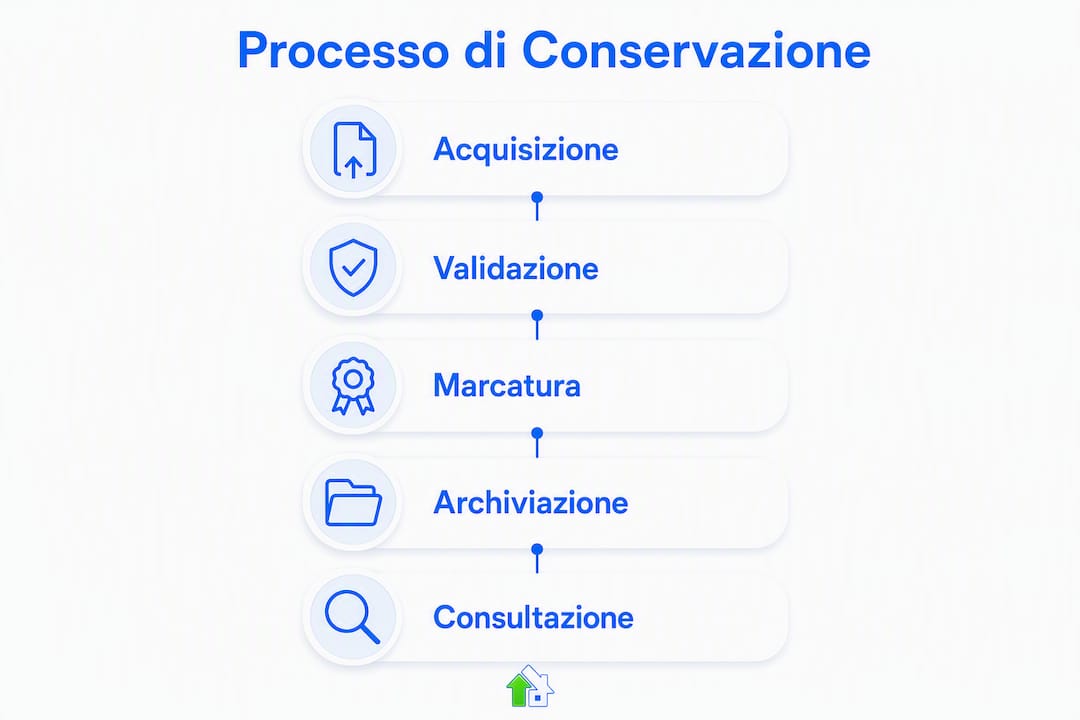
The process consists of sequential stages, each with precise technical requirements.
- Acquisition and digitization: analog documents are scanned in a suitable format (preferably PDF/A for long-term preservation). Born-digital documents enter the workflow directly without conversion.
- Indexing and metadata: mandatory metadata (type, date, creator, unique identifier) are associated with each document. Metadata quality determines future retrievability.
- Creation of the submission package (PdV): documents and related metadata are grouped into a package structured according to AgID specifications. The PdV is the transfer unit for the preservation system.
- Application of the digital signature: the preservation manager (or the system, if delegated) digitally signs the PdV using a qualified certificate. For unique original analog documents, such as certain notarial deeds, the digital copy requires authentication by a public official before the original may be destroyed.
- Time stamping: a certified time stamp is applied to the signed PdV, establishing the date and time in a manner enforceable against third parties.
- Transfer to the preservation system: the PdV is sent to the system (in-house or at an accredited preservation provider) and recorded in the preservation register.
- Generation of the submission report: the system produces an attestation certifying that the PdV has been accepted.
| Stage | Produced artifact | Technical requirement |
|---|---|---|
| Acquisition | Digital file (PDF/A, XML, etc.) | Format suitable for long-term preservation |
| Indexing | Structured metadata | Compliance with AgID specifications |
| PdV creation | Submission package | SIP (Submission Information Package) structure |
| Digital signature | Signed PdV | Manager’s qualified certificate |
| Time stamp | PdV with timestamp | Accredited TSA |
| Registration | Preservation register | Complete chronological traceability |
There are three roles involved: the producer (the party that creates the documents), the preservation manager (a formally appointed internal role responsible for process compliance), and, when outsourcing is used, the preservation service manager of the accredited provider. Technical details on HSM requirements for certificate custody and activity logging are described in the operating manuals of accredited preservation services.
When substitute preservation is mandatory and which documents must be preserved compliantly
Not all digital documents require compliant preservation. The distinction depends on the document’s legal, tax, or evidentiary value and on the specific regulatory obligations applicable to the category.
Documents for which compliant preservation is mandatory or strongly recommended:
- Electronic invoices: preservation in compliance with the law is required within three months of the deadline for filing the income tax return for the relevant year.
- Accounting books and registers (journal, inventory book, VAT registers): subject to compliant preservation to ensure tax validity.
- Tax documents (returns, F24 forms, electronic receipts): minimum retention period for tax documents as required by law.
- Material contracts with evidentiary value in the event of litigation.
- Administrative documentation of public entities and equivalent parties: obligation arising from the CAD.
- Construction-site documents with legal relevance: safety plans (PSC, POS), test certificates, and work handover minutes.
Documents that do not necessarily require compliant preservation include internal communications, drafts, and documents used exclusively for operations without external evidentiary value.
The retention period varies by category. For tax documents, the ordinary period is 10 years from the date of the last document recorded in the tax period. For documents relating to real estate and public contracts, periods may be longer, linked to the duration of the work or contract. Always verify the specific provisions for each category with your tax or legal adviser.
How substitute preservation applies to electronic invoices and accounting books
An electronic invoice in XML format transmitted through the Revenue Agency’s Sistema di Interscambio (SDI) is already an electronic document with a certain date. This does not mean it is automatically preserved compliantly: the XML file must be included in a PdV, signed, and time-stamped according to the process described above.
The operational flow for electronic invoices:
- Receipt or creation of the invoice through SDI.
- Accounting entry in the ERP or accounting system.
- Inclusion of the invoice (XML file plus any attachments) in the submission package.
- Application of a digital signature and time stamp to the PdV.
- Submission to the preservation system within the applicable deadlines.
- Generation of the submission report and updating of the preservation register.
For accounting books, the process involves periodically generating an image of the book (typically in PDF/A), the digital signature of the preservation manager, and time stamping. The frequency of transfers must be defined in the Preservation Manual: for books required for tax purposes, established practice provides for transfers at least annually, coinciding with the close of the financial year.
An often-overlooked aspect is integration between the preservation system and accounting software. If the two systems do not communicate natively, the risk of submission errors (missing documents, incorrect metadata, duplicates) increases significantly. Integrated SaaS solutions that manage the flow from document creation through preservation reduce this risk and speed up access during an audit.

Accredited preservation provider or in-house solution: how to choose
The choice between internal management and outsourcing to an accredited preservation provider depends on concrete variables: document volume, internal IT expertise, budget, and business continuity requirements.
- Assess internal expertise — the preservation manager must be formally appointed and familiar with the AgID Guidelines. If this role does not exist or is not trained, outsourcing is the safer choice.
To verify accredited preservation providers in Italy, AgID publishes and updates the public list of accredited preservation providers, freely available online.
Operating timelines, minimum preservation periods, and deadlines to meet
| Document category | Minimum period | Deadline for submission to the system |
|---|---|---|
| Electronic invoices (issued and received) | 10 years | Within 3 months of the deadline for filing the income tax return for the relevant year |
| Accounting books and registers | 10 years | Within 3 months of the income tax return deadline |
| Tax documents (F24 forms, returns) | 10 years | At the time of creation or receipt |
| Material contracts | Contract term + 10 years | Upon signing or receipt |
| Construction-site documents with legal relevance | Work duration + contractual periods | At the close of the phase or site |
Meeting submission deadlines is just as important as the preservation period. A document that has been created but not yet submitted to the system is not preserved compliantly: in the event of a tax audit or inspection, the company cannot produce the document with the guarantees required by law.
To avoid the risk of backdating or late submissions, it is advisable to define a periodic submission policy in the Preservation Manual, with calendarized deadlines (monthly or quarterly for invoices, annually for accounting books) and an automatic control that flags documents awaiting submission beyond a defined time threshold.
How much substitute preservation costs: pricing components and models
Costs consist of several items, and understanding them makes it possible to build a realistic business case before choosing a provider.
- Setup and configuration: one-time costs for integration with existing systems, metadata configuration, and training the preservation manager.
- Digital signatures and time stamps: charged per unit or as an annual bundle; time stamps have a unit cost that varies with volume.
- Storage: calculated in GB or TB per year; it increases with document volume and preservation period.
- Metadata management and indexing: included in some services and usage-based in others.
- Transfers and migration: costs for periodic transfer operations or migration to new formats.
- SLA and support: guaranteed service levels (availability, response times, technical support) affect the price.
- Termination plan: some providers charge separately for returning data at the end of the contract.
The three most common pricing models are pay-per-document (suitable for low or irregular volumes), annual subscription by volume tier (the most common for SMEs with stable document flows), and modular pricing with usage-based storage (preferred by large organizations with variable volumes). For construction companies with seasonal sites, a fixed annual-volume model tends to be less efficient than a modular model.
Who is responsible and what the Preservation Manual must contain
The roles are defined by the AgID Guidelines and are not interchangeable:
- Producer: the entity or person that creates the documents and transfers them to the preservation system. In private companies, this is often the internal administration team.
- Preservation manager: an internal role formally appointed by the organization and responsible for process compliance. This person is responsible for correctly applying procedures and updating the Preservation Manual.
- Preservation service manager: a role at the accredited provider, present only in the event of outsourcing. This person manages the technical infrastructure and is responsible for the contractual SLAs.
The Preservation Manual must be adopted through a formal measure (resolution, determination, or equivalent act) and contain at least:
- Description of the organization and roles (including names and responsibilities).
- Architecture of the preservation system (hardware, software, network infrastructure).
- Document types handled and their metadata.
- Operating procedures for acquisition, submission, access, and retrieval.
- Security measures adopted (access control, encryption, backup).
- Plan for migration to new formats or systems.
- Service termination plan and data migration procedures.
To maintain compliance over time, the company must plan periodic internal audits: at least one annual review checking the integrity of submission packages, the validity of signature certificates, metadata accuracy, and whether the Manual has been updated to reflect any regulatory or organizational changes.
Why substitute preservation is strategic for the construction sector
In construction, document production is intensive and distributed: safety plans (PSC, POS), specifications, work handover minutes, test certificates, transport documents, and subcontracting agreements. Each site generates dozens of documents with legal, tax, or contractual relevance. Managing them on paper or in unstructured digital archives exposes the company to concrete risks: documents that cannot be found during testing, an inability to demonstrate regulatory compliance, and difficulties during checks by contracting authorities.
Integrated construction-site document management with a compliant preservation system solves these problems at their root. Documents are retrievable in real time, with guaranteed integrity, and can be presented to clients, inspectors, or judicial authorities without searching through physical archives.
From a sustainability standpoint, eliminating paper archiving reduces paper consumption, physical space, and the energy resources required to maintain archives. For companies participating in public tenders with minimum environmental criteria (CAM) or pursuing green certifications, document digitization is a measurable part of their sustainability profile. Edil-up supports this process with tools for digital site management and calculating the environmental savings generated by digitized projects, including tree planting for every active subscription.
Integrating substitute preservation into the digital site workflow also simplifies management of construction-related tax incentives: documentation for accessing incentives for reducing energy consumption often requires precise documentary evidence preserved over time.
Key points
Compliant substitute preservation requires a qualified digital signature, time stamp, structured submission package, preservation register, and formally adopted Preservation Manual: without these elements, a digital document has no independent evidentiary value.
| Point | Details |
|---|---|
| Regulatory basis | Art. 44 CAD and the AgID Guidelines define mandatory requirements for all private and public entities. |
| Tax retention | Invoices, accounting books, and tax documents must be preserved compliantly for at least 10 years. |
| Mandatory Manual | The Preservation Manual must be formally adopted and updated whenever organizational or regulatory changes occur. |
| In-house vs. outsourcing | Choose the accredited provider after checking termination plans, interoperability, and SLAs before signing the contract. |
| Periodic audits | Check package integrity, certificate validity, and metadata accuracy annually to maintain compliance. |
What people who work with these processes every day think
Substitute preservation is one of those areas where the gap between written rules and business practice remains very wide. Many companies, especially in construction, believe they are compliant because they use electronic invoicing or store documents on a shared server. They are not.
The most frequent problem is not a lack of willingness, but the absence of a formally appointed preservation manager and an up-to-date Preservation Manual. Without these two elements, any technical system adopted remains without regulatory coverage.
A second recurring mistake is choosing a provider solely on the per-document price without reading the termination-plan clauses. I have seen companies that, when changing providers, had to negotiate the return of their own documents as though it were a favor. This is not a minor contractual detail: it is the starting point for the evaluation.
For anyone starting today, the most effective path is gradual: first map document types and volumes, then appoint the manager, then draft the Manual, and only then choose the system. Skipping the first two steps to move straight to technology is the main reason projects stall halfway through.
Official resources and regulatory references to consult
To implement or verify compliance with substitute preservation, keep these documents and portals close at hand:
- Compliant digital preservation: official AgID page, providing access to the Guidelines, determinations, and regulatory updates.
- AgID Guidelines on the creation, management, and preservation of electronic documents: full text including Arts. 43 and 44 CAD and the technical operating specifications.
- AgID Preservation Manual (v6.5): reference model for drafting the company Manual, with mandatory content and recommended structure.
- AgID public list of accredited preservation providers: to verify a provider’s accreditation before signing the contract.
- Revenue Agency document management manual: a practical example of how a public administration structures its preservation system, useful as a reference for businesses.
- Resolution of 19 February 2004 (Interlex): historical source on the technical procedures for transfer, digital signatures, and time stamps, useful for understanding the origins of the current regulatory framework.
To use the AgID public list of accredited preservation providers effectively, check not only whether a provider appears on the list, but also the date of the latest accreditation update and the document types covered by the service. Some providers specialize by sector (public administration, healthcare, finance): for construction, prioritize those with documented experience managing technical and construction-site documents.
Note: this article is intended for general information purposes. For application to your specific business, consult a qualified tax or legal adviser or document-management specialist.