Construction-site waste management is a legal obligation that falls on the contractor carrying out the work, not on the client. The waste producer is responsible for correct classification, temporary storage, documented transport and final disposal. Penalties for illegal transport of hazardous waste can reach €26,000, with possible imprisonment. Three pillars support the entire chain: classification by CER codes before materials leave the site, completion of the Waste Identification Form (FIR) for every shipment, and registration with the RENTRI traceability system.
Here are the main obligations at a glance:
- CER classification: each waste stream receives a code before leaving the site
- Temporary storage: grouping by homogeneous categories without prior authorisation, in compliance with art. 183 of D.Lgs. 152/2006
- FIR: mandatory for every shipment; from 15 September 2026, only in digital format through RENTRI
- Register of Environmental Managers: required for transport using the company’s own vehicles (category 2-bis)
- Penalties: applicable from the same date for failure to transmit data to RENTRI
How are construction waste streams classified under Italian law?
Construction and demolition (C&D) waste is classified as special waste under art. 184, paragraph 3, letter b) of D.Lgs. 152/2006. It is divided into three categories: inert (concrete, bricks, ceramics), non-hazardous (wood, metals, plastic) and hazardous (asbestos, paints, solvents, hydrocarbon-containing materials).
Classification by CER codes must take place before the waste leaves the site. The producing company creates a kind of identity card for the waste: it describes the process of origin, identifies possible hazardous properties and, if the available information is insufficient, uses chemical sampling. Construction waste predominantly falls within code family 17 of the European Waste Catalogue.
Chemical analyses follow precise technical standards. For selective demolition, sampling must be repeated every 3,000 m3 for civil or commercial buildings and every 1,500 m3 for craft or industrial buildings. For non-selective demolition, maximum batches fall to 1,000 m3 for civil buildings and 500 m3 for industrial buildings, with analytical characterisation mandatory for every batch. The technical references are UNI 10802:2013 and UNI/TR 11682:2017.
Tip: For renovation sites involving industrial buildings, include substances relevant to the activity carried out on the premises in the analytical characterisation: solvents, heavy metals and hydrocarbons. Ignoring them can lead to incorrect classification and penalties.
Operational stages: from generation to temporary storage
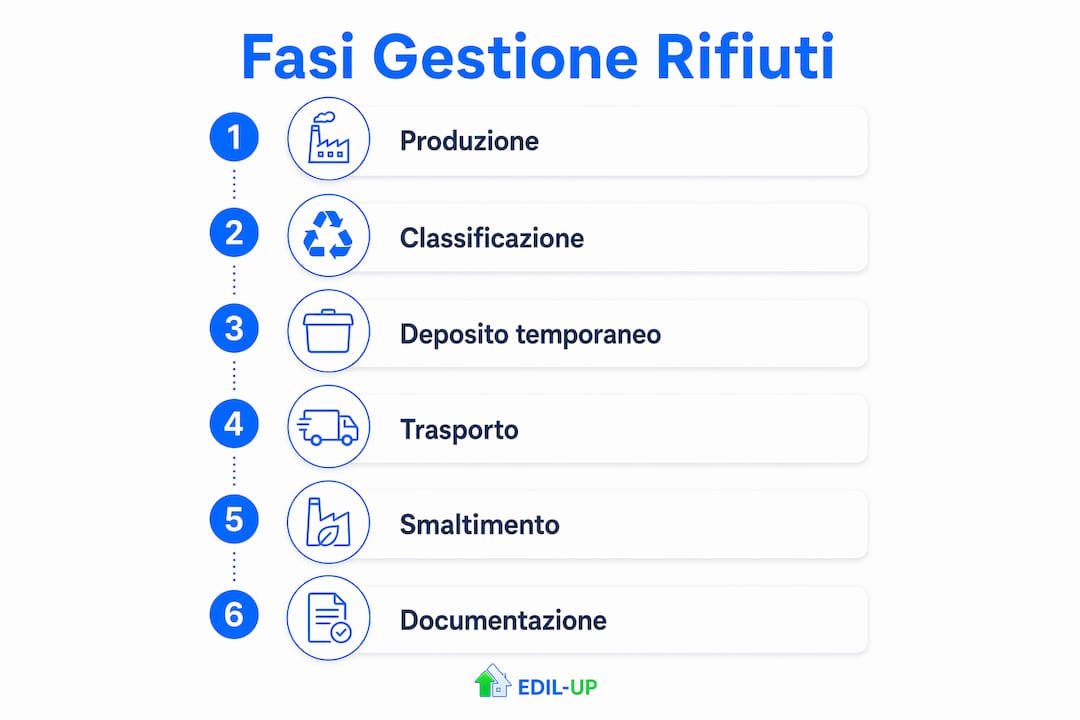
Correct management begins long before the dumpster arrives. SNPA guidelines identify selective demolition as the most effective solution: separating waste types from reusable components makes it possible to obtain homogeneous inert materials, remove hazardous components during the preliminary stages and send separate fractions for more efficient recovery.
The operational stages are as follows:
- Preliminary survey: assessment of the structure, activities carried out, available space and critical issues (asbestos, underground tanks, abandoned waste)
- Preliminary activities: asbestos remediation, tank removal, dismantling of recoverable windows, doors and metal structures
- Demolition and accumulation: waste is accumulated by homogeneous category with its relevant CER code, avoiding mixed piles
- Temporary storage: dedicated area with signage, separation by CER code and protection from the weather for dusty or leaching waste
- Dispatch for recovery or disposal: each batch accompanied by the correct FIR
Separation on site improves waste quality and enables more efficient, sustainable management. Selective demolition pursues three objectives: reducing the quantities generated, eliminating hazardous components and encouraging recovery of separated fractions. (SNPA guidelines, incorporated into the guide issued by the Order of Engineers of Sondrio)
The roles are distinct: the client sets the requirements in the specifications, the works supervisor verifies compliance with procedures, and contractors carry out separation and manage storage. Legal responsibility for the waste produced remains with the contractor carrying out the work.
Transporting construction waste: FIR, RENTRI and documentation requirements
Transport is the stage with the greatest exposure to penalties. Anyone transporting waste using their own vehicles must be registered with the National Register of Environmental Managers in category 2-bis. Transporting waste without registration and forms entails criminal penalties.
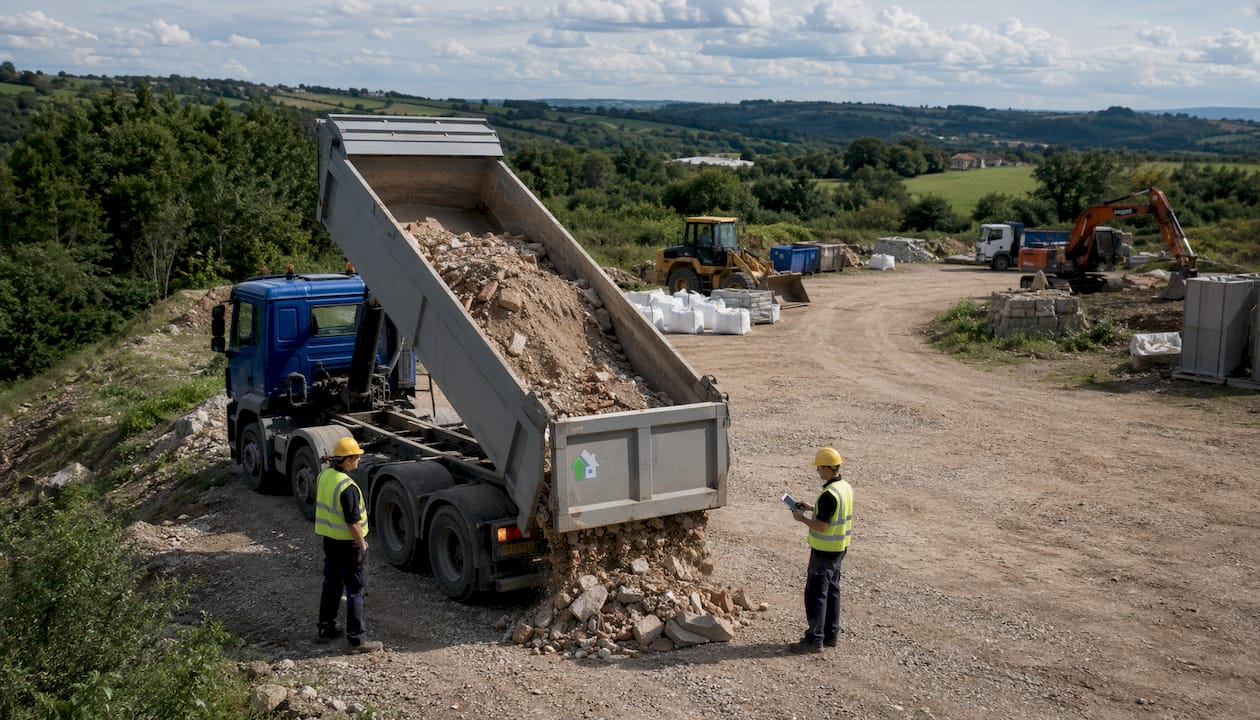
The FIR accompanies every shipment and must state: producer, carrier, recipient, CER code, quantity and waste characteristics. The format selected by the producer determines how the entire chain is managed: if the producer issues the FIR digitally, carriers and recipients must manage it digitally; if it is issued on paper, the entire chain uses paper.
| Deadline | Requirement |
|---|---|
| Until 15 September 2026 | Paper FIR still permitted as an alternative to digital format |
| From 15 September 2026 | FIR exclusively digital through RENTRI |
| From 15 September 2026 | Penalties for failure to transmit data to RENTRI |
Failure to synchronise the producer, carrier and recipient in digital systems can halt operations and result in administrative penalties. For this reason, staff training on digital procedures is a practical priority, not an option.
Tip: Integrating waste management into the site schedule reduces the risk of operational stoppages and makes it possible to plan transport while complying with the maximum temporary-storage periods.
Disposal and recovery: technical criteria and end-of-waste
Disposal is the residual option in the waste-management hierarchy. Recovery is attempted first; only when this is not practicable is landfill used. DM 5 February 1998 regulates inert-waste recovery under the simplified procedure: the producer must verify that the waste falls within the prescribed cases and that its chemical and physical characteristics meet the requirements.
The main permitted recovery activities include:
- Storage pending recovery [R13] to produce secondary raw materials through crushing, screening and particle-size separation
- Use for environmental restoration [R10] following treatment and leaching tests
- Construction of embankments and road sub-bases [R5] following treatment and leaching tests
Waste ceases to be waste (end-of-waste) when it has undergone a recovery operation and meets the criteria of art. 184-ter of D.Lgs. 152/2006: use for specific purposes, compliance with technical requirements and no negative environmental impacts. For landfill acceptance, the producer must carry out basic characterisation before delivery, in accordance with the methods in Annex 3 of D.Lgs. 36/2003.
Specialist operators such as Impresa Sangalli Giancarlo & C. Srl provide complete disposal, environmental remediation and regulatory consultancy services for construction and industrial waste. SOGEAM SRL specialises in laboratory chemical analyses and consultancy in the industrial sector. Conepo Servizi S.c.a.r.l. covers the disposal of hazardous and non-hazardous special waste, with integrated transport services. Centro Del Recupero Srl manages transport and disposal, focusing on material recovery. Ecoberg Srl specialises in recovering industrial waste, including waste from demolitions. Using registered and authorised operators is the only way to transfer responsibility for the waste correctly.
How Edil-up supports digital, sustainable site management
The transition to the digital FIR and RENTRI is not merely a bureaucratic requirement: it is a change in working methods requiring coordination among all participants in the chain. Edil-up meets this need with a centralized project-management platform that enables users to monitor generated waste, coordinate the companies involved and track site progress in real time.
Edil-up enables users to track and monitor generated waste, promote eco-friendly practices and reduce delivery times by up to 20%.
Relevant waste-management features include:
- Integrated document monitoring for FIRs and loading/unloading registers
- Direct communication among contractors, the works supervisor and the client
- Calculation of the environmental savings generated by digitized projects
- Tree planting for every active subscription as a practical offsetting measure
Digitization of the construction sector is not only about productivity: it reduces documentation errors that generate penalties and makes regulatory compliance verifiable at every stage of the site. For companies managing multiple sites simultaneously, having everything in one system prevents discrepancies between producer, carrier and recipient that RENTRI does not tolerate.
Hazardous waste on construction sites: specific safety procedures
Hazardous waste found on construction sites requires procedures distinct from those for inert waste. The most frequent types are asbestos-containing materials, paints and solvents, mineral oils, batteries, electrical and electronic equipment (RAEE), and underground tanks containing hydrocarbon residues.
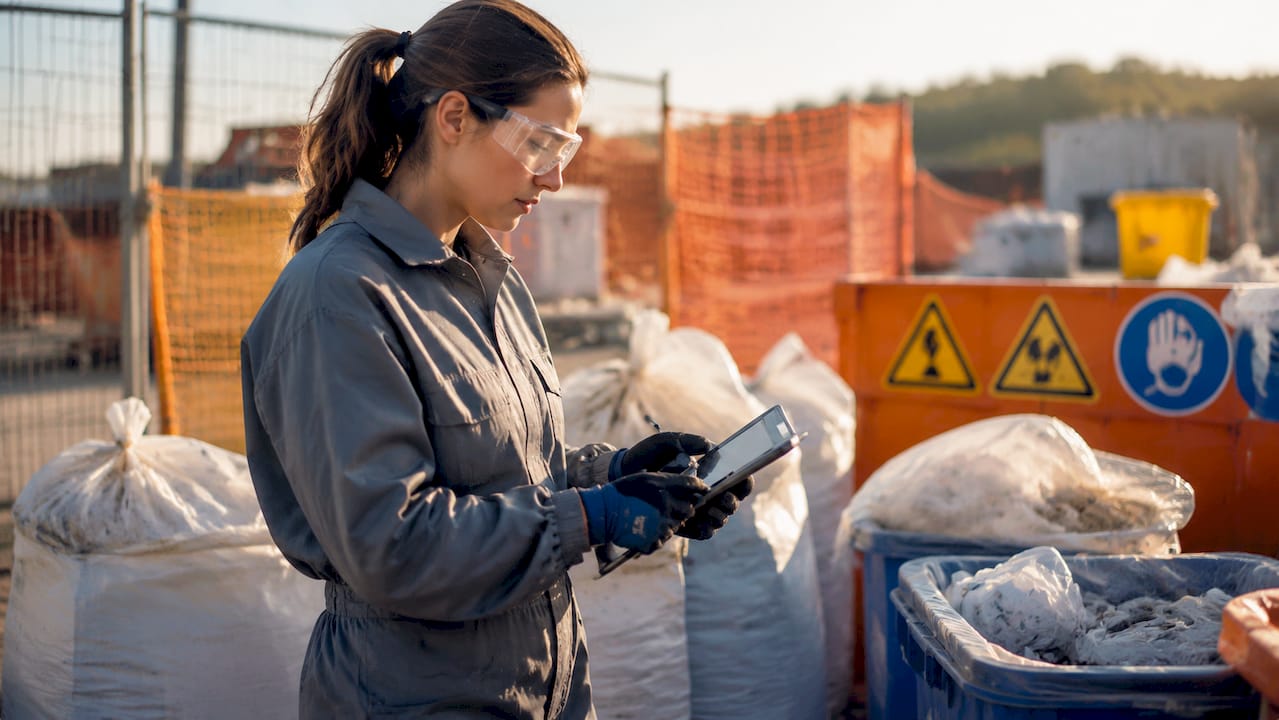
For each category, temporary storage must comply with the rules governing the hazardous substances contained, with compliant packaging and labelling. Hazardous waste may not be mixed with other hazardous waste or with non-hazardous waste. Transport requires a separate FIR for each hazardous CER code and a carrier registered with the appropriate categories in the Register.
Asbestos deserves particular attention: remediation must precede any structural demolition and must be entrusted to certified companies. Removed materials travel in sealed packaging with specific labelling and must be delivered exclusively to authorised facilities. Strategies for separating materials during demolition adopted in other international contexts also confirm that preliminary work on hazardous materials is the factor determining the quality of the entire recovery process.
How is waste-management documentation retained?
Keeping registers is an obligation distinct from completing the FIR. Construction companies that produce hazardous waste must keep a chronological loading and unloading register under art. 190 of D.Lgs. 152/2006. Once RENTRI is fully operational, this register becomes digital and the data is transmitted through an application interface (API) to the ministerial system.
Paper FIRs must be retained for at least five years from the date of issue. The recipient signs and dates the return copy, which the producer archives as proof that disposal took place. With the digital FIR, the copy countersigned by the recipient is available directly on the RENTRI portal.
Analytical waste characterisation, selective-demolition declarations and chemical-analysis certificates form part of the site file and must be retained for the entire duration of the work and for the subsequent period required by law. Rigorous document organisation is not only useful for avoiding penalties: in the event of a dispute, it is the only proof that the chain operated correctly.
Key points
Correct construction-site waste management requires CER classification before removal, an FIR for every shipment and, from 15 September 2026, mandatory digital transmission through RENTRI.
| Point | Details |
|---|---|
| Producer responsibility | The contractor carrying out the work is responsible for the waste until final disposal, with penalties of up to €26,000. |
| Mandatory CER classification | Each waste stream must be classified before leaving the site, based on chemical analyses or available information. |
| Digital FIR from 2026 | From 15 September 2026, the FIR is exclusively digital; until then, paper remains a valid alternative. |
| Selective demolition | Separating materials at source reduces generated waste, removes hazardous components and facilitates recovery. |
| Document retention | FIRs, loading/unloading registers and analytical characterisations must be retained for at least five years. |
Recommended
- Construction schedule: a practical guide for construction professionals
- The benefits of centralized project management – Edil-up – Sustainable construction for the future
- How to build a network of contacts in the construction sector – Edil-up – Sustainable construction for the future
- Digitization of the construction sector: how to prepare for the future – Edil-up – Sustainable construction for the future