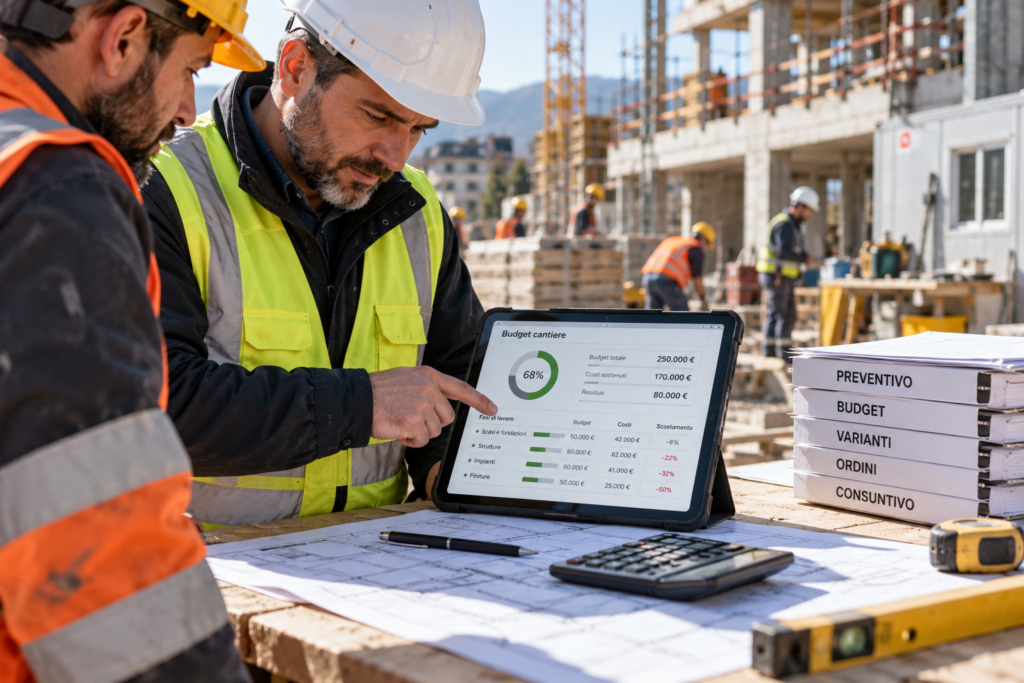
An estimate can be accurate enough to win a project and, at the same time, too weak to control it.
This happens when the document used to set the price for the client remains separate from what subsequently happens on site.
The work begins, and quantities, supplies, working days, teams and operating conditions change. Meanwhile, the estimate remains in the sales folder and the budget is rebuilt in another spreadsheet.
At that point, the company has two realities: the one used to calculate the margin and the one it is actually building.
That is why a good construction estimate should not end when the client accepts the quotation.
It should become the financial basis on which the technician, project manager and owner compare what was planned with what is actually happening.
In this guide, we look at how to turn an estimate into a genuine operating budget, how to connect it to site phases and how to identify variances before they simply become a surprise at the end of the works.
Estimate, budget and actuals are not the same thing
In day-to-day management, these terms are sometimes used almost as synonyms.
Operationally, it is useful to separate them.
| Item | Question | Function |
|---|---|---|
| Estimate | What do we expect the work to cost and be worth? | Build the initial financial assumption |
| Operating budget | How much can we use during execution? | Manage the project while it is being delivered |
| Actuals | How much have we actually spent? | Measure the final result |
| Forecast | How much do we expect to spend at the end, based on what we know today? | Understand in advance where the project might finish |
The fourth element is often missing.
Knowing the cost incurred to date tells us about the past.
Forecasting the cost at completion, by contrast, allows us to make a decision before the margin is permanently lost.
An estimate can be controlled only if we know what it consists of
Imagine a £180,000 quotation presented to the client.
If that total is the only figure available internally, it will be very difficult during the works to understand where the variance is being generated.
That is why the estimate should be divided according to a structure that can also be recognised on site.
For example:
- preparation and set-up;
- demolition;
- structural works;
- masonry;
- building services;
- finishes;
- subcontracting;
- hire;
- indirect costs attributable to the project.
There is no need to create thousands of line items.
What is needed is enough detail to answer one simple question during the work:
“Where are we spending differently from what we planned?”
The number alone is not enough: we must remember how we arrived at it
Suppose we budgeted £8,000 for a particular work item.
That figure may have been based on the assumption of:
- four people;
- five working days;
- a specified quantity of material;
- a price agreed with the supplier;
- easy access to the site;
- no additional work.
Two weeks later, we discover that the work is costing £9,500.
The figure is useful, but it does not explain the problem.
If the original assumptions are recorded, we can understand whether the difference comes from more working days, more material, a different price or a change in the scope of work.
This information also makes it possible to improve the next estimate.
A phase does not cost more simply because we have spent more
Suppose the budget for a phase is £20,000.
By the middle of the month, £12,000 has already been incurred.
Are we out of control?
We cannot know without understanding progress.
If the work is 80% complete, the situation may be perfectly consistent.
If the work is 30% complete, we have a very different signal.
It is precisely the relationship between the value of work performed and the cost actually incurred that makes financial control more useful.
The RICS Construction Productivity Report 2026 highlights that earned value compared with actual cost is one of the metrics most frequently used by the professionals surveyed to interpret construction productivity.
For an SME, the principle can be applied without turning the site into an extremely complex project-controls system:
do not ask only “how much have we spent?”, but “how much work have we obtained from that spending?”
Owner, technician and project manager: three levels of the same control
For it to work, the process must not turn every person into a financial controller.
The site manager sees what changes
This is the person closest to execution and they can report:
- a team taking more working days;
- unusual consumption;
- a different quantity;
- an urgent order;
- additional work;
- a delivery that changes the programme.
Their main task should be to record the event with sufficient context, not to calculate the final margin alone.
The technician understands why it changed
They check quantities, work items and initial assumptions.
They must determine whether the variance is real, whether it results from a change, whether there are costs still to be recorded and what effect it could have on completing the phase.
The owner decides what to do
The owner should not receive every single order.
They should receive exceptions that could change the project’s profitability.
For example:
- do we absorb the cost?
- do we change supplier?
- do we reschedule the team?
- is a contractual variation needed?
- does the expected margin remain acceptable?
The field should provide a few reliable data points
One of the quickest ways to make cost control fail is to ask the site manager to complete a huge amount of information every day.
The system becomes cumbersome and the data start arriving late or incomplete.
For many projects, the following may be sufficient:
- phase concerned;
- phase status;
- relevant hours or working days;
- significant quantities;
- unusual order or supply;
- variation from what was planned;
- photo or document useful for explaining the event.
The rest of the analysis can take place in the office.
A variation should not appear for the first time in the actuals
One of the most dangerous phrases for the margin is:
“Let’s do it for now, then we’ll see.”
Not because every small change requires a complex procedure.
But because an operational change can generate more material, more hours, a new order and a delay to the next phase at the same time.
For a significant variation, it is worth recording:
- what changes;
- who requested the change;
- when;
- which phases it affects;
- estimated financial effect;
- possible effect on timing;
- decision and approval required by the applicable contract.
I would not use universal thresholds such as “anything over 5% requires the owner’s approval”.
A £1,000 variation may be irrelevant for one project and decisive for another.
Thresholds should be set by the company according to project value, expected margin and level of delegation.
The most important number may be the one that has not happened yet
The actuals tell us how much we have spent to date.
Management needs one further question:
“If we carry on like this, how much will it cost to complete the work?”
An updated estimate at completion may take into account:
- costs already incurred;
- orders already committed;
- work still to be carried out;
- observed productivity variances;
- open variations;
- new pricing information.
In this way, the budget does not become a static snapshot, but a forecast that is updated as our knowledge of the project grows.
In 2026, a very simple concept is once again central: measure what is actually produced
In October 2026, McKinsey published a new analysis specifically on the use of production rates in the execution of construction projects.
The principle is particularly useful for SMEs as well.
It is not enough to know that a team cost a certain amount.
We need to understand what quantity of work it managed to produce and compare it with the assumption on which the estimate was built.
If we planned 100 units in five days and completed 60 after five days, we have information that is much more useful than the simple accumulated cost.
We can begin to forecast what might happen over the following days.
Seven indicators are more useful than a dashboard with fifty figures
For an SME, I would start with:
- budget planned for each phase;
- recorded cost;
- physical progress of the phase;
- hours or working days planned versus used;
- value of open variations;
- orders committed but not yet accounted for;
- forecast cost at completion.
The best KPI is not the most sophisticated one.
It is the one that prompts someone to make a different decision.
International standards also start with the quality of the cost structure
In the New Rules of Measurement — NRM, RICS brings together rules and guidance for measurement and cost management in construction projects.
In 2026, the NRM 3 structure was also updated, with the aim of improving the continuity and interoperability of cost data throughout the asset life cycle.
An SME does not necessarily need to implement a professional quantity surveying system based on NRM.
The useful principle, however, is clear:
a consistent cost structure makes it easier to compare forecast, progress and result.
Eight mistakes that make even a good estimate useless
1. Estimating with broad totals that cannot be controlled
If we cannot trace the cost to the main phases, it will be difficult to understand which part is generating the variance.
2. Not recording assumptions
A price without the logic that generated it is much less useful during execution.
3. Looking only at invoices received
Orders already placed and committed costs can change the picture long before the invoice arrives.
4. Ignoring physical progress
Spending half the budget does not mean being halfway through the work.
5. Managing variations only verbally
Their impact may appear only after the cost has already been incurred.
6. Updating the budget too late
A perfect control carried out after we can no longer intervene remains mainly a historical analysis.
7. Asking the field for too much data
An administratively burdensome process produces incomplete or late data.
8. Not using actuals for the next estimate
The completed project should become a source of data for improving future assumptions.
A 30-day test before changing the company’s entire financial control
Days 1–7 — Take a real estimate
Choose an active project and check whether the estimate makes it possible to identify the main phases and the financial assumptions used.
Days 8–14 — Link the phases to the site
For each phase, identify:
- budget;
- planned timings;
- main quantities;
- significant supplies or subcontracting.
Days 15–21 — Activate weekly control
The project manager reports exceptions, the technician assesses the variance and the owner receives only what requires a decision.
Days 22–30 — Make the first forecast
Do not limit yourself to comparing the initial budget with recorded expenditure.
Try to estimate the final cost based on what you have learnt during the month.
Then ask yourself:
- did we identify variances earlier?
- can we explain why they occurred?
- do we know the main open variations?
- do we have a better forecast of final cost than we did a month ago?
Where Edil-Up can help with the transition from estimate to site
Edil-Up is developed as a Construction Operating System with the aim of progressively connecting information that companies often manage separately.
Within site management, the company can organise sites, phases, collaborators, roles and permissions, documents, communications, attendance and basic financial information.
In financial control, the advantage is not automatically replacing specialist accounting or quantity-surveying software.
It is reducing the distance between what happens on site and the financial context of the relevant project.
A phase should not exist only in the programme.
It should be possible to view it alongside the people involved, the documents, the communications and the financial information relating to it.
The mobile app also makes it possible to bring part of the operational workflow directly to the site.
To explore the next stage of the process, read the guide dedicated to site cost control, estimates and budgets.
Those considering different platforms can consult the comparison of site management software.
Checklist before turning the estimate into a budget
- Is the estimate divided into the main controllable phases?
- Do we know the quantities and assumptions used?
- Are labour, materials, supplies and subcontracting identifiable?
- Does the project manager know which events to report?
- Are variations recorded before entering the actuals?
- Do we compare costs and physical progress?
- Do we also take account of orders already committed?
- Do we update a forecast of the cost at completion?
- Are actuals used to improve future estimates?
International reference sources
- RICS — Construction Productivity Report 2026, international research on productivity, metrics, benchmarking and site management.
- McKinsey & Company — Using production rates to excel at executing construction projects, October 2026, analysis of the link between production rates, scheduling and predictability of execution.
- RICS — New Rules of Measurement, an international framework for measurement, cost estimating and cost management in construction.
- RICS — NRM 3 update, 2026, update to the cost-data structure across the asset life cycle.
- Deloitte Access Economics / Autodesk — State of Digital Adoption in the Construction Industry 2026, study of digital adoption by 954 construction and engineering companies.
Conclusion: a good estimate is not only for selling the work
The estimate represents the project’s first financial assumption.
During the works, that assumption will inevitably be tested.
Quantities, productivity, supplies, variations and timings can change.
The purpose of control is not to demand that the estimate remain perfect until the end.
It is to understand early enough where reality is becoming different from what we planned.
To do this, we need a clear financial structure, reliable information from the field and a review cycle fast enough to allow a decision while there is still time.
The estimate protects the margin only when it continues to live after the client signs.
The Edil-Up team