
From 2 February 2026, the Minimum Environmental Criteria for construction have changed radically. The DM 24/11/2025, published in the Official Gazette on 3 December 2025, repealed the previous 2022 decree and rewrote from scratch the rules for every public contract involving buildings, infrastructure and structures. This new decree is mandatory for all public contracts from 2 February 2026. This is not a minor update: six new technical chapters, a BIM requirement above the threshold, life-cycle assessment (LCA), and a CAM Report now also required from the contractor, not just the designer.
- CAMs apply to public contracts involving buildings, infrastructure and structures
- The obligation derives from art. 57 of D.Lgs. 36/2023 (Public Contracts Code)
- The Ministry of the Environment and Energy Security (MASE) issues and updates them
- Those who fail to comply with CAMs risk exclusion from the tender or contract termination
What is the regulatory framework for the 2026 construction CAMs?
CAMs are integrated into the Public Contracts Code (D.Lgs. 36/2023, updated by Corrective D.Lgs. 209/2024 and L. 199/2025), whose art. 57 paragraph 2 makes the application of CAM technical specifications and contractual clauses mandatory in all public contracts in the sector. These are not optional guidelines.
The transitional regime requires attention. The MASE Circular of 10 April 2026 clarified that the old CAMs (DM 256/2022) remain applicable only if the project was validated in accordance with that decree and the tender notice is published within 3 months of validation, even if validation occurs after 2 February 2026. In all other cases, the new 2026 CAMs apply without exception.
- Tender notice published from 2 February 2026: application of the new CAMs
- Project validated under the previous DM 256/2022, with tender notice published within a few months of validation: old CAMs applicable
- Internal design not yet validated: new CAMs apply even if the appointment predates them
- Non-compliance: exclusion from the tender, contract termination, and possible loss of PNRR funding
The relationship with the European “Green Homes” Directive (EPBD IV), to be transposed by 29 May 2026, and with the new EU Regulation 2024/3110 on construction products further strengthens the regulatory framework within which CAMs operate.
What changes with the new 2026 construction CAM requirements?
DM 24/11/2025 introduces substantial changes compared with the 2022 version, expanding both the scope of application and the depth of the technical requirements.
- LCA and LCC become central requirements, no longer merely award criteria
- BIM is provided for as a contractual clause for projects above the threshold, including sustainability parameters and CAM checks
- The DNSH principle requires proof that every technical choice causes no significant harm to the environment, with rigorous traceability for PNRR-funded projects
- A deconstruction and stormwater-management plan is required
- New requirements cover buildings’ summer thermal performance
- CAMs apply to buildings, infrastructure and structures of various types
Advice: Do not confuse mandatory requirements with award criteria. The former must always be met; the latter improve a tender position, but are not optional in the sense that ignoring them can undermine the evaluation of the technical offer.
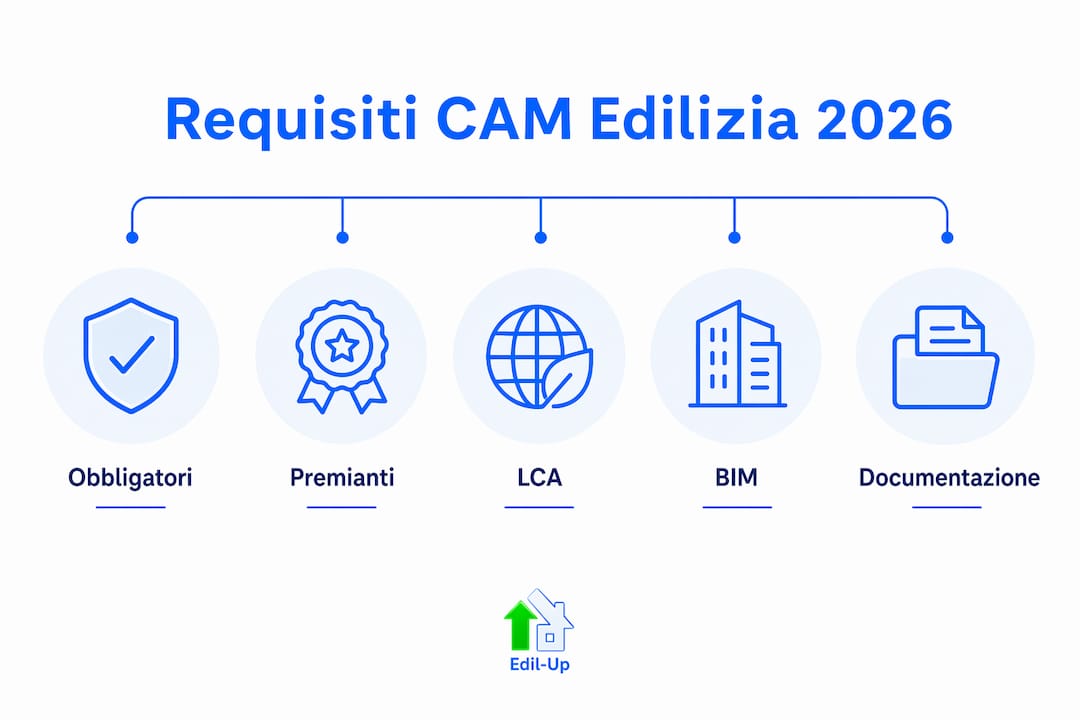
What is the project CAM Report and how is it managed?
The CAM Report is the key document in the entire system. It must be prepared from the Technical-Economic Feasibility Design (PFTE) stage and updated throughout the works. MASE published the official template on 2 February 2026: a section-based structure in which each decree criterion has its own section, where the designer justifies its application or reasoned non-application.
The most significant change introduced by DM 24/11/2025 concerns the contractor: the designer’s report is no longer enough. The contractor must produce its own CAM Report, updated and verified at each Work Progress Report (SAL). This transforms CAM compliance from an initial obligation into an ongoing process.
- Complete the CAM Report criterion by criterion, using the MASE template
- Justify every non-application with documented technical reasoning
- Update the document at each SAL, referring to the checks performed
- Keep all supporting documentation (EPDs, certifications, VOC tests and recycled-content statements)
Advice: Start the CAM Report as early as the DIP stage (Design Instruction Document), even before PFTE. Those who wait until the detailed design stage to gather documentation often find themselves chasing suppliers and certifications under pressure.
Why are UNI standards central to CAM implementation?
UNI technical standards are referenced almost 200 times in the decree, nearly once for every criterion. The introductory chapter alone contains 43 references, including UNI EN 15978 for calculating the environmental performance of buildings and UNI EN 15804 for environmental product declarations (EPDs).
This is not a minor technical detail. UNI standards provide the test methods and definitions that make CAM compliance verifiable, reducing the risk of disputes in public contracts. The UNI Mark appears in the CAMs both in mandatory form (glazing complying with UNI EN 1279) and voluntary form (installer competence, water protection under UNI EN 1433 and the UNI EN 124 series).
- Know the UNI standards referenced for each criterion applicable to your project
- Verify that selected materials have certifications complying with the standards cited in the decree
- Use the standards as documentary protection in the event of a dispute
- Stay updated on revisions to UNI standards, which may change compliance requirements
Who does what: responsibilities of contracting authorities, designers and works directors
Final verification of CAM compliance is the responsibility of the contracting authority, while producing and updating the technical documentation is the task of designers and works directors. The chain of responsibility is precise and does not allow overlaps.

Contracting authority: includes CAM requirements in tender documents, verifies compliance during award and execution, and may use accredited third-party bodies for technical checks.
Designer: prepares the CAM Report from PFTE, selects compliant materials and solutions, and coordinates the collection of the certifications needed for each criterion. Communication among the people involved is crucial to avoiding documentation gaps.
Works director: checks that execution follows the CAM design choices, gathers site documentation, and verifies updates to the contractor’s CAM Report at each SAL.
Contractor: produces and updates its CAM Report during the works and demonstrates that the materials actually used comply with the project requirements.
How Edil-up supports 2026 construction CAM management
Managing CAM documentation across multiple fronts—including the project report, SAL updates and material certifications—requires a coordination system that email and spreadsheets cannot support. Edil-up was created to meet this practical need.
The platform connects contractors, professionals and collaborators in one digital environment, with tools for monitoring work progress and centralised document management. According to Edil-up, adopting the platform enables better workflow organisation, which can reduce delivery times. Centralised project management makes it possible to track every CAM document, from the PFTE stage through final testing.
Edil-up also calculates the environmental savings generated by digitised projects and plants trees for every active subscription, aligning with the sustainability principles promoted by CAMs. For those seeking to understand how to digitise site management in compliance with the new obligations, the platform offers a practical starting point.
What additional costs are associated with adopting the 2026 CAMs?
Adopting the new minimum environmental criteria involves real additional costs, although their scale depends greatly on the type and size of the project. The most common expenditure items concern the production of technical documentation (LCA, LCC and CAM Report), obtaining environmental certifications for materials (EPD, EU Ecolabel and UNI/PdR 88), and any adjustments to the supplier chain.
For contracts above the threshold, the BIM requirement with integrated sustainability parameters calls for investment in software, training and often dedicated professionals. The mandatory energy audit for buildings with an area exceeding 1,000 m² adds a further design cost, with the hourly dynamic method required for buildings over 5,000 m².
However, the other side should also be considered: those who master CAMs win tenders. Award criteria reward more sustainable offers with additional technical points, turning investment in compliance into a direct competitive advantage. Initial adjustment costs tend to fall over time as procedures become established and the supply chain adapts.
Good practices and practical application of the 2026 CAMs in projects
Effective application of the minimum environmental criteria in real projects depends on several operational choices that make the difference between formal and substantive compliance.
Start at the DIP stage. Contracting authorities that include CAM requirements in the Design Instruction Document avoid having to chase compliance in later stages, when room for manoeuvre is narrower.
Build the supply chain before the tender. Companies that map suppliers of EPD-certified materials in advance, with verifiable recycled content under UNI/PdR 88, do not have to replace materials during the works. A network of industry contacts becomes a practical resource, not merely a relationship advantage.
Integrate BIM and CAM from the information model onwards. Above-threshold projects that build the BIM model with sustainability parameters already incorporated simplify checks during execution and reduce the risk of inconsistencies between design and site.
Use UNI standards as an operational guide. Each CAM criterion refers to a specific technical standard: following it is not only an obligation but the most direct way to demonstrate compliance without room for dispute.
Key points
The 2026 construction CAMs, mandatory from 2 February 2026 for all public construction contracts, require LCA, LCC, BIM above the threshold, and a CAM Report updated by both the designer and contractor at each SAL.
| Point | Details |
|---|---|
| Effective date | From 2 February 2026, DM 24/11/2025 replaces the 2022 decree and is mandatory for all public contracts involving buildings, infrastructure and structures. |
| Dual CAM Report | Both the designer and contractor must produce and update the CAM Report at each SAL. |
| Mandatory BIM above the threshold | BIM design with sustainability parameters is a contractual clause, no longer an award criterion. |
| UNI standards as a reference | UNI standards are cited almost 200 times in the decree and are the main tool for proving compliance. |
| Limited transitional regime | Old CAMs remain applicable only where the project was validated under DM 256/2022 and the tender is issued within 3 months of validation. |