
Digital construction accounting is the real-time management of site accounts and project cost monitoring through SaaS platforms that replace Excel spreadsheets and paper archives. For Italian construction companies and subcontractors managing several sites at once, the most direct solution is Edil-up, which reports delivery-time reductions of up to 20% for customers adopting the platform. The system covers the works register, SAL progress, document management and compliance with the Sistema di Interscambio (SDI) and GDPR, all in one environment accessible from site.
Key points
Digital construction accounting reduces delivery times, improves margin control and ensures compliance with Italian regulations when the platform covers SAL, SDI export, GDPR and integration with the accountant.
| Point | Details |
|---|---|
| Start with an Excel audit | Map current cost items before importing them: overly aggregated categories make variances impossible to read. |
| Implementation in 1–2 weeks | Data import, dual entry and site manager training (2–3 hours) are enough for the cut-over. |
| ROI in 3–6 months | Compare the monthly subscription with the hours saved on data reconciliation and delivery delays. |
| Mandatory Italian compliance | Verify native SDI export, AgID-compliant digital preservation and GDPR data management before signing. |
| Edil-up as the direct solution | Covers the works register, SAL, document management and sustainability, and reports delivery-time reductions of up to 20%. |
Contents
- What benefits does digital construction accounting bring to site?
- What features are essential in a construction accounting platform?
- How is a SaaS solution implemented in Italy: timing, costs and expected ROI
- What integrations and regulatory requirements are needed to operate in Italy?
- How to evaluate a platform during the demo: questions, tests and warning signs
- How Edil-up covers digital construction accounting in practice
- Useful resources for further information
- The accounting digitalisation no one wants to do, but everyone must do
- Edil-up: the starting point for anyone who truly wants to control site costs
- Sources
What benefits does digital construction accounting bring to site?
Moving to digital accounting management is not just a matter of being organised. The benefits can be measured on three distinct levels.
Real-time financial control. With a professional system, the estimate and updated actual costs are compared with every entry, rather than at the end of the month.
Multi-site visibility. A centralised dashboard shows the financial status of all active sites at a glance. This type of centralised project management removes the need to open ten different files to understand where margin is being lost.
Less paper and lower environmental impact. Fewer printouts, fewer paper DDTs and fewer physical archives. Edil-up goes further: it calculates the environmental savings generated by digitalised projects and plants trees for every active subscription.
The most relevant operational benefits for those managing sites in Italy include:
- Real-time estimate-versus-actual comparison, with variance projections visible before works are closed
- Configurable alerts at budget thresholds (80% and 100%) for each site or cost item
- Mobile cost entry directly from site, with no manual office steps
- Delivery-time reductions of up to 20%, according to data reported by Edil-up
- Elimination of duplicate files and outdated versions, a documented problem in companies using Excel across more than 2–3 sites
A tip: Before choosing a platform, measure how much time your team spends each week reconciling data between different Excel files. That number is your starting point for calculating ROI.
What features are essential in a construction accounting platform?
An effective platform for digital site accounting must cover at least six functional areas. Missing even one creates gaps in financial control.
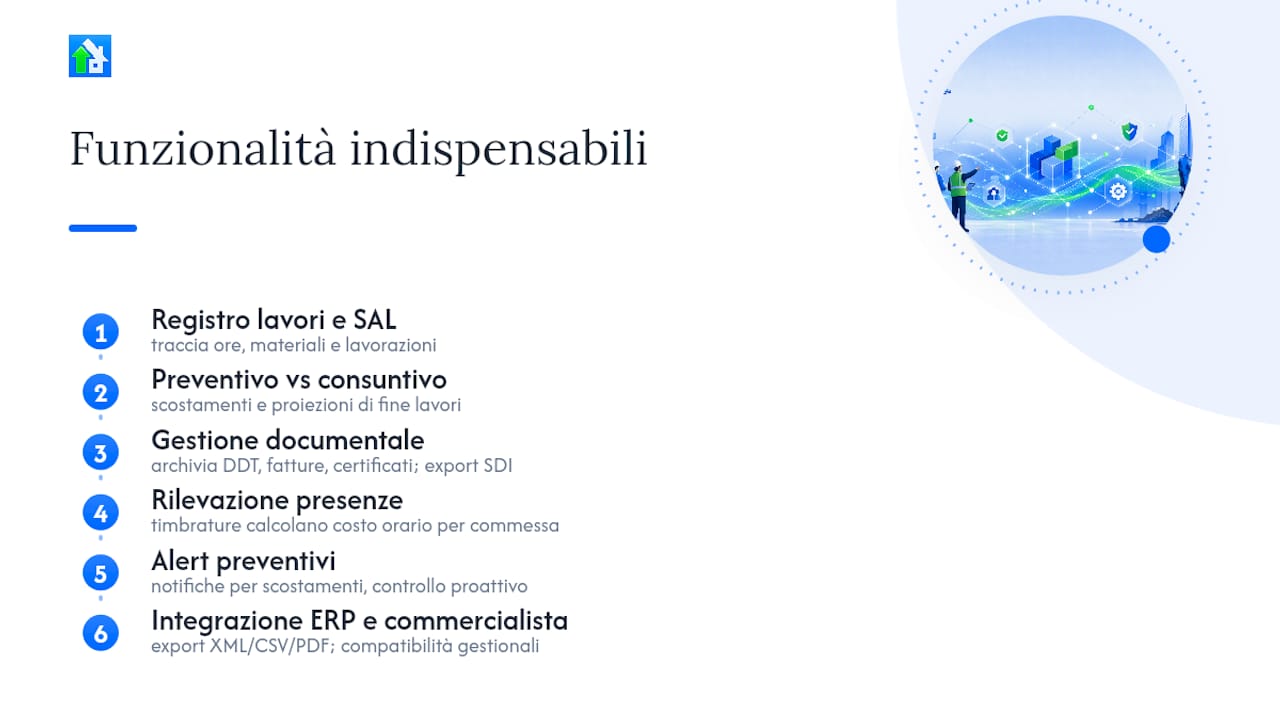
Works register and SAL. The core of the system: tracking hours, materials and work carried out for each phase. Linking physical progress to financial monitoring is what turns a simple site diary into a cost-control tool. Edil-up’s guide to works progress monitoring explains how to integrate SAL and financial reporting in practice.
Estimate versus actual costs with projections. Recording costs is not enough: you need to see at any time how far costs are deviating from the estimate and where they will end up if the trend continues. This is the function that protects margins.
Integrated document management. DDTs, electronic invoices and certificates of conformity must all be archived, searchable and linked to the project. Export in a format compatible with the Sistema di Interscambio (SDI) is mandatory for electronic invoicing in Italy.
Attendance and labour-cost tracking. Site clock-ins must automatically feed the calculation of the hourly cost for each project. Site attendance tracking is one of the areas where companies lose the most data if the process is not integrated.
Without alerts, control becomes reactive rather than preventive.
Integration with the accountant and ERP. Export in standard formats (XML, CSV, PDF), compatibility with the main accounting management systems and the ability to share data with the accountant without manual reworking.
A tip: Map the cost items in your standard estimate before importing them into the system. If you use overly aggregated categories (for example, “construction work” as a single item), variances will be impossible to understand. Separate at least labour, materials, plant hire and subcontracting.
How is a SaaS solution implemented in Italy: timing, costs and expected ROI
Moving from Excel to a professional system is more daunting than it deserves to be. Excel becomes a real problem beyond 2–3 sites: duplicate files, broken formulas and no single reliable version. Migration, by contrast, can be structured in four phases.
The four operational phases
- Initial data import (1–2 days): loading site records, cost items, suppliers and price lists. Most platforms accept imports from Excel or CSV.
- Dual-entry verification (1–2 weeks): continue recording in the old system as well to check data consistency. This phase is the one most often skipped, resulting in errors at cut-over.
- Site manager and administration training (2–3 hours): modern SaaS platforms do not require lengthy courses. A practical session on entering costs, SAL and generating reports is enough to get started.
- Cut-over to the management system: close the old system and work only on the new platform, with active support from the provider during the first few weeks.
Pricing models and ROI estimate
| Model | Typical structure | Suitable for |
|---|---|---|
| Annual subscription per company | Fixed fee, unlimited users or user tiers | Companies with several active sites |
| Project plan | Cost per active project | Businesses with seasonal or intermittent work |
| Per-user plan | Monthly fee per seat | Professional practices and small teams |
To estimate break-even, calculate the platform’s monthly cost and compare it with the time saved each month (hours spent reconciling data, invoicing errors and delivery delays). Details of the available plans can be found on Edil-up’s pricing page.
What integrations and regulatory requirements are needed to operate in Italy?
The Italian market has specific requirements that a construction accounting platform must meet to be usable without workarounds.
Electronic invoicing and SDI. Every solution must generate or export invoices in XML FatturaPA format compatible with the Sistema di Interscambio of the Agenzia delle Entrate. Without this function, managing sales and purchase invoices remains manual.
Digital preservation of documents. Tax documents must be preserved in a format compliant with AgID specifications (PDF/A formats, XML with metadata). Check that the platform supports substitute preservation or integrates with an accredited preservation provider.
GDPR and worker data. Clock-ins, attendance records and employees’ personal data on site are personal data in every respect. The platform must guarantee controlled access, operation logs and the ability to export or delete data on request.
Technical integrations to check:
- Clock-ins and attendance tracking (integration with badges or mobile apps)
- Import/export of quantity surveys and BIM 5D (IFC, PriMus, Primus DCF formats)
- Supplier contact management and updatable price lists
- Site supplier coordination with notifications and document sharing
- Export for the accountant in standard formats (XML, CSV, PDF)
How to evaluate a platform during the demo: questions, tests and warning signs
A well-run demo is worth more than any technical datasheet. Here is how to structure it.
Questions you must ask
- Is XML export for SDI native, or does it require an additional paid module?
- How many active projects does the basic plan support without performance degradation?
- What is the technical support SLA in Italian? Is telephone support available, or only tickets?
- Does the Excel import preserve customised cost items, or normalise them into fixed categories?
- How are backups and data restoration handled in the event of an error?
Quick tests to run during the demo
- Simulate a SAL: enter partially completed work and check that actual costs update in real time
- Record a materials purchase from a smartphone: assess how many taps are required and whether the interface is usable with gloves
- Generate an export for the accountant: check that the file is readable without reworking
Warning signs not to ignore
- Interface not optimised for mobile: the site manager does not work from a desktop
- No native SDI export, or export available only as PDF
- Technical support available only in a foreign language or only by email
- No configurable alerts for budget thresholds
- Inability to import the Excel history without paid assistance
For a broader comparison of solutions, the guide on how to choose site management software offers practical criteria and a detailed evaluation checklist.
How Edil-up covers digital construction accounting in practice
Edil-up is an Italian SaaS platform covering the core functions of site accounting and integrating them with networking and sustainability tools. The digital site register guide published by Edil-up supports operational implementation step by step.

| Functional area | Edil-up coverage |
|---|---|
| Works register and SAL | Progress tracking linked to financial data for each project |
| Estimate versus actual costs | Real-time updates with variance projections |
| Document management | Storage of DDTs, invoices and certificates with SDI export |
| Attendance tracking | Clock-in integration for labour-cost calculation |
| Multi-site dashboard | Centralised visibility with alerts at configurable thresholds |
| Sustainability | Environmental savings calculation and tree planting for each active subscription |
Support and training. Edil-up provides support in Italian, with proprietary training materials and practical guides available directly on the platform. Basic training for a site manager can be completed in 2–3 hours.
For every active subscription, Edil-up plants trees and calculates the environmental savings generated by the digitalisation of processes.
Useful resources for further information
The resources below cover the main stages of the adoption process, from initial evaluation to operational implementation.
- Works progress monitoring — an operational guide to linking SAL and financial accounting, useful during the demo phase
- Site management software: how to choose — a comparative checklist for evaluating suppliers and features
- Site attendance tracking — to integrate clock-ins and labour-cost calculation into construction accounting
Use these resources in the order shown: first the register and monitoring guides to understand what is needed, then the checklist to evaluate suppliers, and finally the pricing page when you are ready to compare plans.
The accounting digitalisation no one wants to do, but everyone must do
There is a widespread misconception in the industry: many companies think digital construction accounting is a problem to address when they grow, not now. The reasoning is understandable. With two or three sites, Excel works well enough not to seem urgent. The problem is that the moment Excel stops working coincides exactly with the moment the company is under the greatest pressure: more open sites, more suppliers to coordinate and less time to reconcile data.
The real question is not whether to digitalise, but when. Those who wait until they have a serious problem pay twice: for the platform and for recovering historical data during a period of operational chaos.
These are two different things. General accounting is the accountant’s domain. Site accounting is the real-time financial control of every project, item by item. A company can have an excellent accountant and lose margin on every site because no one monitors variances while the work is under way.
The most counterintuitive advice is this: start with a pilot site, measure KPIs at 30 and 90 days, then decide. Do not wait for the system to be perfect before starting. An imperfect system that works beats a perfect system that is never adopted.
Edil-up: the starting point for anyone who truly wants to control site costs
Anyone managing sites in Italy knows that margin is lost in the details: an unrecorded cost item, a SAL updated too late or an invoice that cannot be matched to the estimate. Edil-up is the platform that closes these gaps, with tools designed for the Italian construction sector rather than for a generic market.
The platform covers the works register, progress monitoring, document management with SDI export and attendance tracking, all accessible from mobile on site. For every active subscription, Edil-up calculates environmental savings and plants trees: tangible sustainability, not merely a claim.
Consult the digital site register guide to learn how to structure your first pilot site, or check the available plans on the pricing page to choose the model best suited to your company.
Sources
- How to Manage Site Costs Without Excel: Practical Guide | Drilon Hametaj