
The recommended solution is clear: a digital badge with an anti-counterfeiting code, certified GPS geofencing clock-in, and document integration with DURC, training, and medical fitness. This combination meets the obligations of D.L. no. 159/2025, complies with the requirements of D.Lgs. 81/2008, and provides a defensible record before the National Labour Inspectorate.
Within the first 72 hours, the lead contractor must: submit the New Work Declaration to the territorially competent Cassa Edile, request badges for all workers (employees and self-employed, construction and non-construction workers), download the CNCE BadgeCheck app, and appoint at least one clock-in coordinator. While waiting for the physical badge, the virtual clock-in is permitted if carried out by the appointed coordinator; disregarding it does not exempt the company from the traceability requirement.
Contents
- Why digital attendance tracking really pays off
- What features should a construction-site attendance tracking system have?
- How is a construction-site attendance tracking system implemented?
- What impact does it have on safety, compliance, and company finances?
- How are operational savings and environmental impact measured?
- Key points
- Why attendance tracking is more than a requirement
- Edil-up: the platform for managing construction sites and attendance in one place
Why digital attendance tracking really pays off
The paper register has a structural problem: it cannot be verified in real time and is susceptible to falsified signatures. A system with certified GPS geofencing eliminates this vulnerability at its root because clock-ins can occur only within the defined perimeter and the timestamp cannot be altered.
The practical benefits are immediate. Reports for the Work Progress Statement are generated automatically, without manual entry, with hours, coordinates, and activities already sealed. The Works Management receives objective data, not declarations. In the event of a dispute with a subcontractor, the audit trail is the strongest evidence that can be presented.
Penalty provided for by D.L. no. 159/2025: from 100 to 500 euros for each worker without a digital badge.
Emergency mustering is the other frequently underestimated issue. Knowing in real time how many people are present and where they are is not a convenience: it is the minimum condition for coordinating an evacuation or directing rescue efforts. Traditional systems do not allow this.
What features should a construction-site attendance tracking system have?
A compliant and practical field system should cover at least these points:
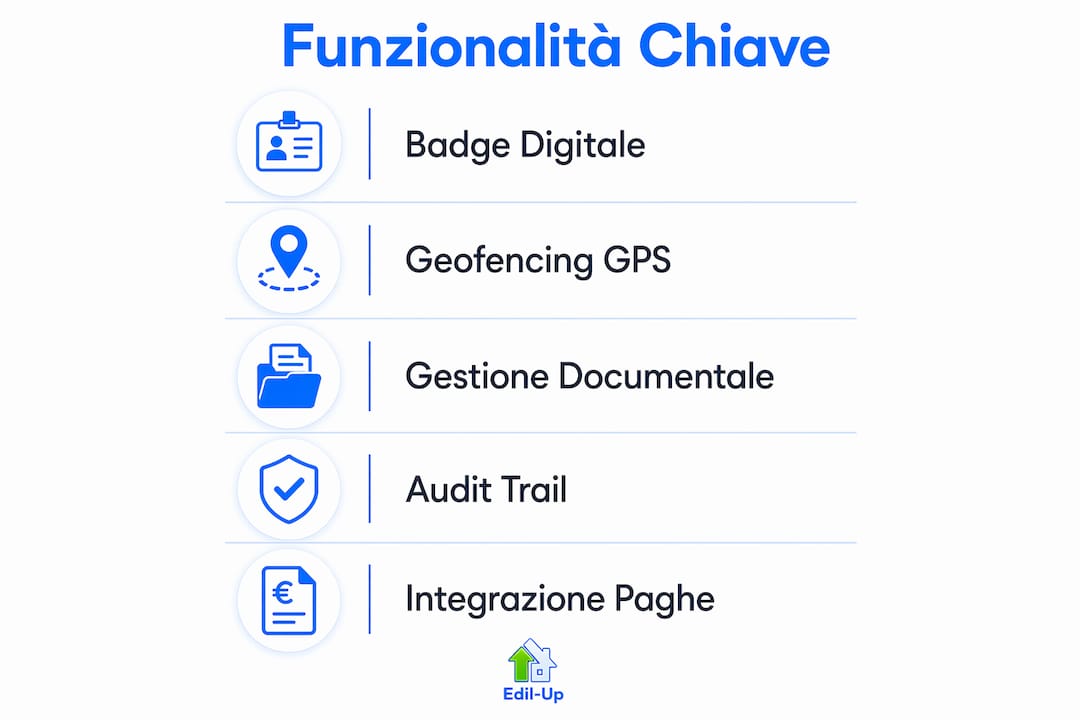
- Digital badge with an anti-counterfeiting code, NFC technology, and QR code for reading through a mobile app (CNCE BadgeCheck or an equivalent certified app).
- GPS geofencing clock-in with a configurable perimeter: attendance is recorded only inside the construction-site area, eliminating remote clock-ins.
- Certified timestamp and immutable audit trail: every access must generate an unmodifiable log, ready for inspections and SALs.
- Document integration: connection to DURC, master data, authorizations, and mandatory training. A worker with an expired DURC or outdated training should not be able to access the site, and the system must flag this automatically.
- Subcontractor and delegation management: the lead contractor must be able to assign separate roles to clock-in coordinators for each company present.
- GDPR-compliant data retention: clock-in history must be stored so that it constitutes an immutable audit trail during unannounced inspections, with role-based access.
- Data exportability: standard-format reports for SALs, Works Management, and Labour Inspectorate inspections.
Attendance tracking systems that do not integrate document management create information silos: clock-ins exist, but it is impossible to verify whether the person who clocked in was actually authorized to access the site.
A tip: when configuring the geofencing perimeter, add a 15–20 metre margin beyond the construction site’s physical boundary. GPS signals in dense urban areas or near metal structures may drift by several metres, and a margin that is too narrow creates false negatives that then require manual corrections.

How is a construction-site attendance tracking system implemented?
Operational stages, from week zero to the first month
- Initial audit (days 1–3): map all workers present and expected, and verify the validity of DURC, training, and medical fitness for each person. Responsible party: lead contractor or administrative manager.
- Master-data digitization (days 3–7): upload workers’ data and photos to the platform and submit the badge request to the competent Cassa Edile. Badges arrive in about 5 working days.
- Geofencing configuration (days 5–8): define the site’s GPS perimeter, assign roles to clock-in coordinators, and test the app on at least two devices.
- Coordinator training (days 8–10): a 2–3-hour practical session with the clock-in delegates. Cover: NFC clock-in, QR clock-in, virtual clock-in when a badge is unavailable, and anomaly management.
- Pilot rollout (week 2): launch with a small group, monitor anomalies daily, and correct geofencing parameters if necessary.
- Expansion and monitoring (weeks 3–4): extend to all workers, perform the first review of the automatically generated SAL report, and compare it with the hours declared by subcontractors.
Indicative implementation cost ranges
| Range | Site profile | Main items | Indicative cost |
|---|---|---|---|
| Basic | Small sites with few workers | Free CNCE app, Cassa Edile badge, internal training | Low costs |
| Intermediate | Medium-sized sites | SaaS platform with geofencing, NFC readers, external training | Medium cost range |
| Advanced | Large or multiple sites | Enterprise platform, payroll integration, dedicated support | Higher costs |
The cost of physical badges is borne by the Cassa Edile; variable items mainly concern software licences and additional hardware (fixed NFC readers and dedicated tablets).
What impact does it have on safety, compliance, and company finances?
- Emergency mustering: with real-time tracking, the safety manager knows within seconds how many people are present and can compare the figure with the evacuation list. This reduces the margin for error in high-risk situations, where every minute counts.
- Legal defence: timestamps, GPS coordinates, and the immutable audit trail constitute documentary evidence that the Labour Inspectorate recognizes as objective and defensible. In a dispute with a subcontractor over hours worked, the digital register closes the dispute without room for interpretation.
- SAL consistency: attendance traceability synchronized with the schedule makes it possible to verify in real time whether the hours reported correspond to the actual hours, avoiding discrepancies that emerge only at the end of the work.
- Operational safety: the digital badge is not merely a technological change. It is an evolution in how attendance is managed—as active information, not data to be archived.
A tip: linking the weekly attendance export directly to payroll software reduces the risk of transcription errors and cuts the time spent on monthly reconciliation in half. Most SaaS platforms offer this integration through CSV files or APIs.
To learn more about how centralized project management improves emergency response and operational data consistency, Edil-up has created a dedicated guide on the subject.
How are operational savings and environmental impact measured?
Digitizing attendance generates measurable savings on multiple fronts. Defining KPIs from the outset makes it possible to quantify them and justify the investment.
Reference data: companies that adopt digital tools for construction-site management record delivery-time reductions of up to 20%, with direct effects on reporting and cost control.
| KPI | Data source | Measurement frequency |
|---|---|---|
| Average SAL generation time | Attendance platform (automatic logs) | For each SAL |
| Unreported hours vs. actual hours | Comparison of digital register / subcontractor declarations | Weekly |
| Number of open disputes | CRM or internal register | Monthly |
| Paper sheets eliminated | Estimate based on previous volumes | Quarterly |
| CO2 avoided through verification travel | Km saved × emissions factor | Quarterly |
In terms of sustainability, every digitized process reduces paper consumed on site and physical travel for checks and signature collection. Edil-up calculates the environmental savings generated by digitized projects and plants trees for every active subscription, making this dimension measurable as well.
Key points
Digital construction-site attendance tracking, based on NFC badges, GPS geofencing, and document integration, is now both a legal requirement and a tool for protecting the company financially.
| Point | Details |
|---|---|
| Legal requirement | D.L. no. 159/2025 requires the digital badge; the penalty ranges from 100 to 500 euros per worker. |
| Priority within the first 72 hours | Submit the DNL to the Cassa Edile, request the badges, and appoint clock-in coordinators. |
| Non-negotiable features | GPS geofencing, immutable audit trail, DURC and training integration, and data exportability. |
| Impact on safety and finances | Real-time mustering, documented legal defence, and SALs without discrepancies. |
| Edil-up | Integrated platform for construction-site management, attendance tracking, and environmental-impact calculation. |
Why attendance tracking is more than a requirement
The most common risk I see among construction companies is treating the digital badge as a bureaucratic requirement to be dealt with as quickly as possible. Request the badge, download the app, clock in. Done. But this approach leaves the most useful part of the system on the table.
A digital register with geofencing and an audit trail is not only for avoiding penalties: it is for knowing what really happened on site, when, and with whom. That certainty is worth much more than any saving on paper. It matters for SALs, disputes with subcontractors, and when an inspector arrives without warning.
The real breakthrough is not technological. It is cultural: stop seeing attendance as data to be archived and start treating it as operational information. Companies that understand this before others gain a tangible advantage, not only in compliance.
Edil-up: the platform for managing construction sites and attendance in one place

Edil-up integrates construction-site document management, project monitoring, and sustainability tools into a single platform. For those starting to digitize attendance, this means being able to connect clock-in data to the schedule, master-data management, and environmental-impact calculations without using separate systems.
Available features include real-time dashboards, integration with construction-site documentation (DURC, training, authorizations), environmental-savings calculations, and communication management between companies. Every active subscription contributes to tree planting through the Eco di Edil-up programme.
To get started, review the available plans or contact the team at edil-up.com/contatti for an assessment of your site.
Recommended
- Optimizing communication in construction projects – Edil-up – Sustainable construction for the future
- How to post job ads in the construction industry – Edil-up – Sustainable construction for the future
- 5 digital tools for managing construction sites more efficiently – Edil-up – Sustainable construction for the future
- The advantages of centralized project management – Edil-up – Sustainable construction for the future