
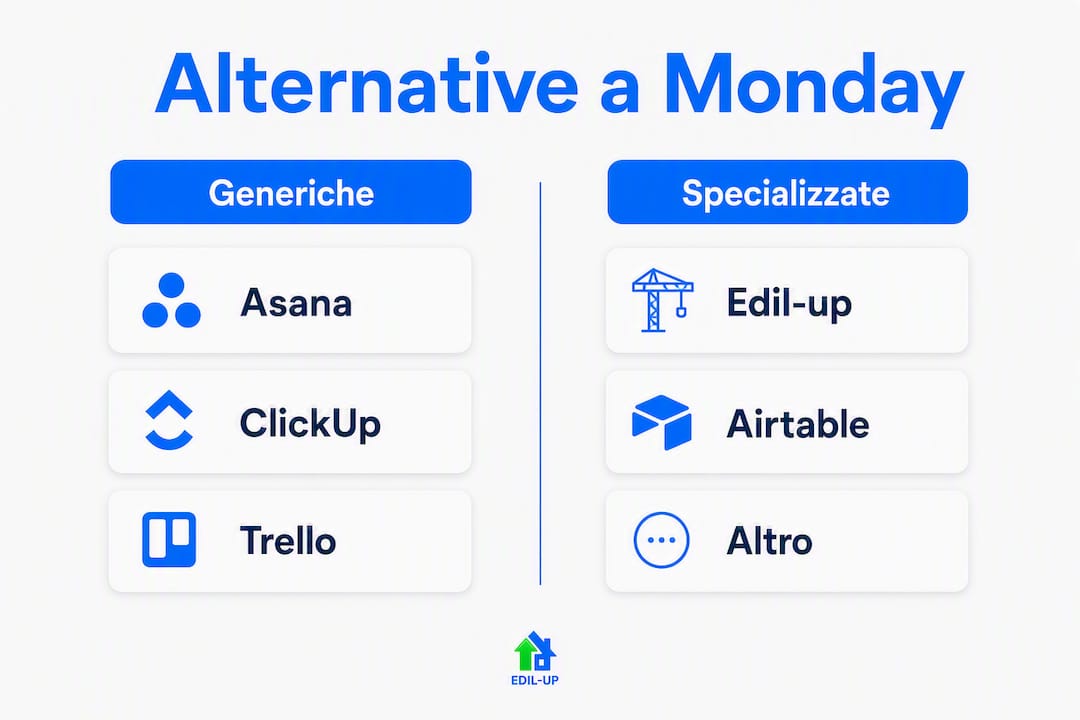
For construction companies and job-site professionals looking for an alternative to Monday.com, the answer depends on one precise factor: the type of work you do. For job-site management, sustainability monitoring and GDPR compliance in Italy, Edil-up is the most coherent vertical choice. For teams that prioritise accountability, Asana. For those who want everything in one platform, ClickUp. For relational data models, Airtable. For immediate simplicity, Trello.
TL;DR — which alternative is right for you:
- Edil-up: job sites, sustainability, networking between companies and Italian compliance. Up to 20% shorter delivery times, EU hosting, annual plan in euros.
- Asana: clear project structure, accountability for distributed teams, good integration with third-party tools.
- ClickUp: maximum functional flexibility, suitable for those who want everything in one place but accept a configuration learning curve.
- Airtable: relational data model, ideal for technical firms with advanced reporting needs.
- Trello: simple Kanban boards, suitable for small teams or the early stages of digitalisation.
Contents
- Which Monday alternative is best for the job site?
- Quick profiles: what each option offers
- How to choose the right alternative for your construction company
- How to migrate from Monday without bringing the job site to a standstill
- Why Edil-up is the recommended choice for sustainable construction
- Which alternative to choose based on your company profile
- Key points
- The construction sector deserves purpose-built tools
- Edil-up: job-site management and sustainability in one platform
- Useful sources and regulatory references
Which Monday alternative is best for the job site?
| Criterion | Edil-up | Asana | ClickUp | Airtable | Trello |
|---|---|---|---|---|---|
| Best for | Job sites, sustainability, construction SMEs | Structured teams, accountability | Full functionality, hybrid teams | Relational data, technical firms | Simplicity, small teams |
| Pricing and licensing | Annual subscription in EUR, Plus plan for companies | Per user/month, variable minimums, billing in USD | Per user/month, limited free plan, USD | Per user/month, USD, minimums on enterprise plans | Basic free plan, Business plan in USD |
| GDPR / hosting | EU hosting, DPA available | US servers, DPA on request | US servers, DPA available | US servers, DPA available | US servers, DPA available |
| Construction features | Job-site management, job adverts, environmental impact calculation, networking between companies | Task and milestone management, no vertical functionality | Customisable, no native vertical functionality | Customisable models, no vertical functionality | Kanban boards only, no vertical functionality |
| Data model | Vertical relational model for construction | Board / list / timeline | Board, list, Gantt, database | Flexible relational database | Kanban board |
| Main integrations | Construction ecosystem, communication between companies | Slack, Google Workspace, Salesforce, API | Numerous integrations, Zapier, API | Slack, Google Workspace, API, Zapier | Slack, Google Drive, Zapier |
| Implementation time | Fast for construction SMEs, sector-specific training included | 1–3 weeks for an average team | 2–6 weeks for full configuration | 2–4 weeks | Less than 1 week |
| Mobile / offline | Mobile app, use on the job site | Mobile app, offline limitations | Mobile app, partial offline functionality | Mobile app, limited offline functionality | Mobile app, limited offline functionality |
| Support / training | Construction-sector support, Italian community | Extensive documentation, ticket support | Active community, ticket support | Documentation, ticket support | Documentation, community |
Quick guide: for immediate simplicity, Trello. For relational data and reporting, Airtable. For vertical job-site and sustainability management in Italy, Edil-up.
Quick profiles: what each option offers
Asana
Asana excels at structure: every project has clear owners, visible deadlines and dependencies between tasks. For a construction company with several crews distributed across different job sites, milestone management works well. The limitation is that it does not distinguish billable from non-billable hours, a critical gap for anyone who needs to report to the client.
- Pros: clean interface, automation rules, good integration with third-party tools
- Cons: no job-site-specific functionality, limited resource reporting on basic plans, prices in USD
Use case: coordinating a contract with multiple subcontractors, where responsibility tracking is a priority.
ClickUp
ClickUp offers more functionality than any other tool on this list: Gantt charts, boards, documents, time tracking and goals. The problem is that so much flexibility requires configuration. For a construction SME without a dedicated IT manager, the risk is spending weeks building the environment instead of using it.
- Pros: integrated time tracking, advanced customisation, generous free plan
- Cons: steep learning curve, lengthy configuration, dense interface
Use case: a general contractor with an in-house team managing design, procurement and the job site on one platform.
Airtable
Airtable is a relational database disguised as a spreadsheet. For technical firms that need to link projects, resources, suppliers and documents in coherent data structures, it is the most powerful tool among the general-purpose options. The 2026 trend towards relational data models for construction also makes it relevant to sustainability reporting.
- Pros: flexible data model, multiple views, robust API
- Cons: no vertical job-site functionality, enterprise prices in USD, technical learning curve
Use case: a design firm managing a portfolio of 20+ contracts with linked suppliers and deadlines.
Trello
Trello is the choice when the priority is getting a tool adopted by a team that has never used project-management software. Kanban boards are intuitive in less than an hour. For complex job sites with multiple phases, resources and documents, however, it soon becomes insufficient.
- Pros: extremely fast adoption, free for small teams, visual interface
- Cons: no native Gantt, no time tracking, limited scalability
Use case: a small trade contractor that wants to track the phases of a single job site without technical training.
Edil-up
Edil-up is the only vertical platform for the construction sector among the options compared here. It manages job sites, job adverts, communication between companies and environmental impact calculation in one environment. The annual Plus subscription is denominated in euros, eliminating the USD/EUR exchange-rate uncertainty affecting the other options. Centralised project management reduces delivery times by up to 20%, according to the brand’s data.
- Pros: construction-specific, EU hosting, environmental savings calculation, networking between companies, sector-specific training
- Cons: less suitable for non-construction sectors, more focused integration ecosystem than ClickUp
Use case: an Italian construction company with several active job sites that wants to manage projects, find collaborators and demonstrate environmental impact to access incentives such as the Piano Transizione 5.0.

How to choose the right alternative for your construction company
Before assessing any tool, map your critical workflows: if your company requires on-premise storage or compliant document retention, cloud-only solutions can be ruled out regardless of their features.
Priority criteria:
- GDPR compliance and EU hosting (always request the Data Processing Agreement)
- Distinction between billable and non-billable hours in time tracking
- Integration with ERP, accounting software or BIM tools already in use
- Mobile and offline operation for job-site crews
- Real price: convert USD to EUR, check seat minimums and features locked by tier
Questions to ask vendors before signing: “Where is the data hosted? Can I export it at any time? What is your SLA? Do you offer on-site or sector-specific training? How does the offline app work on the job site?”
| Check | What to ask | Why it matters |
|---|---|---|
| GDPR / DPA | “Do you have a DPA I can sign? Where are the servers?” | Mandatory for job-site data in Italy |
| Actual pricing | “What is the total annual cost including minimums?” | Licence minimums increase SME TCO |
| Data export | “Can I export everything in CSV/JSON?” | Avoids lock-in if the platform changes |
| Mobile/offline | “Does the app work without a connection?” | Job sites often lack a stable network |
| Training | “Do you offer sector-specific sessions or only documentation?” | Faster adoption with vertical training |
How to migrate from Monday without bringing the job site to a standstill
A well-planned migration takes 2–4 weeks for an SME with one active job site, and 6–10 weeks for companies with multiple job sites and large teams.
- Workflow mapping (week 1): list all processes active in Monday: projects, recurring tasks, automations and integrations. Identify what is critical and what is merely habit.
- Data export (week 1): export boards, attachments and histories in CSV. Check that nothing is lost before proceeding.
- Template configuration (week 2): create the basic templates in the new platform: typical project, job-site record, resource list. Do not migrate everything at once.
- Sandbox testing (week 2–3): a pilot team of 3–5 people uses the new platform in parallel for one week. Gather concrete feedback.
- Gradual rollout (week 3–4): job site by job site, not all at once. Keep Monday active in read-only mode for two weeks.
- Cut-over and post-go-live: deactivate Monday, monitor adoption for 30 days and correct workflows that do not work.
Friday close-out template (to automate in the new platform): the literature on Monday blues psychology indicates that automating a weekly closing ritual reduces return-to-work anxiety. Configure an automatic reminder every Friday at 4:30 p.m. with three actions: update the status of every open task, generate a brief job-site report and move anything that will not start on Monday to the backlog. Anyone returning on Monday finds the situation already clear.
Why Edil-up is the recommended choice for sustainable construction
Edil-up is built around the real problems of an Italian construction company: job-site management, finding collaborators, communication between companies and measuring environmental impact. It is not a general-purpose platform adapted to construction; it is vertical by design.
| Metric | Data |
|---|---|
| Reduction in delivery times | Up to 20% reduction stated by the Edil-up brand |
| Hosting | EU |
| Environmental savings calculation | Integrated into the platform |
| Environmental commitment | One tree planted for every active subscription |
| Subscription currency | EUR (annual plan) |
| Training | Sector-specific, focused on construction |
EEAT note: the data on time reductions and environmental impact are stated by the Edil-up brand. For specific case studies and testimonials from Italian construction companies that have adopted the platform, see the dedicated page.
The connection with incentives such as the Piano Transizione 5.0 is concrete: a tool that calculates and documents the energy savings generated by digitalised projects becomes an asset for accessing calls for applications and incentives. Edil-up is designed to produce that documentation.
Which alternative to choose based on your company profile
- Small company or tradesperson (1–5 people): Trello to get started, Edil-up as job-site complexity grows.
- Construction SME with 2–10 active job sites: Edil-up, for its vertical focus, EUR pricing and sector-specific support.
- Technical firm with advanced reporting needs: Airtable for the data model, or Edil-up if job-site management is the priority.
- General contractor with hybrid teams: ClickUp if maximum flexibility is needed; Edil-up if the job site is the operational centre.
- Team seeking accountability without complexity: Asana.
Immediate steps: check the selected vendor’s DPA, test the mobile app on the job site before signing, and train at least one internal point of contact before go-live. For Edil-up, the pricing page and companies section are the starting points.
Key points
For Italian construction companies, the best choice among Monday.com alternatives is the one that combines job-site verticalisation, GDPR compliance with EU hosting and a transparent euro-based pricing model.
| Point | Details |
|---|---|
| Main criterion | Choose based on your critical workflow: job site, data, simplicity or accountability. |
| GDPR and pricing control | Always check the DPA, EU hosting and actual annual cost in EUR before signing. |
| Relational data model | For sustainability and reporting, favour platforms with a relational data structure. |
| Gradual migration | Allow 2–4 weeks for SMEs; use a pilot team before the full rollout. |
| Edil-up for construction | Vertical for Italian job sites: up to 20% shorter delivery times, EU hosting, environmental impact calculation. |
The construction sector deserves purpose-built tools
General-purpose platforms fail in construction for a structural reason: they are built to manage tasks, not job sites. The difference is not semantic. A job site has physical resources, crews working offline, regulatory documents, billable hours to report to the client and a measurable environmental impact. None of these elements is adequately addressed by a generic Kanban board or a flexible database not configured for the sector.
The point most often underestimated is sustainability. Not as a stated value, but as an operational requirement: with the Piano Transizione 5.0 and the green homes directive, companies that do not document their energy savings lose access to tangible incentives. A tool that calculates and stores that impact is not optional; it is a measurable competitive advantage.
Advice: integrate the new tool into the team’s weekly routine with one fixed ritual: the Friday job-site report, automated and sent to all managers. Anyone returning on Monday with the full picture already clear works better from the first hour.
Edil-up: job-site management and sustainability in one platform
Anyone managing job sites in Italy knows that general-purpose platforms require months of configuration to do half of what is needed. Edil-up starts already calibrated for construction: project management, communication between companies, job adverts, environmental impact calculation and an annual subscription in euros with no exchange-rate surprises.
The Plus plan includes sector-specific training, EU hosting and one tree planted for every active subscription. For those seeking access to Piano Transizione 5.0 incentives, documentation of environmental savings is already integrated. No configuration from scratch and no external consultant needed to get started.
Visit Edil-up’s pricing page or request a demo to see the platform applied to your type of job site.
Useful sources and regulatory references
The following resources are useful for validating your platform choice, checking prices and SLAs, and exploring Italian regulatory requirements.
- Best Monday.com Alternatives by Team Type (2026 Guide): comparison by team type and reason for dissatisfaction, useful for justifying the choice based on the critical workflow.
- Comparing 10 Monday software alternatives for every team size: analysis of storage requirements and cloud versus on-premise compatibility.
- Stress da inizio settimana: cause, sintomi e strategie efficaci: reference on the psychology of Monday blues and the value of weekly closing rituals.
- Piano Transizione 5.0: Al via il decreto con bonus fino al 45%: incentives for digitalisation and energy efficiency, relevant to those adopting environmental-impact measurement tools.
- Edil-up: piattaforma per gestione cantieri e sostenibilità: brand proof point on time reductions and environmental impact, with references to available case studies.
- La digitalizzazione del settore edile: come prepararsi al futuro: strategic analysis of the digital transformation of Italian construction.
To verify the DPA and EU hosting of any vendor, always request the specific contractual document before uploading job-site data to the platform. The Garante per la protezione dei dati personali (Garante Privacy) is the reference authority in Italy for any GDPR dispute.
This article provides general information for guidance purposes. For software purchasing decisions with contractual or regulatory implications, consult a qualified professional or verify the current terms directly with vendors.