A construction company may have estimating software, Excel for the budget, a cloud folder for documents, WhatsApp for the job site, email for suppliers, and a separate app for attendance.
Technically, it is already highly digital.
Operationally, however, it may still be working exactly as it did twenty years ago: people searching for information, phone calls to determine which version to use, data entered multiple times, and decisions spread across different tools.
This difference is where the concept of a Construction Operating System comes from.
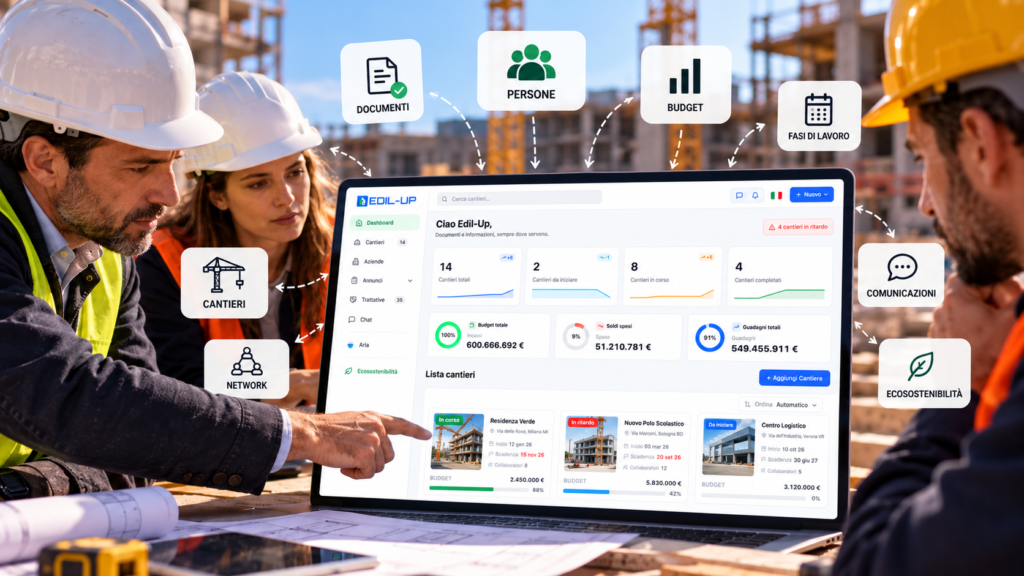
Not simply another management system to add to the list, but an operating environment in which projects, people, documents, phases, communications, and other business information can be viewed in the same context.
One point should be made clear immediately: Construction Operating System is not currently an international standard equivalent to an ISO standard. It is a model Edil-Up uses to describe a platform designed to connect processes that are often separated in traditional construction management.
The question, therefore, is not simply whether digital is better than paper.
The more interesting question is:
how much work is lost every day manually connecting information that belongs to the same job site?
The problem with traditional management is not that it uses old tools
Traditional management is often presented as paper versus software.
That is an oversimplification.
A company may use only modern tools and still have an extremely fragmented organization.
Imagine an ordinary Monday morning.
The site manager sends several photos on WhatsApp. The technician updates a drawing and sends it by email. Administration changes the budget in Excel. The owner calls to ask how far along a phase is. A subcontractor’s document is in a different cloud folder.
Everything works.
Until someone has to connect that information.
That is when the hidden cost of fragmentation appears:
- searching;
- asking;
- re-entering;
- copying;
- checking;
- reconstructing the context.
The problem, then, is not necessarily the individual tool.
It is the amount of human work needed to make tools that describe the same project communicate with one another.
What Construction Operating System really means
In the Edil-Up model, a Construction Operating System is an operating layer that puts the job site at the center.
Rather than starting with a function—documents, attendance, budget, chat—it starts with the project and progressively connects the information related to it.
The conceptual structure is:
Company → Job Site → Phases → People → Documents → Communications → Attendance → Budget → Network
This does not necessarily mean that every specialist function must be developed internally by the same platform.
Accounting, BIM authoring, payroll, ERP, structural design, and other activities can continue to have dedicated software.
The difference is that the COS should become the place where the company understands what is happening operationally.
Traditional management and Construction Operating System: what changes in practice
| Process | Fragmented management | COS approach |
|---|---|---|
| Documents | Folders, emails, and distributed copies | Documents linked to the project and accessible according to roles |
| Communications | Chats and phone calls that are difficult to reconstruct | Operational information kept in the project context |
| People | Separate lists and implicit responsibilities | Collaborators, roles, and permissions linked to the job site |
| Costs | Budget updated separately from operations | Financial information viewed together with project status |
| Network | Directory and partner search separate from the work | Professional relationship that can continue into operational collaboration |
| Decision-making | Information from multiple sources must first be reconstructed | The aim is to reduce the work required to obtain context |
This does not mean that an integrated platform automatically makes every process better.
If roles, procedures, and responsibilities are unclear, even a single environment can become disorganized.
Technology reduces friction only when it is accompanied by a coherent organization.
The first leap: from an isolated document to connected information
A cloud folder solves the problem of file availability.
Not necessarily the problem of context.
When I open a document, I should be able to understand at least:
- which job site it belongs to;
- which phase it is linked to;
- who can view it;
- whether later versions exist;
- who needs to use it.
This approach is consistent with the international evolution of information management.
In 2026, the second edition of ISO 19650-2 is in development, defining an information management process throughout the asset life cycle and information exchanges between the parties involved.
ISO 19650 concerns a specific information management and BIM framework: using Edil-Up does not automatically mean applying or complying with that standard.
The principle is nevertheless interesting: information gains value when it has structure, ownership, and context.
To explore this topic further, you can also consult our guide to organizing job-site documents.
A job site is not made up of users: it is made up of people with different responsibilities
Many software systems treat a user as an account.
Operationally, that is not enough.
The owner, administration, technician, site manager, collaborator, and outside contractor do not need the same information.
A Construction Operating System should therefore make it possible to build context through:
- company;
- job site;
- role;
- permission;
- operational responsibility.
This reduces two common extremes.
In the first, everyone sees everything.
In the second, no one can find what they need without asking someone for access.
The budget becomes more useful when viewed together with the job site
A budget updated once a month may be correct from an administrative standpoint and arrive too late from an operational standpoint.
Imagine that a phase is taking more days than expected.
In the field, the information is already obvious.
It may appear in the financial file weeks later.
A COS does not necessarily have to replace professional cost-management software.
It can, however, reduce the distance between what is happening and what the person monitoring the project is able to see.
The RICS Construction Productivity Report 2026, based on nearly 3,000 professionals in five global regions, shows how fragmented productivity measurement remains in construction.
In many markets, monthly control continues to be more widespread than weekly monitoring, while scheduling, sequencing, coordination, and site management are identified as important productivity factors.
The message is consistent with the COS approach: more frequent data has value only when it is linked to operational decisions.
For the financial side, you can also explore our article on cost control, estimates, and budgets.
Being digital does not mean being integrated
The 2026 data shows this clearly.
The study Deloitte Access Economics / Autodesk — State of Digital Adoption in the Construction Industry 2026 analyzed 954 construction and engineering companies in six Asia-Pacific markets.
Fifty-six percent use data analytics, 50% use cloud construction-management software, and 47% use mobile applications.
Yet fewer than half say that field teams have predominantly real-time project data, and around one in four companies continues to depend mainly on paper-based processes.
There is another particularly interesting finding.
The median number of systems and point solutions used by the companies analyzed fell from eleven to six.
That is an improvement.
But six systems are still six possible places to look for information.
This is where integration becomes more important than simple digitalization.
From network to job site: why professional relationships are also part of the system
Traditional management often treats two worlds as completely separate.
First, there is the company.
Then we start working together through other tools.
In the Edil-Up model, network and operations can instead be two phases of the same journey.
A company identifies a potential partner, creates a professional relationship, and, if a collaboration develops, those people can enter the project’s operational context.
This does not mean that a marketplace automatically becomes a procurement system.
It means reducing the distance between who we know and who we are actually working with.
This is the approach we also explore in the article dedicated to the Edil-Up company network.
With AI, the Construction Operating System becomes even more important
Artificial intelligence makes it clear why fragmented data is a limitation.
In the analysis How AI is reshaping the future of the AEC industry, published in July 2026, McKinsey describes a future in which AI agents can connect information from design, procurement, scheduling, and the job site.
The example proposed by McKinsey is significant.
A problem identified in the field can be compared with the model, drawings, procurement, and schedule to quickly estimate possible consequences for costs and time.
But this scenario has an obvious prerequisite.
The information must be available, structured, and accessible.
If the problem is in the photo sent on WhatsApp, the updated drawing in a technician’s mailbox, and the order on the administrator’s computer, the agent does not automatically have the necessary context.
McKinsey explicitly discusses redesigning workflows and building data around the decisions they must support.
That is exactly why an operating system becomes more interesting than a simple collection of features.
A practical example: a delivery is delayed by four days
Imagine that a supplier reports a delay.
In fragmented management, the news may arrive in a phone call to the site manager.
The manager informs the technician.
The technician changes their schedule.
The owner is informed later, when they discover that the team planned for that phase must be rescheduled.
In a more integrated workflow, the event should instead enter the project and make it easier to understand:
- which phase is affected;
- which people need to know;
- which subsequent activities depend on that delivery;
- which documents or communications explain the change;
- whether there is a potential financial impact.
The platform does not automatically decide on the solution.
It reduces the work required so that the right people can make decisions with the necessary context.
Five mistakes that can turn a COS into another unused software tool
1. Digitalizing chaos
If the current process does not define roles and responsibilities, copying it into a new tool will not make it better.
2. Expecting it to replace every specialist software tool
An operating system does not necessarily have to perform the function for which each vertical software tool was created better than that tool does.
Its value lies above all in connecting context.
3. Activating everything on day one
Introducing documents, attendance, budget, network, communications, and every other function at the same time can increase internal resistance.
4. Designing the system only from the office
The real test is the smartphone used during a normal day in the field.
5. Assuming integration means automatic compliance
Centralizing documents and information can make work easier.
It does not replace professionals, assessments, responsibilities, or checks required by applicable regulations.
How to find out in 30 days whether a Construction Operating System really serves your company
Week 1 — Measure fragmentation
Choose one job site and record:
- how many tools are normally used;
- how many times information has to be resent;
- how long it takes to find a document;
- how many decisions remain only in chats or phone calls;
- how much data is manually transferred from one system to another.
Week 2 — Centralize three processes
Not everything.
For example, documents, collaborators, and operational communications.
Week 3 — Take the test into the field
Involve the site manager and check whether they can actually use the new workflow without slowing down the work.
Week 4 — Measure again
Compare the same indicators.
If you have simply moved the work into new software, the project needs to be corrected.
If searching, resending, duplication, and manual handoffs decrease instead, the system is beginning to deliver an operational benefit.
Edil-Up: the Construction Operating System built around the job site
Edil-Up is being developed according to this approach.
The starting point is not to build a separate app for every need, but to progressively bring together the information that describes the life of the company.
Within job-site management, the company can organize:
- job sites;
- phases;
- collaborators;
- roles and permissions;
- documents;
- communications;
- attendance;
- basic financial information.
The mobile app brings part of the operating environment into the field.
The Network, on the other hand, extends the system to professional relationships between companies.
The value of the model does not lie in claiming that one software tool should do everything.
It lies in creating a layer in which company, job site, people, and information progressively stop being separate worlds.
Anyone evaluating different solutions can also consult our guide to job-site management software and our comparison of job-site management alternatives.
Checklist: do you need another software tool or an operating system?
- How many tools are needed to reconstruct the status of a job site?
- Do documents have a recognizable official source?
- Is it easy to understand who is working on a particular project?
- Do important communications remain linked to the project?
- Do the field and office work within the same context?
- Can the budget be viewed together with phase status?
- Can a new partner join the project without creating a new ecosystem of files and chats?
- Could the information produced today be used tomorrow by an AI agent?
- Has digitalization eliminated steps, or has it merely added applications?
International reference sources
- RICS — Construction Productivity Report 2026 , international research on productivity, measurement, skills, coordination, and site management.
- Deloitte Access Economics / Autodesk — State of Digital Adoption in the Construction Industry 2026 , an analysis of 954 construction and engineering companies and the sector’s digital maturity.
- ISO/DIS 19650-2:2026 , second edition in development on the information-management process in the built environment.
- McKinsey & Company — How AI is reshaping the future of the AEC industry, 2026 , an analysis of the evolution of workflows, data, AI, and operating systems in AEC.
Conclusion: the next leap is not having more software
Traditional management is not inefficient because it uses Excel, email, or WhatsApp.
These tools can continue to be extremely useful.
The limitation emerges when they become the architecture on which the company tries to coordinate dozens of job sites, people, documents, and decisions.
At that point, the work is no longer only about building.
It is about holding distributed information together.
A Construction Operating System seeks to move that work from people’s memory into the structure of the system.
It does not eliminate the need for skilled professionals.
It does exactly the opposite: it seeks to give them a better context in which to make decisions.
The real digital leap is not moving from paper to screen. It is moving from scattered information to a system that understands how it is connected.
Edil-Up Team