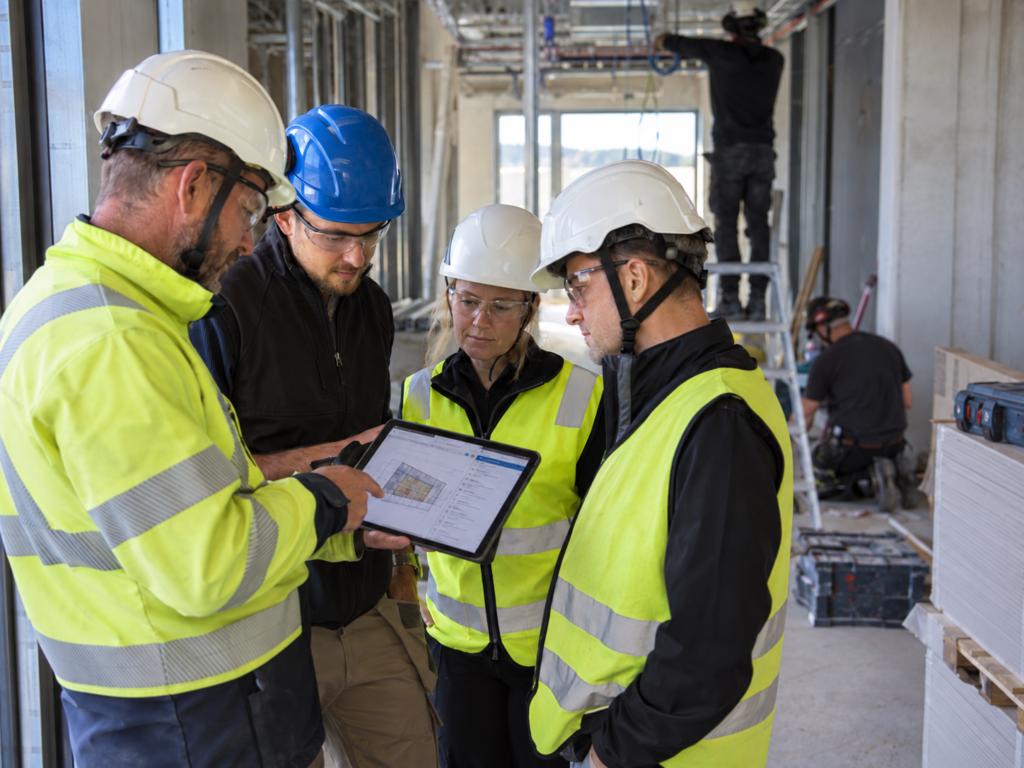
Scattered construction site documents are more than an administrative nuisance: they can lead to downtime, supply errors, misunderstandings between teams, and difficulties reconstructing decisions and responsibilities. When technical instructions, certificates, drawings, and daily reports remain scattered across personal chats, local folders, and emails, the project loses control and traceability.
This article presents a practical method for organizing construction site documents so that contractors, suppliers, technicians, and field crews can collaborate using better-structured information. We will look at why documents become scattered, the consequences this fragmentation can create, which measures can be applied immediately, and how a Construction Operating System such as Edil-Up can help keep people, phases, documents, and communications in the same context.
Why documents become scattered: the dynamics that create confusion
Document dispersion almost always results from several causes that add up: no single point of reference, unclear document responsibilities, tools that do not communicate with one another, and time pressure that leads people to simply use the fastest channel. A technical drawing sent as a PDF via WhatsApp by the crew leader, supplier documentation kept in a salesperson’s email inbox, and a report saved only on the site computer are far from unusual situations.
The result may be multiple versions of the same document, difficulty identifying the latest revision, and little clarity about who has seen or approved particular information. When documents, responsibilities, and work phases are not connected, collaboration depends too much on individual memory and habits.
Practical consequences: delays, hidden costs, and compliance risks
The consequences can appear quickly. A material is ordered outside specification because the supplier received an outdated measurement; a crew is left waiting because it did not read an operational update; an administrative review takes hours because the documentation is distributed among several people. These problems are compounded by less visible costs: time spent searching for files, duplicating documents, requesting information again, and checking which version is actually valid.
In public and private projects, poorly organized document management can also complicate reviews, inspections, and compliance requirements. For this reason, construction site document management should not be considered a secondary task, but rather a component of the project’s operational organization.
A practical example: how the problem appears on a residential construction site
Imagine a construction site for a residential building where a general contractor, electrician, plumber, flooring contractor, and window supplier are working. During the work, some measurements are changed and the drawing is updated. However, the window contractor continues using the previous version. The frames are manufactured using information that is no longer current and, when they arrive on site, they do not comply with the new conditions.
At that point, this is no longer just a document problem: it is necessary to determine who received the update, check the orders, coordinate with the supplier, and reorganize subsequent work. If the updated drawing had instead been available in a shared environment, linked to the installation phase and communicated to the relevant people, the likelihood of catching the problem before production would have been greater. Up-to-date documentation and timely communication are two parts of the same process.
How to transform collaboration: roles, responsibilities, and a single source of truth
The foundation is simple: define who is responsible for each document, when it is produced, who must approve it, and where it must be stored. This requires clear roles and permissions and a shared point of reference where the companies involved can access the information they need within the limits of their respective rights.
In practice, this means mapping the main document types — drawings, reports, declarations of conformity, supplier documents, invoices, DUVRI, POS, and other documents required for the contract — assigning a person responsible for each category, and establishing a minimum approval workflow. When every document has an identifiable owner, version, and status, collaboration becomes more repeatable and less dependent on individuals.
Tools and best practices that work in the field
Centralizing does not simply mean moving files to the cloud. A method is needed to connect documents with construction sites, phases, people, and communications. Consistent naming conventions, version control, roles, approvals, and contextual notifications help prevent information from being forgotten in generic folders.
Structured information management is also addressed at the international level. ISO 19650-1, dedicated to information management through Building Information Modelling, defines principles for organizing, recording, exchanging, and versioning information among the parties involved throughout a project’s life cycle. This does not mean that every SME must fully implement the standard, but it shows how organization and information control have become central elements in the digitalization of construction.
In daily practice, it may be enough to start with a minimum procedure that all participating companies can understand: where to upload documents, how to identify versions, who can modify them, and who must approve them. A few rules applied consistently are often more effective than highly complex procedures that no one actually uses in the field.
Practical scenario: coordination between a materials supplier and an installation contractor
Consider a materials supplier that must deliver certificates and technical documentation along with the goods. The files arrive by email at the office, but the site manager has no immediate visibility. The review is therefore postponed or takes place only when the material is already on site.
With a shared workflow, the supplier can submit the documentation through a defined point, and the manager can receive the information linked to the relevant order or phase. The review then takes place before installation, and it becomes easier to retrieve certificates and documentation later for inspections, acceptance tests, or internal reports.
Common mistakes to avoid in construction site document management
A frequent mistake is to think that digitalization is simply a matter of putting files in the cloud. Without usage rules and training, there is a risk of reproducing online the same dispersion that existed before. Another very common problem is the lack of version control: nearly identical files, unclear names, and copies saved by different people can make it difficult to determine which revision should be used.
Delegating document uploads without assigning clear responsibilities can also create gaps. Similarly, completely separate systems between contractors and suppliers can hinder collaboration if there is no shared exchange point. Finally, archiving a document without linking it to the work phase or contract causes it to lose much of its operational context.
Practical checklist to bring order tomorrow morning
- Identify a person responsible for each relevant document type.
- Create a simple convention for file names and versions.
- Establish a single point for uploading operational documents and define permissions.
- Provide brief training for the people and companies that will use the new workflow.
- Whenever possible, link each document to the contract, phase, and relevant person responsible.
It is not necessary to implement everything at once. The checklist can be applied gradually on a pilot construction site and improved based on the problems that arise in daily use.
Where collaboration between contractors, suppliers, and crews makes a difference
Collaboration means sharing at least part of the same operational language. When construction companies, suppliers, and crews use common document rules, it becomes easier to check which version was approved, who delivered a certificate, or when a particular change was communicated.
This synchronization is especially important for SMEs working as subcontractors because it reduces repeated documentation requests and makes it easier to reconstruct the work performed. For contractors, greater document transparency facilitates the coordination of multiple operators and reporting to the client.
How a Construction Operating System helps keep documents in context
A Construction Operating System is an operational environment designed to connect construction sites, people, phases, documents, and communications. The difference from a simple archive is precisely the context: the document does not remain isolated but can be associated with the project and the activities to which it relates.
This direction is consistent with the sector’s broader transformation. The Construction Transition Pathway of the European Commission identifies digital transition as one of the elements needed to build a more competitive, resilient, and modern European construction ecosystem.
At Edil-Up, this approach is applied by progressively bringing construction sites, phases, collaborators, documents, roles, permissions, attendance, budgets, communications, and a professional network into the same environment. The goal is not simply to collect more functions, but to reduce the number of points at which information can become dispersed.
Step-by-step implementation: what to do in the first four weeks
Week 1: map the key documents and appoint responsible people. Involve the site manager, technical office, and contacts at the main suppliers to define which documents are genuinely needed at each phase. This first step is mainly intended to clarify responsibilities and reduce ambiguity.
Week 2: choose the sharing environment and establish common rules. Organize folders or operational spaces, define naming conventions, and prepare simple templates for reports and minutes. Test the workflow on a single construction site.
Week 3: quick training and operational launch. Organize short sessions with the people who will actually use the system. Training should focus on daily activities: how to find a document, upload a change, identify the valid revision, and inform the relevant people.
Week 4: consolidation and measurement. Assess the initial results: document search times, version errors, repeated requests, and supplier response times. Use a few simple metrics to determine whether the new method is genuinely reducing fragmentation.
Integration with safety and reporting obligations
Construction site document management is also connected with health and safety matters. For obligations and responsibilities, it is necessary to refer to current legislation and institutional sources. The Italian Ministry of Labour and Social Policies provides guidance on employers’ obligations.
Safety on construction sites is also governed by specific legislation at European level. The European Directive 92/57/EEC on temporary or mobile construction sites, referenced by the European Agency for Safety and Health at Work (EU-OSHA), places particular emphasis on coordination and the chain of responsibilities among those involved in preparing and carrying out the work.
A digital environment can help make documents and information more readily accessible to authorized people, but it naturally does not replace the legal requirements, checks, or responsibilities established by law.
Documentation and cost control
Documents are not separate from the project’s financial control. A change can modify a quantity, order, specification, or schedule and therefore affect the contract budget. Connecting specifications, changes, orders, and documents with financial information makes it easier to reconstruct the reason for a variance.
To understand the broader cost context, company data can be supplemented with official sources such as the construction cost indexes published by ISTAT. These data do not replace control of the individual contract, but they provide a useful reference for interpreting general cost trends.
Complex scenarios: sites with many contractors and external suppliers
On sites with many stakeholders, a centralized approach becomes even more useful. This does not mean sharing every piece of information with everyone, however. It is important to define consistent access levels: some documents must be available to multiple parties, while others must remain visible only to specific roles.
Good collaboration therefore requires two seemingly opposing elements: sharing and control. Initial operating agreements on document workflows, response times, and responsibilities can reduce misunderstandings and make coordination between contractors, suppliers, technicians, and clients easier.
Useful sources and further reading
To explore the different aspects covered in this article, you can consult several institutional and international sources directly:
- ISO 19650-1 – principles for information management in construction;
- European Commission – Construction Transition Pathway;
- EU-OSHA – Directive on temporary or mobile construction sites;
- Ministry of Labour – employers’ health and safety obligations;
- ISTAT – construction cost indexes.
To compare operational tools and approaches, you can consult the Edil-Up overview dedicated to construction site management software.
How to get started without overhauling processes
There is no need to immediately overhaul the entire organization. It is often more effective to start with a pilot site and a few clear rules, using a tool that can grow with the company’s needs. The first objective should be to eliminate a tangible part of the dispersion: documents that are easier to find, clearer versions, and better-defined responsibilities.
The process can then be extended to other activities, such as phase management, attendance, communications, reporting, or financial control. For SMEs and smaller suppliers, ease of use remains essential: a complex system that no one uses correctly solves far less than a simple procedure adopted by everyone.
Conclusion: what to do at the company tomorrow morning
Tomorrow morning, you can start with the construction site where information is currently hardest to retrieve. Appoint a document manager and collect at least the essential documents in one place: updated drawings, safety documentation, supplier certificates, reports, and the main changes. Establish a simple rule for names and versions, and test the new workflow with an important supplier.
After a few weeks, measure how many searches, clarification requests, and version errors have been avoided. These figures, more than the number of software features, can show whether the new process is genuinely improving collaboration between contractors, suppliers, and crews.
Edil-Up Team