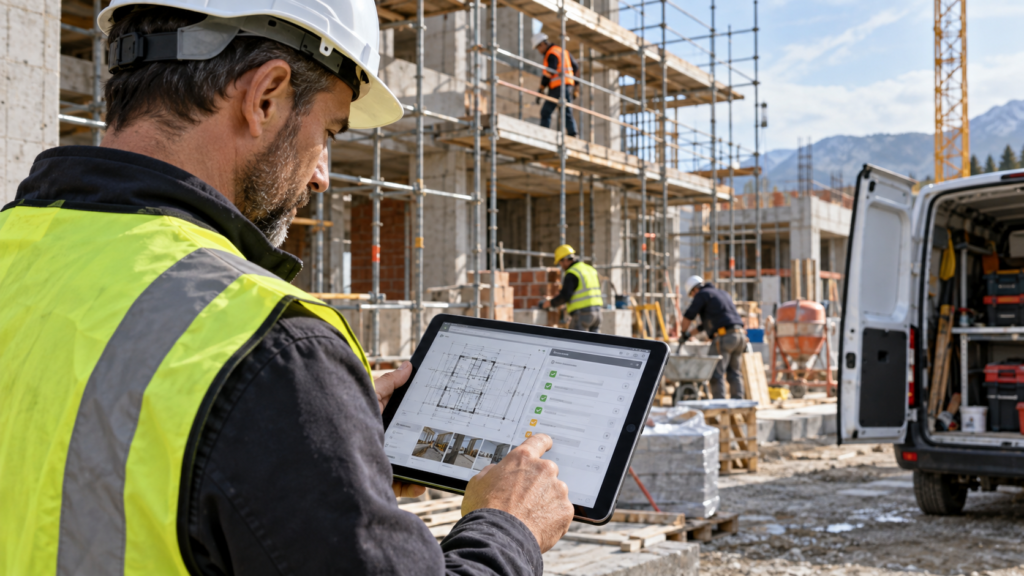
A technician leaves the office just to deliver an updated drawing. A foreman prints a document again because they are not sure the copy on site is the latest one. A supplier sends a delivery note by email, while the delivery photo remains in a chat and the office waits for confirmation by phone.
None of these activities seems particularly serious. Repeated every day, however, they generate hours of administrative work, paper, travel, fuel, and above all a constant need to keep the office and site aligned.
This is where construction digitalization can deliver a concrete benefit: not simply by turning a sheet of paper into a PDF, but by reducing the steps needed for information to reach the right person.
The point is not to eliminate all paper or replace every site visit with a video call. Some documents, inspections, and meetings will necessarily continue to require specific forms and methods.
The more realistic goal is different: eliminate paper and travel when they add no value to the work.
The true cost of paper is not the sheet
Printing ten pages costs very little. The significant cost comes afterward: someone has to prepare, transport, deliver, file, replace, and check them when they change, while ensuring the previous version is no longer used.
The same applies to travel. A 20-minute trip may seem negligible, but it becomes inefficient when the only reason for the journey is to deliver a document, show a photo, or retrieve information that could have been shared securely at a distance.
Hidden costs can therefore be divided into four categories:
- time: printing, searching, delivery, and updating;
- mobility: fuel, vehicles, and hours spent traveling;
- errors: obsolete copies, duplicate information, and missing data;
- materials: paper, toner, binders, and physical archives.
Digitalization makes sense when it reduces at least one of these steps without introducing others that are more complex.
Before software: map the information flow
A common mistake is to start by asking which document to digitalize. The more useful question is: what path does that information currently follow?
Consider a material delivery. The supplier announces its arrival, the person in charge verifies the delivery, a document is produced, someone sends it to the office, and the information may subsequently be needed for checks or administration.
If paper, phone calls, email, and a photo sent in a chat are used to complete this cycle, we do not have a single document problem. We have a fragmented process.
For every recurring activity, it is therefore useful to record:
- who generates the information;
- who must receive it;
- where it is recorded;
- how many times it is manually entered or copied;
- whether it generates travel;
- whether legal, contractual, or technical constraints apply to its format.
Only after creating this map does it make sense to decide what to eliminate, what to digitalize, and what should remain unchanged.
Digitalizing a document does not simply mean saving it to the cloud
A PDF scattered across ten folders is digital, but not necessarily more useful than its paper version.
To genuinely reduce reprints and resends, the document must be easy to find, and it must be clear which copy is the operational reference.
A few rules are therefore needed:
- one official source for each job site;
- clear categories;
- recognizable versions;
- permissions aligned with roles;
- clear responsibility for updates.
Otherwise, there is a risk of simply replacing the physical binder with an equally difficult-to-use digital folder.
On this topic, we have also explored a specific method for organizing construction-site documents.
Not every trip is wasteful
A site visit remains essential when it is necessary to physically observe work, carry out an inspection, make a technical decision on site, or perform activities that require the presence of qualified personnel.
Digitalization should not try to replace this type of presence.
It is more useful to identify purely informational trips, for example when someone travels only to:
- deliver an updated copy;
- pick up documentation that is already available;
- show some photos;
- communicate the status of a phase;
- retrieve information that the job site could update directly.
The rule can be very simple:
If physical presence adds technical or operational value, keep it. If it is needed only to transport information, first try redesigning the flow.
The process must be able to start on site
Many digitalization initiatives fail because they are designed exclusively from the office.
The person responsible on site should not have to wait until they are back at a computer to upload a photo, consult a document, or update simple information.
A genuinely usable procedure should allow, from a smartphone or tablet, at least the actions that are part of a normal day on site, without turning the foreman into an administrative clerk.
The principle is also important in light of the 2026 data. The study Deloitte Access Economics / Autodesk — State of Digital Adoption in the Construction Industry 2026 involved 954 construction and engineering companies in six Asia-Pacific markets.
In the sample, 50% use cloud construction-management software and 47% use mobile applications. Digital adoption is therefore significant, but the challenge remains turning tools into usable, genuinely integrated processes.
Digitalization and sustainability: the link exists, but it must be measured
Reducing paper and travel can lower material consumption and some logistical activities, but it would be incorrect to automatically turn every digital process into a quantified environmental benefit.
Technology also uses energy, infrastructure, and devices. For this reason, the best approach is to measure what actually changes in the business process.
At the European level, the European Commission’s Construction Transition Pathway treats the green transition and digital transition as two closely connected dimensions of the sector’s evolution.
At the sixth High-Level Construction Forum, held in April 2026, the Commission and stakeholders continued working specifically on implementing a more resilient, digital, and sustainable construction ecosystem.
The Commission also emphasizes that the environmental impact of the built environment must be addressed throughout the entire life cycle: materials, construction, renovation, use, and end of life. Administrative digitalization is therefore only one piece, not the complete solution.
How to measure paper and travel without making up percentages
Before changing the process, collect some simple data for one month.
- number of prints produced for the job site;
- miles traveled for activities that are exclusively informational or document-related;
- number of avoidable office-to-site trips;
- time spent delivering and retrieving documents;
- number of reprints caused by revisions;
- number of resends of the same file.
After introducing the new process, measure exactly the same indicators.
At that point, the company can say, for example, that it eliminated a specific number of miles or prints at its pilot job site, rather than applying generic percentages taken from other contexts.
What is the economic value of avoiding a trip?
Here too, it is best to use your own data.
The minimum formula can be:
Avoidable trip cost = person’s time + vehicle cost + any additional costs
The value must be calculated using the company’s actual costs, not a universal average.
If a technician spends 40 minutes in total traveling to the job site solely to deliver documentation, that time can be assigned a value.
If, instead, they carry out a necessary site visit during the same trip, it would not be correct to consider the entire journey avoidable waste.
Six mistakes that can make digitalization less sustainable than the previous process
1. Digitalizing everything at once
Too many new procedures at the same time increase the likelihood that staff will continue using paper and digital systems in parallel.
2. Turning every sheet into a PDF without changing the process
If the PDF still has to be downloaded, sent to three people, modified, and manually uploaded again, the improvement is limited.
3. Keeping paper and digital as two official systems
During a transition phase, it may be necessary to use both, but it must be clear which one is the operational reference when regulations or the contract do not require otherwise.
4. Eliminating trips that have technical value
A necessary site visit is not inefficiency. Good digitalization eliminates trips that carry only information, not the professional presence the project requires.
5. Ignoring suppliers and external contractors
If the company digitalizes internally but continues receiving everything else on paper, by email, and through unstructured chats, a significant part of the fragmentation remains.
6. Claiming environmental benefits without measuring them
Saying “we digitalized” is not equivalent to demonstrating an emissions reduction. Credible results require data, measurement boundaries, and transparent assumptions.
A 30-day test to reduce paper and travel
Days 1–7: measure
Choose one job site and record prints, resends, document-related trips, miles, and the time needed to circulate the most frequent information.
Days 8–14: choose three processes
Do not digitalize everything. Start, for example, with site documents, operational photos, and communications related to project phases.
Days 15–21: eliminate one step
For each process, ask which manual step can be eliminated without reducing control or quality.
The goal is not to add digital tools to the existing procedure. It is to simplify the procedure.
Days 22–30: compare
Measure the same indicators again and check where behavior has actually changed.
Only then extend the method to other job sites.
Where Edil-Up can reduce fragmentation
Edil-Up is developed as a Construction Operating System to connect information that construction companies often manage in different places.
Within construction-site management, the company can organize job sites, phases, collaborators, roles and permissions, documents, communications, basic budgets, and attendance in the same operational environment.
The mobile app makes it possible to bring part of the process directly to the field, reducing the need to wait until returning to the office to consult or record certain information.
The component dedicated to environmental sustainability also makes it possible to include environmental considerations in the company’s digitalization journey, without confusing an operational reduction in paper with environmental certification.
The value of the model is not simply having fewer sheets of paper.
It is reducing the distance between where information is created and where it is needed for work.
Those evaluating different tools can also consult our guide to construction-site management software and our in-depth article on construction-site document management.
Checklist: how physical is your information flow?
- How many times do we print the same document?
- How many trips are needed only to carry information?
- Can the field and office consult the same source?
- Are previous versions easy to identify?
- Can the person responsible update the job site from a smartphone?
- Do suppliers and partners feed the same flow, or do they create parallel archives?
- Do we measure miles, prints, and time before claiming savings?
- Has digitalization eliminated a step or added one?
International reference sources
- Deloitte Access Economics / Autodesk — State of Digital Adoption in the Construction Industry 2026 , a study of 954 construction and engineering companies covering adoption of cloud, mobile, analytics, and digital tools.
- European Commission — Construction Transition Pathway , a European pathway to make the construction ecosystem more resilient, green, and digital, with activities continuing in 2026.
- European Commission — Guidance to decarbonise buildings, 2026 , guidance on the life cycle of buildings and reducing the environmental impact of the built environment.
- European Commission — Level(s) , a European framework for measuring and communicating building sustainability performance throughout the life cycle.
Conclusion: sustainability also means avoiding an unnecessary action
Digitalizing a job site does not mean completely eliminating paper, meetings, or travel.
It means avoiding paper when reliable digital information already exists and not moving a person when only data needs to move.
The best result comes when efficiency and sustainability coincide.
Fewer duplications mean less administrative work. Fewer reprints mean less material used. Fewer purely informational trips mean fewer hours spent in the car and lower operating costs.
But these benefits become credible only when they are measured.
The most useful digitalization is not the one that makes the job site more technological. It is the one that eliminates steps that were no longer necessary.
The Edil-Up Team