
On British construction sites and in manufacturing plants in Italy, the most effective material tracking systems in 2025 combine RFID, GPS, Bluetooth Low Energy (BLE) and Ultra-Wideband (UWB) to provide real-time visibility of every resource. Solutions such as Hilti’s ON!Track and UBI Solutions’ BLE trackers are currently among the most widely used on the Italian market, but the right choice always depends on the operating context, budget and regulatory obligations.
Here are the key points to consider before choosing:
- Available technologies: RFID for automatic identification, GPS for outdoor location tracking, BLE for low-power indoor environments, UWB for centimetre-level accuracy, and barcodes and QR codes for low-cost manual tracking.
- Leading solutions: Hilti’s ON!Track integrates Bluetooth tags and GPS into a single software platform; UBI Solutions offers BLE trackers 10 times smaller and less expensive than standard GPS devices, with equivalent battery life.
- Practical benefits: fewer inventory errors, optimised stock levels, and document traceability for static testing.
- Regulatory requirement: NTC 2018 (Chapter 11) assigns the Works Director direct responsibility for accepting and ensuring the traceability of structural materials on site.
- ERP integration: the most advanced RTLS systems connect directly to company management software to calculate holding times and analyse logistics flows.
- Comparison criteria: technology used, application area, accuracy, infrastructure cost, ease of integration, and compliance benefits.
Contents
- Which technologies do the best material tracking systems use?
- How is material tracking applied on construction sites and in production?
- How do you choose the most suitable tracking system for your company?
- Regulatory compliance and material tracking in Italian construction
- Comparative analysis: pros and cons of the most widely used systems in Italy
- Key points
Which technologies do the best material tracking systems use?
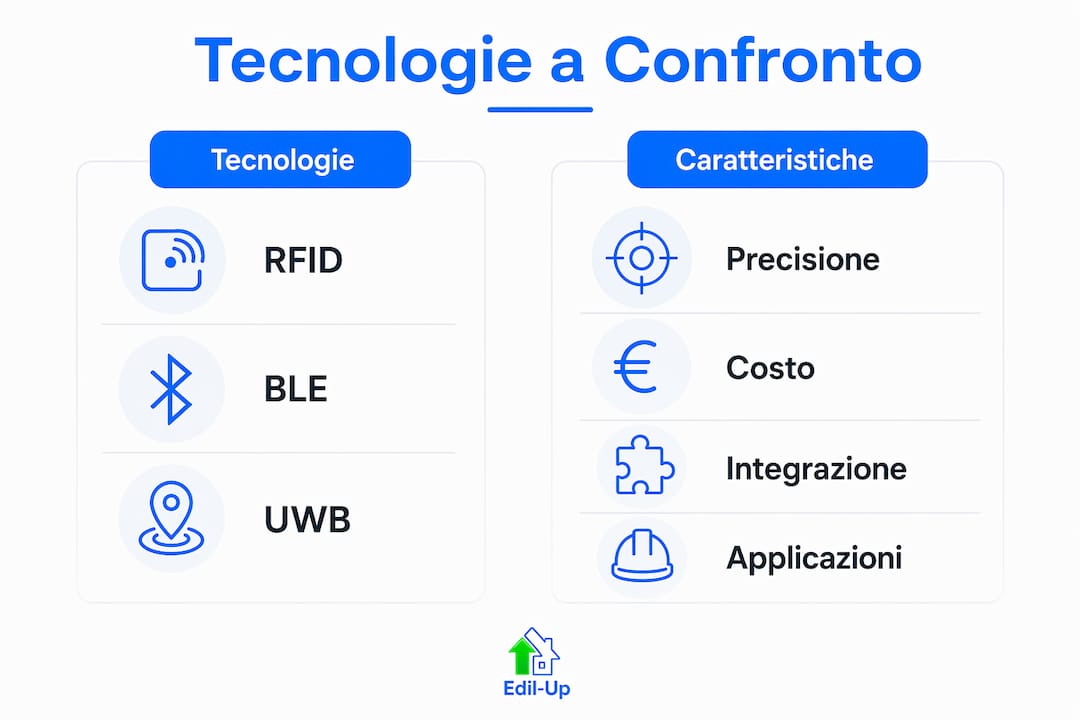
RTLS systems are not based on one universal technology: each solution represents a trade-off between accuracy, energy consumption, coverage range and infrastructure cost. Understanding the differences is the first step towards making the right choice.
| Technology | Application area | Accuracy | Infrastructure cost | Ease of integration | Compliance and operational benefits |
|---|---|---|---|---|---|
| RFID | Indoor / mixed | Medium (1–5 m) | Medium | High with ERP | Automatic document traceability |
| GPS | Outdoor | High (3–5 m) | Low (no fixed infrastructure) | High | Asset location on open sites |
| BLE | Indoor / mixed | Medium (1–5 m) | Low | High | Low power consumption, lower tag cost |
| UWB | Indoor | Very high (10–30 cm) | High | Medium | Accuracy for critical environments |
| Barcodes / QR codes | Indoor / mixed | N/A (manual) | Very low | Very high | Basic tracking, easy adoption |
RFID is the most widely used technology in warehouses and processing centres: tags are read automatically at gates without human intervention, eliminating manual entry errors. On outdoor sites, GPS remains the most direct way to know where machinery and transport units are located. BLE has rapidly gained ground thanks to low tag costs and long battery life, making it suitable both for indoor environments and logistics shipments. UWB offers centimetre-level accuracy that no other technology can achieve in enclosed spaces, but it requires a denser and more expensive antenna infrastructure. Barcodes and QR codes remain the entry-level solution for those starting from scratch, with minimal costs and immediate integration with any management system.
Advice: Before investing in RFID or UWB, check whether your process really requires that level of accuracy. On many construction sites, a BLE system with QR scanning on receipt covers 90% of requirements at one-fifth of the cost.
How is material tracking applied on construction sites and in production?
Real-time monitoring fundamentally changes how a construction site operates. It is not just about knowing where a pallet is: RFID, GPS and RTLS systems make it possible to calculate holding times, analyse equipment routes and receive automatic alerts when a material remains stationary for too long.
Benefits documented in practical applications:
- Real-time digital inventory: the exact quantity of each available material, its location and the expected next delivery are known without manual counts.
- Reduced equipment downtime: immediately locating missing equipment prevents unplanned stoppages that slow down the entire project.
- Supply chain management: end-to-end visibility across the supply chain makes it possible to anticipate supplier delays and reschedule work before the problem appears on site.
- Sustainability and ESG criteria: lifecycle monitoring of materials supports environmental-impact calculations and waste reduction, requirements increasingly requested in public tenders.
- Access control and safety: RTLS systems integrate attendance detection and access control for restricted construction-site areas.
- Integration with management software: location and holding data flow directly into the company ERP, eliminating duplicate entry and transcription errors.
Industry data: RTLS location systems can significantly reduce the time spent searching for materials and equipment, with applications ranging from warehouse management to construction sites and hospitals.
Digital traceability also addresses ESG criteria that now influence access to tenders and environmental certifications such as LEED and BREEAM. Monitoring the origin and journey of materials ensures transparency throughout the supply chain, increasing trust among business partners and reducing the risk of disputes.
How do you choose the most suitable tracking system for your company?
The choice is not simply a matter of comparing technical specifications. Every company has different processes, and the right technology depends on a practical analysis of its operational, financial and regulatory needs.
Criteria to assess before deciding:
- Required accuracy: a warehouse with dense racking requires UWB or RFID; an outdoor construction site can be managed effectively with GPS or BLE.
- Total implementation cost: consider not only the price of tags and readers, but also infrastructure installation, staff training and annual maintenance.
- Integration with the existing ERP: verify that the chosen system has native connectors for the management software in use, or open APIs for custom development.
- Regulatory compliance: for structural construction sites, the system must support the production of traceable documentation valid for static testing under NTC 2018.
- Technical support in Italy: prefer suppliers with local support, guaranteed response times and references in the Italian market.
- Implementation times: some cloud-based solutions can be activated within a few days; RTLS systems with physical infrastructure require weeks or months of installation and configuration.
- Scalability: assess whether the system can grow with the company by adding tags, sensors or sites without starting from scratch.
For companies managing several construction sites at the same time, centralised project management becomes decisive: a tracking system that does not integrate with the construction-management platform creates information silos and undermines some of the expected benefits.
Regulatory compliance and material tracking in Italian construction
Tracking on site is not an organisational choice: for structural works, it is a legal requirement. The NTC 2018, Chapter 11, assigns the Works Director direct responsibility for accepting structural materials, including document checks, sample testing and guaranteed traceability from the manufacturing plant to the construction site.
Mandatory tests vary by material:
- Concrete: sampling of specimens on site and compression testing.
- Steel: tensile testing of samples at the frequency required by regulations for steelwork.
- Masonry: compressive-strength testing of samples at the frequency required by regulations for masonry.
- FRP systems: tensile, pull-off and delamination tests, with a Certificato di Valutazione Tecnica (CVT) mandatory in the absence of CE marking.
A frequently misunderstood point concerns the 3.1 certificate under EN 10204: this document certifies the mechanical and chemical characteristics of a specific batch, but it does not replace CE marking. They are complementary documents, and confusing them exposes the Works Director to direct liability if the static test is challenged.
Edil CAM Sistemi’s Sistema CAM® offers a practical example of how traceability integrates with certification: all materials are covered by CE marking, and when the work is completed the installer issues the Dichiarazione di Corretta Posa in Opera (DCPO), required to complete the static test. The digitalisation of the construction industry makes this process faster and more verifiable, reducing the risk of post-test disputes.
Best practices for ensuring compliance:
- Acquire and digitally archive all accompanying documentation for materials.
- Document specimen traceability using technology, including microchips or RFID tags, as provided for by Circular NTC 2018.
- Verify that certificates are issued by laboratories authorised under art. 59 of D.P.R. 380/2001.
- Keep samples for at least 30 days after testing.
- On public construction sites, verify compliance with the Minimum Environmental Criteria (CAM).
Comparative analysis: pros and cons of the most widely used systems in Italy
The Italian market includes solutions that differ widely in technology, cost and application area. None is universally superior: the choice depends on the type of construction site, company size and the level of digital integration already in place.
Hilti’s ON!Track is the system most widely adopted by medium-sized and large Italian construction companies. It combines Bluetooth tags and GPS in software accessible via smartphone and web, with inventory-management, scheduled-maintenance and low-stock-alert functions. Its strength is native integration with the Hilti ecosystem: companies already using Hilti equipment find everything in one place. The main limitation is dependence on the manufacturer’s ecosystem: tracking assets from other brands requires additional configurations.

UBI Solutions with BLE trackers stands out for its cost-to-performance ratio in logistics and shipping. The BLE tracker is 10 times smaller and less expensive than a standard GPS device with the same battery life, and pairing is completed through QR scanning without technical training. The Connected Things platform manages the entire fleet from a centralised dashboard. It is less suitable for sites requiring centimetre-level accuracy or very dense indoor tracking.
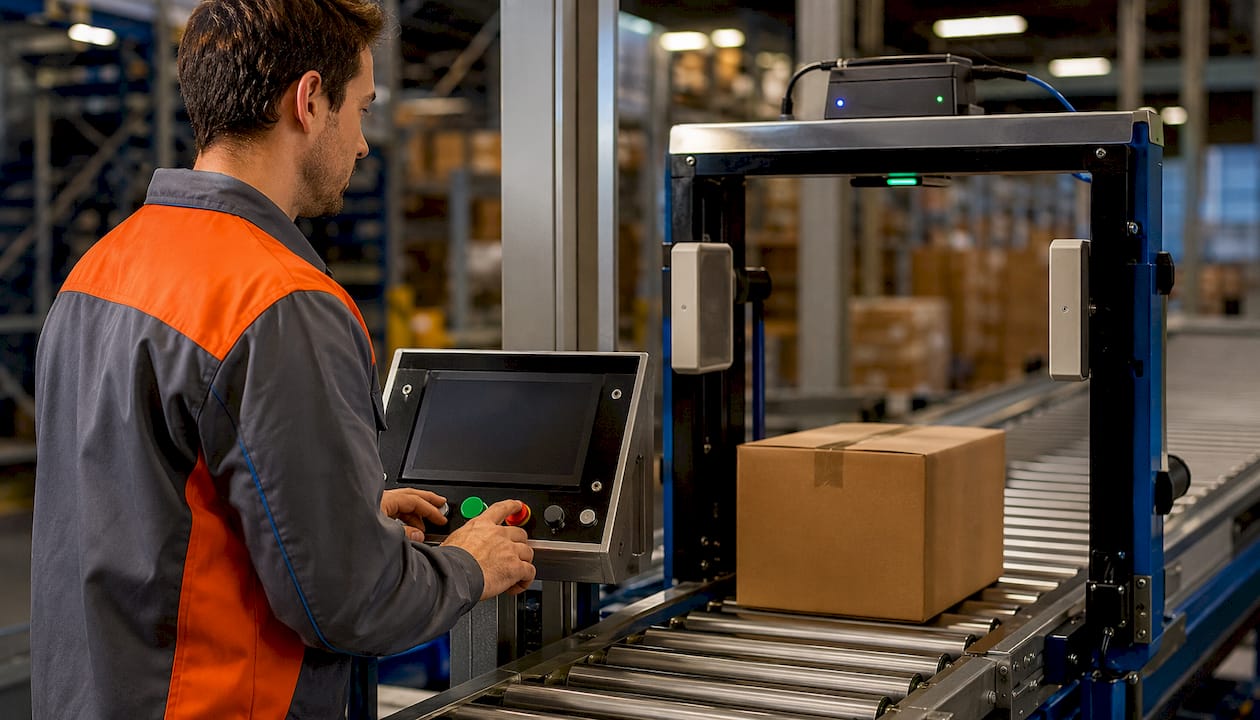
RFID systems with smart gates (such as those offered by specialised manufacturing operators) provide maximum automation when receiving and dispatching materials. Identification takes place without human intervention, with instant inventory updates. The cost of installing gates and fixed readers is higher than for BLE solutions, but the return on investment is rapid in operations with high movement volumes.
UWB RTLS solutions for critical indoor environments provide accuracy that other technologies cannot match, useful, for example, in prefabrication plants or metalworking shops where the exact position of a component determines the assembly sequence. However, the required infrastructure is the most complex and expensive to install and maintain.
Barcodes and QR codes remain the entry point for small businesses. Near-zero cost, immediate integration with any management system and no fixed infrastructure. The limitation is structural: a manual operation is required for every scan, so they do not provide continuous, automatic tracking. They work well as a complement to more advanced systems, for example, for receiving on site combined with a BLE system for warehouse monitoring.
For companies seeking a gradual approach to the digital transformation of construction sites, the most effective strategy is to start with QR and BLE, measure results on the first sites, and then assess whether investing in RFID or RTLS is justified by actual volumes.
Key points
The best material tracking systems for the Italian market combine complementary technologies, ERP integration and compliance with NTC 2018 to ensure operational efficiency and the validity of static testing.
| Point | Details |
|---|---|
| No universal technology | The choice between RFID, GPS, BLE and UWB depends on the required accuracy, application area and available budget. |
| BLE is cost-effective for logistics | UBI Solutions’ BLE trackers are much less expensive and smaller than standard GPS devices, with equivalent battery life. |
| NTC 2018 requires traceability | The Works Director is directly responsible for accepting structural materials and maintaining traceable documentation. |
| Certificate 3.1 does not replace CE marking | They are complementary documents: using them interchangeably creates liability in static testing. |
| ERP integration is decisive | A tracking system that does not communicate with company management software creates duplication and undermines the expected benefits. |
Edil-up supports Italian construction companies in digitalising their sites, with tools for project monitoring, document management and communication between companies. If you are considering how to integrate a material tracking system into your operations, the Edil-up platform provides the digital context in which these technologies deliver their greatest value.
Recommended
- 5 digital tools for managing construction sites more efficiently – Edil-up – Sustainable construction for the future
- How to publish job adverts in the construction industry – Edil-up – Sustainable construction for the future
- Optimising communication in construction projects – Edil-up – Sustainable construction for the future
- The benefits of centralised project management – Edil-up – Sustainable construction for the future