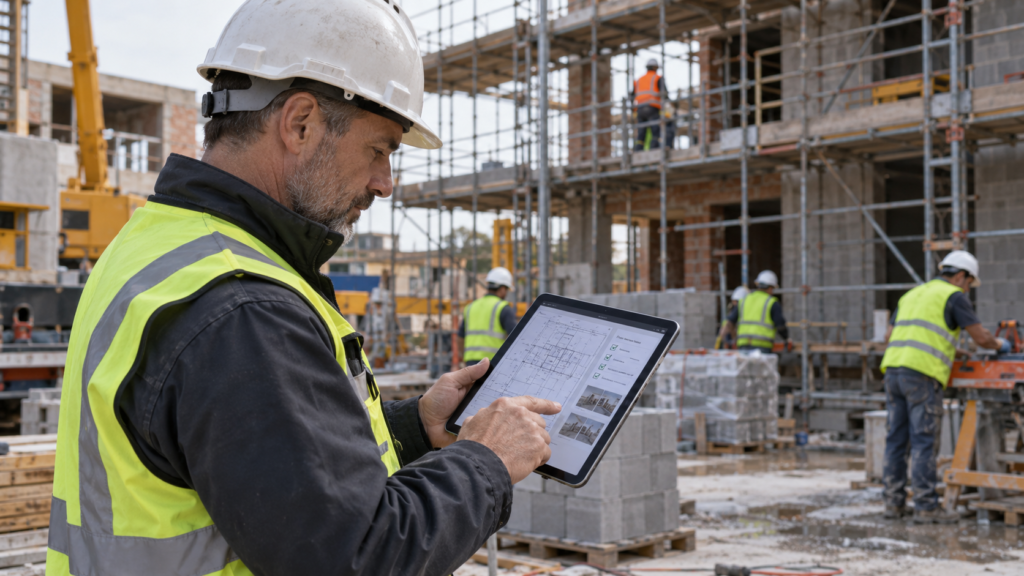
On many construction sites, paper has not yet disappeared. And it probably should not disappear completely.
There are documents, procedures and situations in which a physical copy may still be useful or required. The problem arises when printing, transporting and returning documents becomes a routine part of the work, even when the information could be accessed or shared more simply.
The same applies to travel.
A necessary technical site visit is not wasteful. A visit to the site to check work should not be replaced by a video call merely to reduce miles.
It is different when someone drives dozens of miles to deliver a document, collect a signature, bring photographs to the office or update someone on information that could have been shared digitally.
This distinction should form the basis of a good construction digitalisation strategy: not indiscriminately eliminating paper and travel, but reducing what does not add value to the work.
The hidden cost is not the sheet of paper: it is everything that happens around it
The cost of paper is almost always insignificant compared with the time spent managing it.
A document is printed in the office, taken to the site, modified, photographed, brought back and then archived.
If a new revision arrives in the meantime, the process may start again.
Printing costs only a few cents. The activities around it create the real operational burden:
- time needed to prepare and distribute copies;
- the need to replace outdated versions;
- difficulty knowing which copy is current;
- travel made to deliver or retrieve documentation;
- time needed to transfer into digital form what was completed by hand.
Digitalisation creates value primarily when it removes one or more of these steps.
Before digitizing, follow a document’s journey
One of the most common mistakes is to start directly with the choice of software.
It is more useful to choose three frequently used documents and follow their actual journey.
For each one, ask:
- who creates it;
- where it is saved;
- who needs to access it;
- how many times it is printed;
- how revisions are communicated;
- who has to bring it back to the office;
- how many times the same information is entered again.
This exercise makes it possible to distinguish the document from the process around it.
Digitizing only the file without changing the process risks creating an electronic version of the same problem.
Which documents should you start with?
There is no need to turn the entire company archive digital in a week.
It is more effective to start with the documents that generate the most movement between office and site.
Depending on the company, these may include:
- technical documents used in the field;
- progress photographs;
- technical data sheets;
- minutes and operational notes;
- supply-related documents;
- certifications;
- documentation relating to contractors and collaborators;
- safety documentation required for the specific project.
Each category should have a recognizable official source.
A copy sent via chat can be useful for quickly alerting someone, but it should not automatically become a new official version.
We have also explored a specific method for organizing construction site documents.
Not every trip should be eliminated: distinguish technical visits from information trips
The construction site remains a physical place.
For this reason, a credible digital strategy should not promise to manage everything remotely.
Many site visits are essential because a photograph or video call cannot fully assess a situation.
There are, however, very different kinds of travel.
For example:
- taking a document from the office to the site;
- going to retrieve photographs or reports;
- delivering a revision that is already available digitally;
- going to the site solely to learn the status of a phase;
- holding an in-person meeting exclusively to exchange information that is already structured.
These are the trips worth examining.
The right metric is therefore not “how many trips have we eliminated?”, but how many unnecessary trips have we avoided without reducing the quality of site oversight?
A common scenario: the office has the information, but the site does not
Imagine that a new revision of a document arrives at the office at 4:30 p.m.
The crew must use it the following morning.
In a traditional process, someone may print it, prepare it and physically deliver it to the person in charge.
In a well-organized digital process, the new version is instead added to the site’s official source and made accessible to authorized people.
The difference is not simply about avoiding paper.
It means that the office and field no longer have to synchronize physically to share the same information.
In 2026, the challenge is no longer simply to “go digital”
The construction industry already uses a significant amount of technology.
The State of Digital Adoption in the Construction Industry 2026 by Deloitte Access Economics and Autodesk analyzes 954 construction and engineering firms across six Asia-Pacific markets.
In the sample, 56% use data analytics, 50% cloud construction management software and 47% mobile applications.
At the same time, about one in four firms still depends primarily on paper-based systems, and fewer than half say that field teams predominantly have access to real-time project data.
There is another significant figure: the median number of systems and point solutions used by the firms surveyed fell from eleven to six.
That is an improvement, but six different systems can still mean six possible places to look for information.
The 2026 problem is therefore not just digitization. It is better integrating what is already digital.
Digitalization and productivity: technology alone is not enough
The RICS Construction Productivity Report 2026, based on responses from nearly 3,000 professionals across five global regions, offers a particularly useful indication.
Skills, planning, work sequencing, coordination and site management remain central productivity factors.
RICS also highlights how fragmented productivity measurement remains and how no single intervention is considered transformative by the majority of professionals.
The lesson is also important for a paperless project.
A tablet does not automatically make a process efficient.
If someone has to enter the same data into three different platforms, the sheet of paper has disappeared but the inefficiency remains.
Information management: digital works when information remains organized
The ISO 19650 series addresses the digital management of information in the built environment.
In 2026, the second edition of ISO 19650-1 is under development, covering principles relating to the recording, versioning, organization and availability of information for the parties involved.
The standard is not the same as ordinary construction management software, and adopting a platform does not automatically mean applying ISO 19650.
The principle is nevertheless useful for an SME: digitizing a document makes sense above all if it improves how the document is found, understood and shared.
Less paper and fewer miles can be measured—but do not invent percentages
Digitalization is often linked to sustainability.
The connection is plausible, but it must be measured.
If a company prints fewer pages, it uses less paper.
If it avoids a trip that would have been made solely to exchange information, it also reduces the miles traveled by the vehicle used.
To turn these effects into credible environmental indicators, however, you must start with actual data.
For example:
- number of pages printed before and after;
- reams of paper purchased;
- number of administrative trips avoided;
- miles actually not traveled;
- type of vehicle normally used.
Only afterward can these data be converted into environmental estimates using documented methodologies.
At the European level too, the approach to building sustainability is increasingly shifting toward a whole-life perspective. In 2026, the European Commission published new guidance on whole-life carbon, emphasizing the need to consider materials, construction, use, renovation and end of life in an integrated way.
Reducing paper therefore does not by itself make a project “sustainable.” It is one small component of a much broader picture.
Five mistakes that can turn digitalization into more work
1. Turning every sheet into a PDF without changing the process
If the digital document still passes manually between five people, we have reduced paper but not necessarily the work.
2. Using a new application for every problem
Documents in one app, photographs in another, chat in yet another and attendance elsewhere can create a completely digital site that is also highly fragmented.
3. Eliminating paper where it is still useful
Paperless should not become an ideological goal.
If a physical copy genuinely improves a particular activity or is required by the applicable process, keeping it may be the right choice.
4. Designing everything from the office
A system that is perfect on a monitor can become very slow on a smartphone used with gloves, outdoors or during a work activity.
5. Claiming savings without measuring the previous situation
Without a baseline, it is impossible to know how much has really changed.
That is why it is worth recording the data before starting the trial.
A simple 30-day test on one construction site
To begin, I would choose an active site and three processes that generate a lot of paper or many physical handoffs.
Before launch, record for one week:
- number of printouts related to the three processes;
- time needed to find the information;
- number of trips made exclusively to exchange information;
- miles traveled;
- number of requests to resend or clarify information.
Then centralize those three processes and leave everything else unchanged.
After thirty days, repeat the same measurement.
This approach makes it possible to understand the result without attributing improvements to digitalization that may depend on other factors.
The most useful indicators are often the simplest
A first dashboard might contain only:
- pages printed per construction site;
- requests to resend documents;
- average time to find a file;
- information-related trips made;
- miles associated with those trips;
- number of tools needed to complete a normal process.
It is not necessary to immediately convert every figure into dollars or CO₂.
First, it is worth checking that the process is actually changing.
Where Edil-Up fits into the process
Edil-Up is developed as a Construction Operating System with the goal of progressively reducing fragmentation among the information used by the company.
Within construction site management, documents, photographs, phases, collaborators, roles and permissions, communications, basic budgets and attendance can be managed in the same operating environment.
The Edil-Up mobile app also allows some information to be accessed and managed directly from the field, reducing the need to route every request through the office.
This does not mean that every site visit can be replaced by an app or that every document can be eliminated in paper format.
It means having a shared place where authorized people can access operational information without constantly requiring copies and resends.
Edil-Up also includes a sustainability component with indicators linked to paper reduction. The figure becomes meaningful above all when used together with a real measurement of the company’s process.
Those comparing several solutions can also explore the guide to construction site management software and the comparison with alternatives for construction site management.
Checklist: which activities can we stop doing physically?
- Which documents do we print every week?
- Which are reprinted when a revision changes?
- Which information is transferred manually from the site to the office?
- Which trips are made solely to deliver or retrieve information?
- Which meetings really require physical attendance?
- Which data is entered more than once?
- Which documents must still remain physically available?
- Can people in the field independently access what they need?
International reference sources
- RICS — Construction Productivity Report 2026 , research on nearly 3,000 construction professionals across five global regions.
- Deloitte Access Economics / Autodesk — State of Digital Adoption in the Construction Industry 2026 , analysis of the digital maturity of 954 construction and engineering firms.
- ISO/DIS 19650-1:2026 , second edition under development on information management principles in the built environment.
- European Commission — Life Cycle Approaches to Decarbonise European Buildings, 2026 , guidance on reducing the environmental impact of buildings throughout their life cycle.
Conclusion: good digitalization means eliminating steps, not just paper
Reducing paper can be a good result.
Reducing unnecessary trips can be an even better one.
But neither should be the ultimate goal.
The goal is to simplify the path of information between those working in the field and those coordinating the project.
If a digital process eliminates one printout but adds three manual steps, we have not really improved the work.
If, instead, it enables the person in charge to find the correct document from the site, avoids a trip made solely to deliver it and reduces another entry of the same data, then digitalization is producing a concrete benefit.
The best digital construction site is not the one without paper. It is the one where every tool, paper or digital, is used only when it is genuinely needed.
The Edil-Up Team