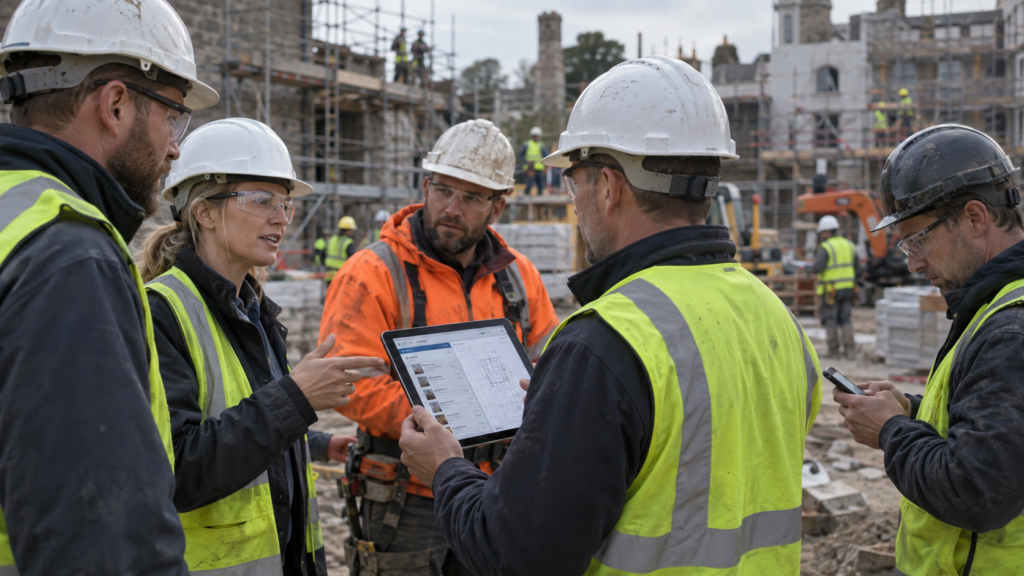
One company is highly skilled in renovations and structural work, but does not have an in-house team for building systems. Another specializes in exactly that, but struggles to access larger contracts. A supplier knows both companies, but normally meets them only after the work has already started.
This is a very common situation in the construction supply chain.
The skills exist, the companies exist, and the opportunities exist. What is often missing is a simple system for bringing them together and, above all, turning the initial contact into a collaboration that truly works in the field.
That is why collaboration between construction companies should not be viewed merely as networking. It can become a real commercial and operational tool: it makes it possible to expand the skills offered, take on more complex contracts, find suppliers or subcontractors, and build relationships that can be reused across multiple projects.
But three elements are needed for it to work: the right partner, clear rules, and an organized way of working together.
Why collaboration can become a competitive advantage today
Few companies can have all the skills needed for every contract in-house.
Building systems, steelwork, windows and doors, finishes, waterproofing, design, safety, specialized supplies: work is naturally distributed across a supply chain made up of different players.
The ability to quickly build a team of reliable companies can therefore expand what a single business is able to offer the market.
The European Commission itself describes construction as a true ecosystem, made up of companies, associations, authorities, professionals, and other stakeholders that must collaborate to address digital transition, sustainability, skills, and new business models.
The European Commission’s Construction Transition Pathway places collaboration, knowledge sharing, digitalization, and resilience among the elements driving the sector’s transformation.
For an SME, all of this translates into a very practical question:
“Which companies can we work well with when a contract comes up that we could not cover on our own?”
The first mistake: looking for a partner only when the problem is already urgent
Many collaborations start like this:
“Do you know anyone available starting next week?”
When the search begins in an emergency, price and availability risk becoming the only criteria.
It is far more effective to build a small network before it is needed.
For each potentially interesting company, it is useful to know at least:
- specialization;
- geographic area;
- approximate team size;
- types of work completed;
- any relevant certifications or requirements;
- references and previous work;
- organizational approach and availability.
There is no need to create a gigantic database.
Ten well-known partners can be far more valuable than a thousand contacts collected without context.
The winning selection: do not choose based on price alone
Price naturally remains important.
But a collaboration can cost far more than expected if the partner arrives late, uses incomplete documentation, communicates poorly, or requires constant checking.
Before starting, I would evaluate at least four areas.
Expertise. Does the company have real experience with the required work?
Reliability. Do references and previous work confirm what it claims?
Organization. Can it meet documentation, update, and deadline requirements?
Compatibility. Is its way of working sufficiently compatible with yours?
The last item is often overlooked, but it is essential.
Two excellent companies can work poorly together if one operates through highly structured procedures while the other communicates almost exclusively through informal phone calls.
Practical scenario: a contract requiring three different areas of expertise
Imagine a renovation requiring structural work, replacement of building systems, and finishes.
None of the three companies involved could offer the entire service on its own.
Together, however, they can present a more complete proposal.
The value of collaboration does not arise when the customer signs, however.
It arises beforehand.
The companies must define:
- who coordinates the contract;
- the sequence of the work;
- the information needed between one phase and the next;
- how changes will be managed;
- documents and responsibilities;
- the financial arrangements defined in the agreements.
If these points are clarified in advance, the collaboration has a structure.
If they are discussed only when a problem arises, the project becomes the place where the relationship between the companies is continuously negotiated.
Put it in writing: trust and rules must coexist
Trust is essential in construction.
But precisely when a good relationship exists, it is advisable to clarify the rules before starting.
The specific agreements naturally depend on the type of relationship and the project, but from an operational standpoint it is useful to clarify at least:
- scope of activities;
- operational responsibilities;
- timelines and dependencies between work activities;
- how changes will be managed;
- documentation to be produced;
- financial criteria and payment terms;
- contacts for the different companies.
The goal is not to turn every collaboration into a hundred pages of procedures.
It is to prevent an important decision from depending on someone’s recollection of a conversation that took place weeks earlier.
Safety cannot be “delegated to the collaboration”
When several parties work on the same project, operational coordination and safety become even more important.
But oversimplification must be avoided.
Documents, obligations, and the people involved depend on the actual configuration of the construction site and the applicable regulatory framework.
The general reference remains D.Lgs. 81/2008, Title IV of which specifically governs temporary or mobile construction sites.
INAIL also dedicates specific resources to construction sites and to the technical and organizational measures required for prevention.
A platform can help organize information and operational responsibilities. It does not replace the obligations or roles established by law.
The second mistake: working well in the field but poorly with information
Two teams can work very well together and still have disorganized information management.
One uses WhatsApp.
One sends everything by email.
The coordinator keeps their own Excel file.
The client receives updates through a fourth channel.
As long as the work proceeds normally, this seems sufficient.
When a change or delay occurs, someone has to reconstruct what was decided.
That is why effective collaboration should include at least:
- an official location for documentation;
- identified contacts;
- a shared way to update project phases;
- a simple procedure for problems and changes.
The hidden advantage: good collaboration can be reused
The value of a partnership should not end with the construction site.
If two companies have worked well together, that relationship becomes an asset for both.
On the next contract, they already know:
- contacts;
- response times;
- quality of work;
- operating methods;
- required documentation.
The cost required to initiate the relationship decreases.
And this is where a simple collaboration can turn into a genuine professional network.
Construction network: not a directory, but a way to find capabilities you currently lack
A directory with thousands of companies can be useful.
But it is not enough.
When a need arises, the company wants to know:
who can do that work?
where do they operate?
what experience do they have?
how can I contact them?
and, once I find them, how can I work with them?
The value of a construction network increases when partner discovery and operational collaboration begin to be connected.
That is an important difference between a list of contacts and a professional ecosystem.
From opportunity to contract: the step that is often missing
Finding an interested company is only the beginning.
From that point, you need to move through:
initial contact;
mutual evaluation;
definition of the collaboration;
exchange of documentation;
contract kickoff;
coordination of activities.
If each step takes place through a different tool, part of the value generated by the network is dispersed once again.
That is why the concept of a Construction Operating System is interesting: the network can be the place where the opportunity arises, while the management software becomes the environment where that relationship produces work.
Realistic scenario: five companies building a more complete offering
Imagine a group of local companies specializing respectively in building work, systems, windows and doors, insulation, and finishes.
Each remains independent.
But when a complex redevelopment project arises, they can build a coordinated offering.
The customer gets a more organized point of contact.
The companies gain access to a contract that would have been more difficult to cover individually.
For this to work, however, it is not enough to place five logos in the same presentation.
Responsibilities, work sequence, documentation, contacts, and coordination methods must be defined.
Commercial collaboration must become operational collaboration.
How to tell whether a partner deserves a place in your network
After each collaboration, I would record a few pieces of information.
- Did they meet the main deadlines?
- Did they produce the required documentation?
- How did they handle problems and changes?
- Was communication effective?
- Would we work with this company again?
There is no need to turn everything into a sophisticated rating system.
The goal is to create organizational memory.
Otherwise, six months later, the company starts the search from scratch.
Measuring collaboration: the KPIs that really matter
Even a relationship between companies can be measured.
Some interesting indicators include:
- time needed to find a suitable partner;
- time between initial contact and operational kickoff;
- delays caused by dependencies between companies;
- number of clarification requests;
- number of repeat collaborations;
- business opportunities generated through existing partners.
The most interesting figure may be the last one.
A professional network truly works when it produces not just contacts, but new work opportunities.
Three powerful actions to take tomorrow morning
1. Map what you are missing.
Write down five skills you frequently outsource.
2. Identify two companies for each skill.
Do not wait for the next emergency to get to know them.
3. Make clear what you can offer others.
Collaboration works in both directions.
Your company profile should quickly explain:
- what you do;
- where you operate;
- what work you are looking for;
- what skills you can offer other companies.
Where Edil-Up comes in: from finding a company to working together
This is precisely the connection on which Edil-Up builds its approach.
On one side is the professional network: companies, profiles, listings, contacts, and opportunities.
On the other is operational construction-site management: projects, phases, collaborators, roles and permissions, documents, communications, attendance, and operational information.
The idea is simple:
the platform where I meet a company can also become the environment where I start working with that same company.
For construction companies, this means being able to use the network not only to increase visibility, but also to create relationships that can develop into operational collaborations.
Those who want to compare the management side can also consult the guide to construction management software.
Why a Construction Operating System can strengthen the supply chain
The modern construction site is not made up of a single company.
It is a temporary group of parties that must deliver a shared result.
The problem is that once the project ends, much of the information and relationships generated are lost.
A Construction Operating System can help maintain greater continuity across:
- company;
- person;
- skill;
- construction site;
- document;
- collaboration.
The real value comes when these elements do not have to be rebuilt from scratch for every new contract.
Checklist before starting a new collaboration
- Have we verified relevant skills and references?
- Are the scope and operational responsibilities clear?
- Have the contacts been identified?
- Do we know where documents will be shared?
- Is it clear how a change will be managed?
- Have the main financial steps been defined?
- Have the applicable safety responsibilities and obligations been properly assessed?
- Is there a method for updating the status of the work?
- Will we preserve useful information after the contract ends?
Conclusion: building a network does not mean collecting contacts
A contact becomes interesting when it can solve a problem.
A collaboration becomes interesting when it makes it possible to tackle work better than we could have done alone.
A network becomes strategic when these collaborations can be repeated.
This is the real opportunity for the construction supply chain.
Not simply creating more connections.
Creating connections with context, expertise, and a real possibility of becoming work.
Collaboration between construction companies creates value when the network does not end with the contact: that is where it begins.
To learn more about the vision behind the platform, you can also consult the Edil-Up project.
Edil-Up Team