Lean construction planning is a production control system based on the Last Planner System (LPS): site managers stop issuing top-down directives and start collecting verified commitments from operational teams. The practical result is a more reliable workflow, less downtime and a tangible reduction in wasted labour, equipment and materials. Studies conducted by LCI in collaboration with AGC and Dodge show that projects that adopt lean methods are more likely to finish ahead of schedule and under budget than projects managed with traditional methods.
The action to take immediately: convene a pull-planning session for the next critical milestone and launch the first 6-week Look-Ahead with a shared constraints log. You do not need to wait for complete training. A facilitator, the leaders of the trades involved and a wall of sticky notes—or a digital board—are enough to take the first step.
Contents
- Lean versus traditional planning: what really changes?
- What principles guide operational decisions on a lean construction site?
- How do pull planning and the Last Planner System work?
- Last Planner System: how to conduct the five site conversations
- How to launch a lean pilot: from the first session to scaling
- What obstacles arise when adopting lean, and how can you overcome them?
- Operational checklist: 11 best practices for lean planning
- What digital tools and KPIs are needed to support LPS?
- How Edil-up provides practical support for lean planning
- Key points
- What I have seen really work on lean construction sites
- Edil-up: the platform for your lean construction site
- Sources and useful resources for further reading
Lean versus traditional planning: what really changes?
Traditional planning operates in push mode: the project manager prepares a programme, distributes it and expects the teams to execute it. The plan is based on estimates, not verified commitments. When an activity slips, the variance cascades across the entire site, often without anyone seeing it coming.
Lean planning reverses this logic. It starts with the final milestone and works backwards, asking each operational team what is needed to complete its activity. This approach is called pull planning: the workflow is “pulled” by the performers, not pushed by the planners.
The operational key is the can-do concept: last planners—that is, the people directly responsible for the work—commit only to activities verified as free of constraints. This changes the nature of the operational promise. It is not about optimism or hierarchical pressure, but about an agreement based on concrete evidence. The result is a measurable increase in plan reliability week after week.
What principles guide operational decisions on a lean construction site?
Lean construction is not a single technique. It is a set of principles that guide every planning decision, from sequencing work to managing materials. Applying them on site means changing how daily decisions are made.
- Waste elimination. Any activity that does not add value to the final product is waste: waiting, rework, unnecessary movement and overproduction. Lean planning identifies this waste before it occurs, not afterwards.
- Continuous flow. Work must flow without interruption between activities. Excessive batching and uncoordinated handovers break the flow. Activities are sequenced to minimise queues.
- Pull. Activities start only when the downstream team is ready to receive them. No work is “pushed” forwards before the conditions for carrying it out are in place.
- Respect for people. Operational teams actively participate in planning. Their practical knowledge is the most reliable source for estimating actual durations and constraints.
- Continuous improvement (kaizen). Every week, the causes of variance are measured and processes are corrected. The goal is not to find someone to blame, but to improve the system.
- Delay decisions until the right moment. Operational details are defined as late as possible, when information is more complete and reliable. Planning everything in advance with false precision is waste in itself.
On a typical day, these principles translate into concrete choices: the foreman does not start work if the materials are not on site, the coordinator does not assign an activity if its prerequisite has not been verified, and the team meets for 15 minutes every morning to update the actual status of the work.
How do pull planning and the Last Planner System work?
Pull planning and the Last Planner System are not synonyms, but they work together. Pull planning is the collaborative session technique in which teams build the plan by working backwards from the milestone. The Last Planner System is the overall system of conversations that keeps that plan reliable over time.

In practice, a pull session works as follows: the milestone is identified—for example, completion of the structural frame—the teams are asked what each trade must deliver before the next one can begin, and the sequence is built backwards. Each activity is written on a sticky note with its owner, duration and prerequisites. The result is a shared Phase Schedule, built by the people who will perform the work, not by those supervising it from the office.
One tip: for the first pull session, invite the leaders of each major trade, not the project managers. They are the last planners: they know the real constraints and will make the operational commitments.
LPS adds a system of recurring conversations to this session, keeping the plan updated and reliable week after week. Without this cycle, the pull session remains an isolated exercise that loses effectiveness within a few weeks.
Last Planner System: how to conduct the five site conversations
LPS is structured around five conversations, each with a different time horizon and a specific objective. Applying all of them in the correct order is essential for achieving sustainable results.
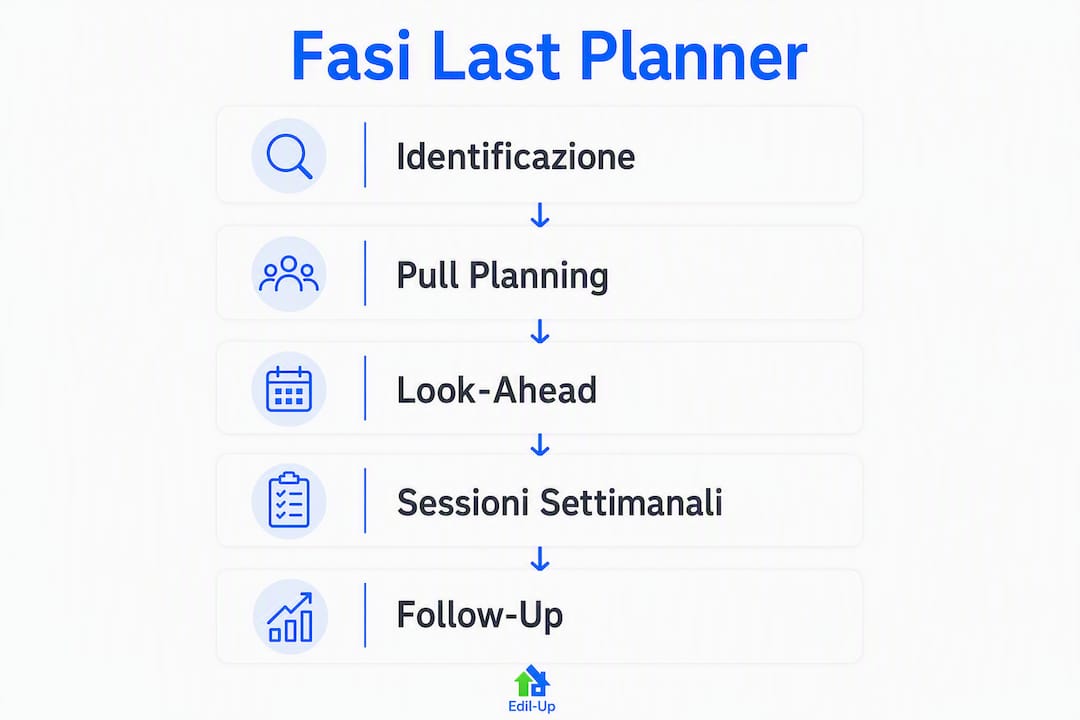
- Master scheduling (what should we do). Defines the project’s main milestones and high-level constraints. Participants include the project manager, works director and leaders of the main trades. Frequency: at project launch and in reviews at critical milestones.
- Phase scheduling (what will we do). A pull-planning session for a specific project phase. Teams build the plan backwards from the phase milestone. The last planners from every trade involved participate. Frequency: before each significant phase.
- Look-Ahead planning (what can we do). A typical 6-week operating window, updated weekly. It identifies constraints that could prevent planned activities and assigns responsibility for removing them. It is the heart of the make-ready process.
- Weekly work planning (what will we do this week). The team selects the activities to be completed the following week, only from those verified as constraint-free. It measures the PPC (Percent Plan Complete) for the week just ended and analyses the causes of variance.
- Daily huddle (what are we doing today). A brief meeting every morning (10–15 minutes). The status of ongoing activities is checked, newly emerged constraints are reported and the daily plan is adjusted. Foremen and the site coordinator participate.
How to structure the Look-Ahead and constraints log
The 6-week Look-Ahead is LPS’s most powerful tool for preventing interruptions. Every activity planned for the next 6 weeks is reviewed against six constraint categories: contracts, drawings, labour, materials, equipment and prerequisites.
| Constraint category | Practical example | Person responsible for removal |
|---|---|---|
| Contracts | Unsigned purchase order | Project manager |
| Drawings | Structural drawing not approved | Works director |
| Labour | Crew unavailable that week | Site manager |
| Materials | Concrete not ordered | Purchasing manager |
| Equipment | Crane occupied on another site | Logistics coordinator |
| Prerequisites | Previous activity not completed | Upstream trade last planner |
Percent Plan Complete (PPC) measures how many activities planned for the week were completed as expected. Well-organised teams typically achieve a high level of plan reliability. A very low value indicates a structural problem, not an issue of individual effort.
How to launch a lean pilot: from the first session to scaling
Implementing lean planning does not require reforming the entire organisation before starting. The most effective path begins with a pilot site, preferably one with a critical milestone in the next 8–12 weeks.
| Phase | Weeks | Main activities | Deliverable |
|---|---|---|---|
| Launch | 1–2 | Pilot selection, appointment of LPS facilitator, basic training (4–8 hours) | Facilitator appointed, team trained |
| First pull session | 3 | Phase scheduling for the critical milestone, creation of the Phase Schedule | Shared Phase Schedule |
| Look-Ahead activation | 4–5 | First 6-week Look-Ahead, active constraints log, assignment of responsibilities | Operational constraints log |
| Stabilisation | 6–8 | Weekly work plan, daily Daily huddle, PPC measurement | Documented PPC baseline |
| Analysis and scaling | 9–12 | Review of variance causes, process adjustments, expansion to other sites | Pilot report, scaling plan |
Roles to assign before starting:
- Last planners — the people directly responsible for the work. They make the operational commitments in the weekly work plan.
A typical agenda for the weekly meeting: 5 minutes to review the previous week’s PPC and analyse the causes of variance, 15 minutes for the Look-Ahead (updating constraints and assigning responsibility) and 10 minutes for the following week’s weekly work plan. Total: 30 minutes, no more.
What obstacles arise when adopting lean, and how can you overcome them?
The main barrier is not technical. According to LCI, industry fragmentation, adversarial relationships between stakeholders and the absence of shared accountability are the hardest obstacles to remove. A site where subcontractors see themselves as suppliers rather than partners will struggle to adopt LPS even with the best technical training.
The most common forms of resistance and practical countermeasures:
Fragmentation and traditional contracts. Lump-sum contracts incentivise each subcontractor to maximise its own return independently of everyone else’s flow. Where possible, introduce elements of risk and reward sharing (the IPD, Integrated Project Delivery, approach). Even without changing the contract, an informal agreement on shared milestone goals reduces tension.
Lack of trust between teams. Start with a pilot on a site where relationships are already reasonably good. Do not try to resolve longstanding conflicts with LPS: use LPS where a foundation of collaboration already exists and let the results build trust on other sites.
Lack of LPS skills. On-the-job training is more effective than classroom training. Pair an experienced facilitator with the team during the first 4–6 weeks. Building professional networks in the construction sector accelerates the transfer of skills between companies that have already tested the method.
Management resistance. Without management support, LPS becomes additional meetings with no impact. Present the pilot with clear KPIs (PPC baseline, number of constraints removed, milestone adherence) and schedule an 8-week review. The numbers speak for themselves.
Operational checklist: 11 best practices for lean planning
This list works both as a guide for launching a pilot and as an audit tool for anyone who wants to assess the maturity of existing planning. The first six items are priorities during the first 30 days; the remaining five are consolidated over the 3- to 6-month period.
First 30 days:
- Appoint the LPS facilitator with an explicit mandate from management. Without formal authority, the role will not work.
- Conduct the first pull session for the nearest critical milestone. Involve all last planners for the affected work.
- Activate the 6-week Look-Ahead with a shared constraints log and an owner for every open item.
- Start the weekly work plan every Monday morning. Maximum duration: 30 minutes.
- Measure and publish PPC every week, visible to all teams. Transparency is part of the method.
- Record the causes of variance for every activity not completed. It is not enough to know that something went wrong: you must know why.
Months 3–6:
- Analyse recurring causes of variance and turn them into traceable corrective actions. Without this cycle, LPS becomes bureaucracy.
- Introduce the Daily huddle (10–15 minutes every morning) with the foremen. It reduces interruptions and speeds up the resolution of constraints.
- Integrate the constraints log with materials management to anticipate critical deliveries and reduce waiting.
- Extend the pilot to a second site using the first site’s facilitator as an internal coach.
- Schedule a quarterly process review with management to adjust the method based on actual data.
What digital tools and KPIs are needed to support LPS?
Analog tools—the sticky-note wall and physical boards—work well in the early stages and on small sites. As the project grows or teams are spread across multiple sites, the transition to digital tools becomes necessary to maintain shared visibility and traceability of constraints.
The features a platform should have to support LPS:
- Digital pull-planning boards with views by phase and week
- Constraints log with owner, due date and resolution status
- Real-time PPC dashboard with weekly history
- Automatic notifications for due constraints or at-risk activities
- Offline mobile access for foremen on site
- Integration with document management (drawings, permits, purchase orders)
- Exportable KPI reporting for management reviews
The essential KPIs to monitor:
- PPC (Percent Plan Complete): activities completed as planned divided by planned activities. Target: a high completion rate for mature teams.
- Average constraint-removal time: the number of days between identifying a constraint and resolving it. A high value signals organisational bottlenecks.
- Critical-activity lead time: actual versus planned time for activities on the critical path.
- LEM (Lavoro, Equipaggiamento, Materiali) utilisation: percentage of productive utilisation compared with available hours/resources.
When evaluating a platform, the most important criterion is ease of use in the field. A tool that foremen do not open is worse than an Excel spreadsheet. Check that the interface works on smartphones, does not require a continuous connection and that the constraints log can be updated in less than two minutes. A practical overview of digital tools for construction sites helps compare the options available on the Italian market.
How Edil-up provides practical support for lean planning
Edil-up is a platform designed for the Italian construction sector that integrates project management, communication between companies and KPI monitoring in one environment. For anyone launching a lean pilot, this means being able to activate the most critical functions immediately without integrating separate tools.
The practical feature-to-operational-benefit mapping:
- Centralised project management — → shared visibility of milestones, activities and progress status, without scattered emails or parallel Excel spreadsheets.
For a lean pilot during the first 12 weeks, the modules to activate immediately are project management (for the Look-Ahead and constraints log), team communication (for the Daily huddle and reporting constraints) and KPI monitoring (for weekly PPC). Impact is measured by comparing the week 1 PPC baseline with the week 8 result: an increase in the range of 15–20 percentage points during the first 8 weeks is a sign that the system is working. Learn more about the benefits of centralised project management to understand which features to activate in your specific context.
Key points
Lean planning on a construction site produces measurable results only when the Last Planner System is adopted as a complete system of conversations, not as a set of additional meetings.
| Point | Details |
|---|---|
| Start with a pull session | Bring together the last planners for the next milestone and build the Phase Schedule backwards in less than half a day. |
| 6-week Look-Ahead | Update the constraints log every week and assign an owner to each open item before it affects the site. |
| Measure PPC every week | High-performing teams typically achieve PPC values in the 75–90% range; a very low value indicates a structural problem. |
| Analyse the causes of variance | Recording completion alone is not enough: the causes of non-delivery are the raw material for continuous improvement. |
| Edil-up in the pilot | Activate project management, communication and KPI monitoring to support LPS from week 1 without separate tools. |
What I have seen really work on lean construction sites
The most common mistake in failed pilots is starting with meetings instead of leadership. A weekly work plan conducted without the explicit support of the works director or owner quickly becomes an appointment that foremen stop attending after three weeks. The method works when people with authority use it to remove constraints, not merely to monitor completion.
The most effective training does not take place in a classroom. It takes place during the first pull session, when an experienced facilitator guides the team through the process and the last planners see for themselves how the plan changes when they build it. That first session is worth more than two days of theoretical training.
One pattern often seen on sites that adopt LPS with discipline is that the most frequent causes of variance during the first weeks are nearly always the same: unavailable materials and unapproved drawings. This is no surprise. It confirms that the system works: it makes visible problems that already existed but that no one had ever measured. From that point on, solving them becomes an organisational priority rather than a random emergency.
Edil-up: the platform for your lean construction site
Anyone launching a lean pilot needs a tool that works from day one, without months of configuration. Edil-up offers Italian construction companies a centralised platform covering exactly the critical functions for LPS: project management with shared visibility, direct communication between teams and subcontractors, KPI monitoring and integrated documentation.
The concrete difference compared with generic tools is that Edil-up is built for construction: its workflows, roles and notifications reflect the reality of the construction site, not that of an office. For every active subscription, the platform calculates the environmental savings generated and plants trees—a tangible added value for companies that need to report the ESG impact of their projects.
The next step is simple: visit the centralised project management page to see how Edil-up integrates with your lean process, or consult the pricing plan to choose the module best suited to your pilot. You can also explore how to digitalise your construction site to prepare the ground before the first pull session.
Sources and useful resources for further reading
For anyone who wants to go beyond this guide and build solid expertise in LPS and lean construction, these are the most authoritative resources available:
- Last Planner System Standard Work (LCI 2023): the official reference document from the Lean Construction Institute for operational implementation of LPS. It contains detailed descriptions of the five conversations, Look-Ahead templates and guidelines for measuring PPC.
- Last Planner System® Introduction & Principles (LCI): a concise introduction to LPS principles, useful for initial team training and presenting the method to management.
- Last Planner® System – P2SL, UC Berkeley: an academic overview of the production control system, with references to the original research by Glenn Ballard and Greg Howell.
- Lean Construction Institute (LCI): the main hub for international lean construction resources, research and communities of practice.
- LPS: the Lean system for successful construction companies (The Lean Six Sigma Company Italia): an operational summary in Italian of Last Planner System adoption, with examples applicable to Italian companies.
- Lean construction: how to improve the planning process (Oracle Italia): a practical guide to transitioning from analogue boards to digital tools, discussing the advantages and limitations of both approaches.
- The benefits of centralised project management (Edil-up): a reference page explaining how Edil-up supports lean management and how to request a platform demo.