
What are variations during construction and what is the regulatory framework?
Variations during construction are modifications to a public works contract permitted while the works are being performed, without initiating a new tender procedure, provided they do not alter the contract’s overall nature and the additional price does not exceed 50% of the initial value; this limit is not merely a percentage cap: it is intended to prevent artificial splitting and misuse of the mechanism.
The central regulatory reference is D.Lgs. 36/2023, whose art. 120 governs the conditions and boundaries within which a contract may be modified during performance, as explored in Bando Parco Agrisolare 2023 – D.M.L. Idee | Impianti Fotovoltaici. Art. 106 establishes the general requirements for legality: the modification must be necessary, must not radically alter the subject matter of the contract, and must comply with the financial limits set by law. The corrective decree D.Lgs. 209/2024 subsequently refined art. 120 by inserting paragraph 15-bis and clarifying the conditions for non-substantial modifications.
The distinction between substantial and non-substantial variations is the first issue to resolve:
- Substantial variations: they modify the contract’s overall nature, exceed the permitted percentage thresholds, or would have required different procedures if known from the outset. They are prohibited and require termination of the contract and the launch of a new tender.
- Non-substantial variations: they fall within the exhaustive cases set out in art. 120, are covered by the project’s financial framework, and do not significantly alter the design content.
- Improvement variations: introduced by paragraph 15-bis, they allow modifications that improve functional or technological aspects without increasing costs, while keeping execution times and safety conditions unchanged.
The ANAC Resolution No. 523/2025 of 22 December 2025 made clear that variations must remain an exceptional instrument, grounded in objective and verifiable requirements. MIT has expressed similar opinions, reiterating that the mechanism cannot become a disguised redesign process.
Who authorizes variations and what are the responsibilities?
The Responsabile Unico del Procedimento (RUP) is the person who authorizes variations during performance, including those proposed by the Works Director. This is not a formal delegation: the RUP is responsible for compliance with regulatory limits and the accuracy of the documentation produced.

The Direttore dei Lavori (DL) performs the investigative and advisory function. The DL provides the RUP with the technical analysis needed to verify whether the conditions under art. 120 exist, proposes variations with the related technical assessments and, in cases involving unforeseen circumstances, describes the factual situation to demonstrate that it is not attributable to the contracting authority. The DL may independently order detailed modifications that do not change the contract amount, notifying the RUP in advance.
The designer becomes involved when the modifications require a revision of the documents: the DL obtains the designer’s opinion before drafting the reasoned report. Following the 2024 corrective decree, design contracts must include clear clauses concerning the designer’s liability for errors or omissions that jeopardize completion of the works.
- The RUP coordinates the entire authorization process and ensures transmission to ANAC when required.
- The DL prepares the variation assessment and the reasoned technical report.
- The designer gives an opinion on design modifications.
- The contractor may propose improvement variations conceived by the contractor, without increasing costs, through a technical assessment accompanied by an economic evaluation.
Synergy between the DL and RUP, supported by accurate analytical documentation, is what distinguishes a properly managed variation from one exposed to challenges during an audit.
What conditions justify a variation during construction?
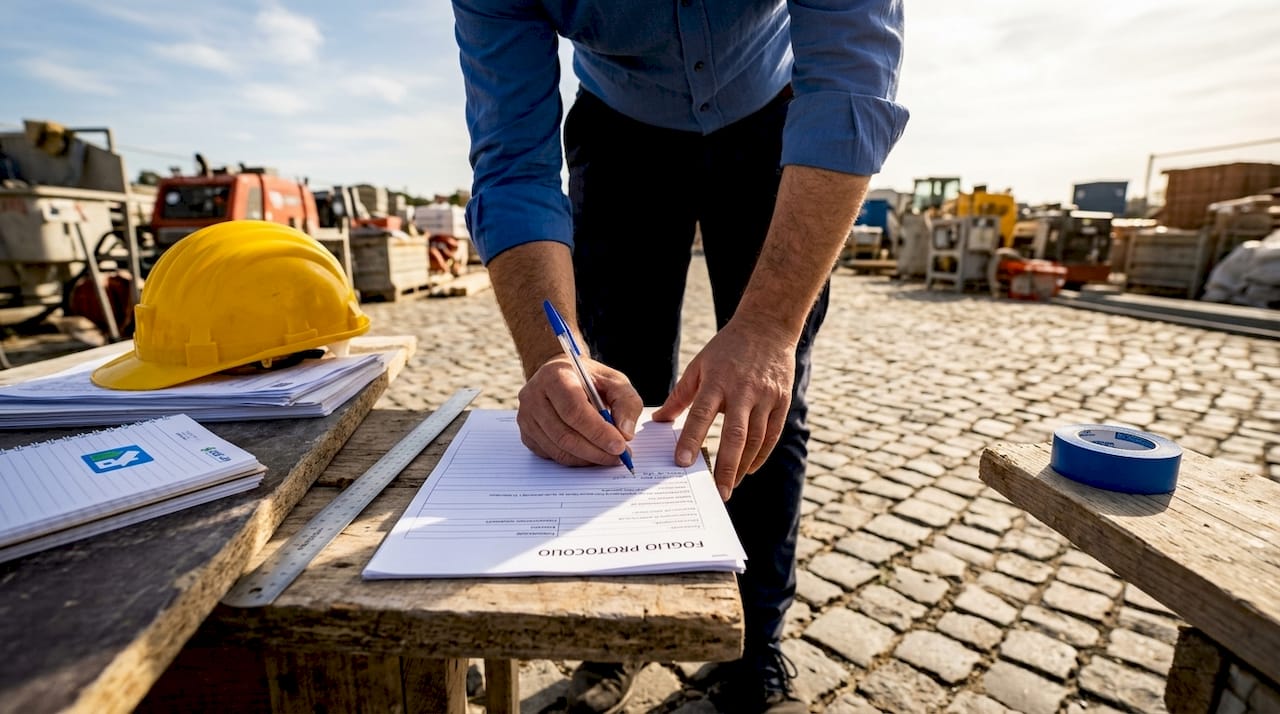
Art. 106 of D.Lgs. 36/2023 exhaustively identifies the admissible cases. It is not enough for the modification to be useful or convenient: one of the conditions established by law must apply.
The main cases are:
- Unforeseen and unforeseeable circumstances for the contracting authority at the time of design, such as archaeological discoveries, subsequent regulatory changes, or ground conditions that could not be detected. The 2024 corrective decree clarified that an adverse weather event is not sufficient unless it directly affected the subject matter of the contract.
- Design errors or omissions, within the limits of the quinto d’obbligo. Paragraph 15-bis introduces the obligation to consult the designer and contractor before proceeding.
- Non-substantial modifications covered by the financial framework, including technically, economically, or time-wise equivalent or improved solutions, including those made possible by materials or technologies unavailable at the design stage.
- Improvement variations proposed by the contractor, without reducing the qualitative or quantitative performance requirements established in the design.
The 50% limit of the original contract value applies to the cases under letters b) and c) of paragraph 1 of art. 120. However, formal compliance with this threshold is not sufficient: the rule expressly prohibits subsequent modifications intended to circumvent the Code, excluding any artificial splitting.
Advice: in the technical report, the DL must demonstrate not only that the circumstance was unforeseeable, but also that it is not attributable to the contracting authority and that the modification is strictly necessary. Generic reasoning exposes the variation to immediate challenges during ANAC verification.
How does the procedure for a variation during construction work?
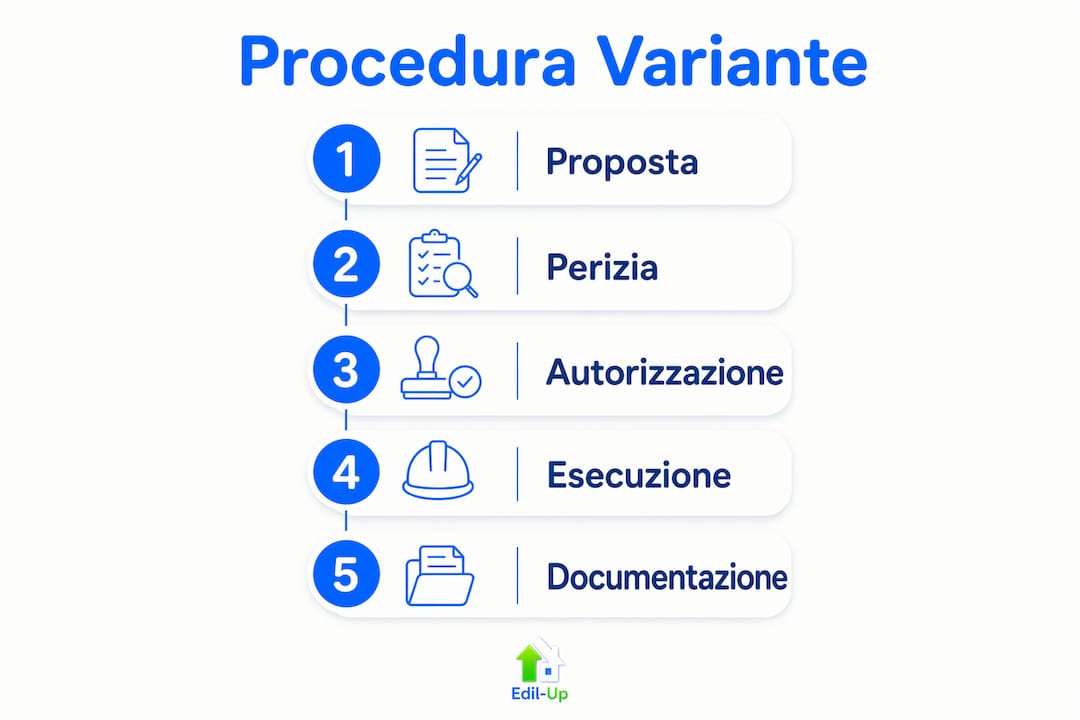
The procedure follows precise stages, with responsibilities and timelines defined by the Code and Annex II.14.
| Stage | Responsible party | Timing |
|---|---|---|
| Proposal and technical assessment | Works Director | When the need arises |
| Designer’s opinion | Designer | Before the reasoned report |
| Reasoned report and approval | RUP / Contracting authority | Before execution |
| Submission to ANAC (if >10% and above the European threshold) | RUP | Within 30 days of approval |
| Agreed new prices (if new categories) | DL and contractor jointly | Before entry in the accounts |
For contracts whose amount is equal to or above the European relevance threshold, variations exceeding 10% of the original amount must be submitted by the RUP to ANAC within 30 days of approval, through the «Amministrazione trasparente» section, with the executive design, validation document, and RUP report attached. The documentation must be retained in the «Varianti in corso d’opera» subsection under «Bandi di gara e contratti». All communications take place exclusively by electronic means, pursuant to the ANAC President’s communication of 30 January 2025.
When the variation introduces new work categories or materials not previously included, agreed new prices are established through consultation between the DL and contractor and approved by the RUP. If the contractor does not accept the new prices, the contracting authority may order performance on the basis of those prices; failure to enter a reservation in the accounting documents is equivalent to final acceptance.
BIM transforms this procedure from a paper-based process into an information-based one: every modification is updated in the shared digital model, tracked with reference to the specific revision, and linked to its impacts on costs, time, and coordination between disciplines. Centralized project management makes it possible to maintain consistency between project versions and reduce the risk of information mismatches between the site and technical office.
Common issues and recommendations for proper management
ANAC Resolution No. 523/2025 examined an emblematic case: the construction of a new hospital facility in which a second variation assessment, formally justified by the Covid-19 emergency, introduced a significant increase in volume, new high-complexity departments, and an overall reorganization of the hospital layout, with a significant financial increase. The contractual deadline slipped by many years. ANAC concluded that the variation did not comply with art. 106: referring to the emergency was not sufficient to justify planning and strategic decisions.
The most recurring issues in managing construction variations are:
- Insufficient reasoning in the DL’s technical report: this exposes the variation to immediate challenges.
- Artificial splitting of modifications to remain below percentage thresholds: expressly prohibited by the Code.
- Removal of essential work to formally remain within the 50% limit: this produces a facility that is not immediately functional and depends on future funding.
- Multi-year delays attributable to design stoppages linked to defining the variation: incompatible with the exceptional nature of the mechanism.
- Failure to notify ANAC within the deadlines applicable to above-threshold contracts.
ANAC Resolution No. 523/2025 clarifies that formal compliance with percentage limits is not sufficient to legitimize a variation that substantially affects the configuration of the facility and the balance of the award.
To avoid these errors, documentation must be analytical from the outset: each assessment must reconstruct the causal link between the subsequent circumstance and the requested modification, with precise references to the original design documents. Communication among the parties involved must be traceable and timely, preventing decisions from remaining informal or unsupported by documentary evidence.
Adopting BIM in public works enables complete traceability of variations, linking each modification to specific events and facilitating subsequent checks. Construction-site digitalization is not merely an operational advantage: it becomes a governance tool that reduces the risk of challenges and accelerates authorization processes.
Edil-up provides construction professionals with tools to manage documentation, communications, and project monitoring in a centralized, traceable way, with features designed to support the management of contract modifications during construction as well.
Key points
Variations during construction are permitted only under the exhaustive conditions established by law: analytical reasoning, compliance with quantitative limits, and documentary traceability are the three pillars of compliant management.
| Point | Details |
|---|---|
| 50% limit of the contract value | The overall increase may not exceed 50% of the original contract; artificial splitting is prohibited. |
| Communication to ANAC within 30 days | For contracts above the European threshold, variations exceeding 10% must be submitted electronically within 30 days of approval. |
| Central role of the RUP and DL | The RUP authorizes and the DL investigates: their cooperation is decisive for the legality of the variation. |
| Mandatory analytical reasoning | The technical report must demonstrate the unforeseeable nature, non-attributability, and necessity of the modification. |
| BIM and digitalization as control tools | The information model tracks every modification in real time, linking it to impacts on costs, time, and coordination. |