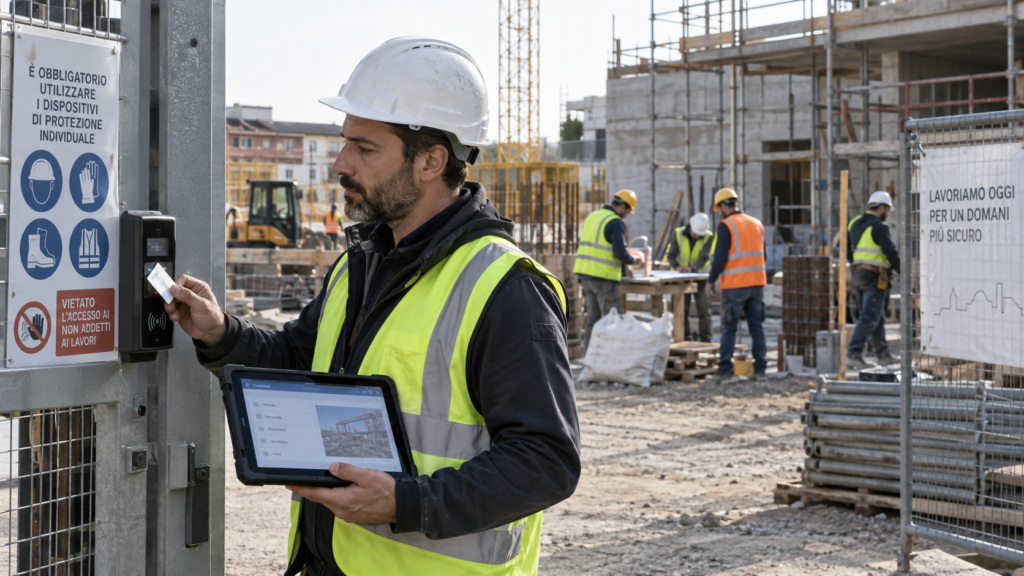
At the end of the month, the administration team asks for the hours. The foreman checks their own sheet, retrieves a few messages, calls two people to verify a replacement, and tries to remember who was present at a particular jobsite three weeks earlier.
This is still common in small and medium-sized construction companies. The problem is not just recording arrivals and departures correctly. Poorly structured construction site attendance management makes it harder to organize crews, compare hours with progress, manage exceptions, and quickly determine who was responsible for a particular activity.
Going digital can help, but introducing a badge or an app without changing the process may simply add another tool to the old spreadsheets, chats, and phone calls.
That is why we suggest a different approach: 30 days to make attendance records more reliable, crews easier to understand, and operational responsibilities clearer, starting with a single jobsite and a few measurable indicators.
Why start with attendance: the simplest data can tell you much more
Knowing who is present may seem like basic information.
But when linked to the right context, it helps answer important operational questions:
- which crew is working on a particular phase;
- how many hours have been used for a job;
- who was present when an event occurred;
- which people have been moved between jobsites;
- where more resources than expected are being used.
The value, therefore, is not in clocking in itself.
It lies in linking attendance to a person, a crew, a jobsite, and a precise moment in the work.
This does not mean confusing attendance tracking with safety management. The obligations remain separate and must be handled under the applicable legislation. The Italian Ministry of Labour summarizes, among others, employers’ obligations regarding risk assessment, training, PPE, emergency organization, and supervision.
Days 1–7: assess the situation before changing anything
The first week is not for choosing software.
It is for understanding how the process actually works today.
Choose one or two jobsites and collect everything used to reconstruct attendance:
- paper sheets;
- Excel;
- time cards;
- messages sent to foremen;
- any apps already in use;
- corrections made by the administration team.
Then observe the real problems.
How many records are corrected?
How long does the administration team take to close the summary?
How often does the foreman have to confirm the hours afterward?
How is someone handled if they arrive late, change jobsites during the day, or forget to record their attendance?
Do not try to solve everything yet.
Create a baseline.
Three KPIs are enough to get started
A small or medium-sized business does not need fifty indicators.
For the first week, three may be enough:
- records requiring no corrections: how many days are closed without manual intervention;
- administrative time: how much time is used each week to reconstruct and correct attendance records;
- exceptions: how many missing, questionable, or unverified records are generated.
Record the initial values.
They will provide the comparison point on day 30.
Days 8–14: make recording so simple that no one needs to work around it
The second week is the time to test the new workflow.
The most important criterion should not be the number of available features.
It should be this:
how easy is it to record attendance correctly during a normal workday on a jobsite?
A digital badge or a construction management app can be useful, but only if the process is clear to the people who have to use it.
Test the system on a single jobsite for several days and observe:
- how long recording takes;
- how many people ask for assistance;
- what happens when there is no connection;
- how forgotten records are handled;
- how errors are corrected;
- whether the office still has to manually enter the same data elsewhere.
If the new method requires people to complete the old record as well “just to be safe,” you have created duplicate work.
And that is exactly what must be avoided.
A digital badge does not mean biometric recognition
It is important to clearly distinguish between the two concepts.
A digital attendance system can be built without using fingerprints, facial recognition, or other biometric data.
The Italian Data Protection Authority also reiterated in 2026 that the legislation in force does not permit the use of employees’ biometric data for ordinary attendance tracking at work.
Therefore, when choosing a solution, it is also important to assess what data is collected, why it is necessary, and how it is processed.
Days 15–18: turn attendance into an organized crew
Once attendance data has become more reliable, the next step is to understand how people are organized.
It is not enough to know that Mario, Luca, and Paolo are present.
You need to know:
- which crew they belong to;
- who coordinates them;
- which phase they are working on;
- who steps in if an operational problem arises;
- who is authorized to change the assignment.
This is the time to clarify roles such as foreman, materials coordinator, or other operational duties defined by the organization.
A useful rule is to describe each responsibility in one sentence.
If it takes three pages to explain who has to do what, the process is probably too complex.
Clear responsibilities do not mean assigning legal responsibilities at random
It is important to distinguish between internal operational organization and responsibilities established by law.
Assigning someone the task of monitoring an operational workflow does not automatically change roles, delegations, or legal responsibilities.
In safety matters, for example, the Italian Ministry of Labour expressly distinguishes between delegable and non-delegable obligations of the employer.
Software can therefore make roles and activities more visible.
It does not rewrite the law or replace the roles established by law.
Days 19–22: connect crews, documents, and communications
At this point, we know who is present and how the crews are organized.
The next step is to prevent this information from remaining isolated from the rest of the jobsite.
A crew must be able to quickly access the documents needed for its work.
The person responsible must know whether an update has arrived.
Important communication should not get lost in a general chat.
This is where attendance, jobsite documents and responsibilities begin to become parts of the same process.
A very simple routine could include:
- checking who is present;
- reviewing the day’s activities;
- any new documents or revisions;
- problems that are still open;
- a brief final report from the foreman.
A few minutes each day can prevent many follow-up phone calls.
Days 23–26: connect hours to the work actually produced
This is when attendance data begins to become genuinely interesting from an economic perspective as well.
Knowing that a crew worked 200 hours is useful.
Knowing that those 200 hours were used on a particular phase allows you to compare them with what had been planned.
For financially significant activities, it may be enough to compare:
- planned hours;
- actual hours;
- planned progress;
- actual progress.
If 70% of the planned hours have already been used but the phase is only halfway complete, there is a signal to analyze.
This does not automatically mean that the crew is working poorly.
There may have been an unexpected issue, an underestimated quantity, or different working conditions.
The value of the data is that it allows you to ask the question before the project is finished.
To explore this connection further, you can also read the guide on jobsite cost control: estimates, budgets, and progress.
Days 27–30: remove what does not work and standardize what does
The final four days are not for adding new features.
They are for simplifying.
Compare the data with the initial baseline.
Have corrections decreased?
Is the administration team spending less time?
Are foremen receiving fewer follow-up requests?
Do people understand how to handle an exception?
If a step continues to cause problems, do not defend it simply because it is new.
Change it.
The aim is to reach day 30 with a procedure simple enough to be used normally even after the implementation project has ended.
The 5 mistakes that make the project fail
1. Keeping the dual system for months.
Digital tools plus paper plus Excel often means three versions of the same information.
2. Assuming that people are always the problem.
If everyone forgets the same step, the process may be poorly designed.
3. Failing to plan for exceptions.
After-hours entry, an unavailable device, moving between jobsites: each needs a procedure.
4. Introducing too many features.
During the first month, the main needs are attendance, crews, responsibilities, and a small amount of operational information.
5. Failing to appoint an owner.
When no one is responsible for the process, every problem inevitably returns to the administration team.
Three realistic scenarios: what changes in practice
Renovation company with two jobsites.
The main problem is reconstructing hours at the end of the month. The company tests the new method on a single jobsite and measures how much administrative time is recovered.
Small or medium-sized business with several specialized crews.
Attendance is progressively linked to crews and phases. Management can then understand more quickly where more hours are being used than planned.
Company that frequently uses contractors and external crews.
The main benefit is organizational: knowing who is present, which company they belong to, and who represents them as the contact person reduces the number of phone calls needed to reconstruct this information.
These are not guaranteed results or percentages to promise in advance.
They are concrete problems against which the effectiveness of the new process can be measured.
The topic is current: construction-site badges and labor traceability
The traceability of people present on construction sites is gaining increasing importance in institutional discussions as well.
In its monitoring of the first quarter of the Piano integrato salute e sicurezza 2026, the Italian Ministry of Labour refers to activities launched to define procedures relating, among other things, to construction-site badges and monitoring labor flows through processed technologies and information.
This does not mean that every badge used internally by a company automatically qualifies as a tool required or recognized by law.
It does, however, mean that identification, organization, and traceability of attendance on construction sites are becoming increasingly central issues.
Where a Construction Operating System fits in
An app dedicated exclusively to attendance can solve one specific problem well.
But attendance becomes even more useful when it can be read alongside other operational information.
Who is the person?
Which company do they work for?
Which jobsite are they assigned to?
Which crew are they part of?
What activities are they carrying out?
This is the logic behind the concept of a Construction Operating System: people, jobsites, documents, phases, and communications begin to share the same operational context.
How Edil-Up fits into the process
Edil-Up is developed with precisely this approach.
Attendance management is not viewed as completely isolated data, but as part of an environment that includes jobsites, collaborators, crews, phases, documents, roles and permissions, communications, and operational information.
For construction companies, the benefit should be reducing the number of steps needed to reconstruct what is happening in the field.
The software does not make decisions instead of the owner or foreman.
It makes it easier to make those decisions using information that is already organized.
The 30-day checklist
- Choose one or two pilot jobsites.
- Measure corrections, exceptions, and administrative time before the change.
- Test a simple, non-invasive recording system.
- Define how to handle forgotten records and exceptional cases.
- Organize people into identifiable crews.
- Assign clear operational responsibilities.
- Gradually connect attendance, documents, and phases.
- Compare hours used with progress on the main activities.
- Collect feedback from the field and office.
- Eliminate steps that continue to create duplicate work.
What to measure after 60 days
Day 30 is used to determine whether the process works.
Day 60 shows whether it has become a habit.
Check again:
- percentage of records corrected without manual intervention;
- time spent by the administration team;
- number of exceptions still open after 24 or 48 hours;
- requests for clarification sent to foremen;
- difference between planned hours and hours used on the main phases.
Do not measure how many times the app is opened.
Measure how much manual work and uncertainty have been eliminated.
Authoritative sources for further reading
- Italian Ministry of Labour – employers’ health and safety obligations;
- Italian Ministry of Labour – 2026 monitoring of construction-site badges and labor flows;
- INAIL – construction and safety on temporary or mobile construction sites;
- EU-OSHA – coordination and responsibilities on temporary or mobile construction sites;
- Italian Data Protection Authority – attendance tracking and workers’ biometric data.
Conclusion: the real goal is not simply knowing who is present
Attendance is only data.
Its value emerges when it helps you better understand how the jobsite is operating.
Who is in the field.
With which crew.
On which activity.
With which responsibilities.
And with what impact on the planned work.
You cannot completely transform a company’s organization in 30 days.
But you can build something much more important: a process simple enough to keep working from day 31 onward.
The Edil-Up Team