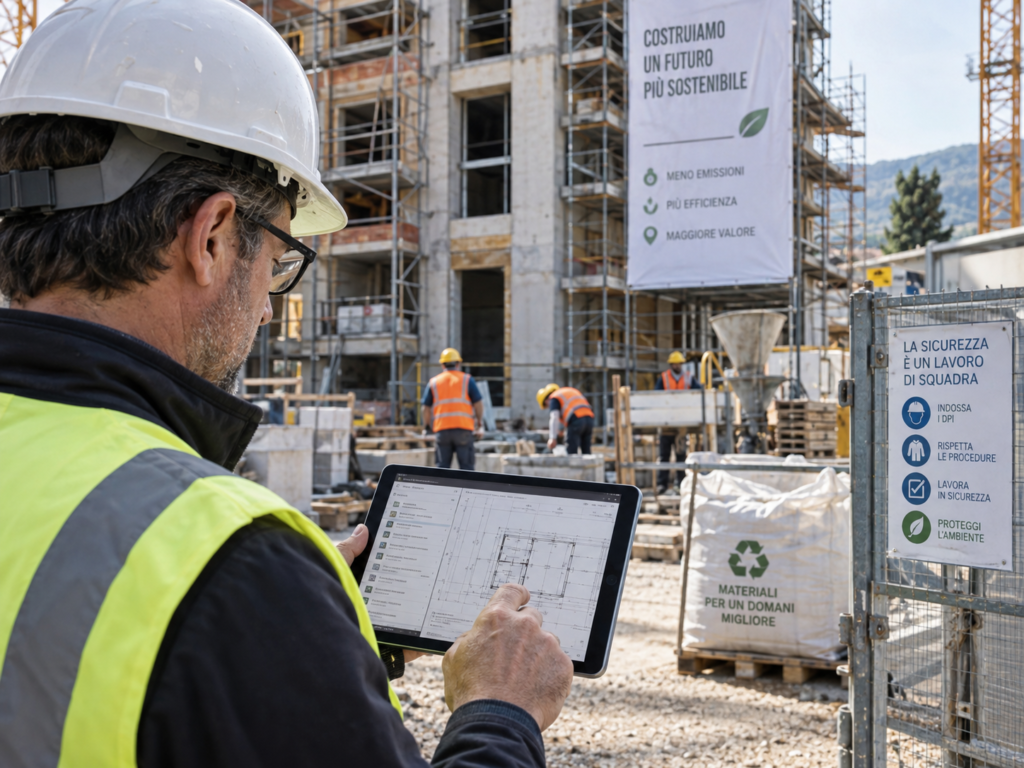
A day on a construction site still often starts with an A4 sheet in hand: the work schedule, an updated drawing, a materials list or a message from the office. Then that sheet passes from the technician to the site manager, ends up in the van, is reprinted after a change and, a few days later, someone has to determine whether that copy is still valid.
This is one reason why construction digitalisation should not be viewed simply as moving from paper to PDF. The real goal is to reduce unnecessary steps: fewer printouts, fewer trips to deliver documents, fewer duplicate versions and an easier way to get the right information to the person who needs it. For an SME, the benefit can be operational, financial and environmental at the same time.
The hidden problem: paper, wrong versions and trips no one measures
Consider an SME managing several construction sites at the same time. Every approved document is printed for the office, delivered to the site manager and perhaps also kept in a folder on site. When a measurement, technical specification or variation changes, the cycle starts again: a new email, a new printout, a new message and, in some cases, someone who has to physically deliver the updated documentation.
The cost is not just paper and toner. You also have to consider people’s time, travel, fuel, the calls needed to verify which version is valid and, above all, the risk that someone continues working with outdated information.
These activities rarely appear in the accounts under a line called “document inefficiency”, but repeated for months and across several sites, they can become a significant part of administrative and operational work.
The turning point: why digital and sustainable are becoming the same journey
The transformation does not concern individual companies alone. The European Commission’s Construction Transition Pathway identifies the green and digital transitions as two fundamental directions for building a more competitive and resilient European construction ecosystem.
There are also increasingly structured references on sustainability. Level(s), the European framework for sustainable buildings, promotes a life-cycle approach and the measurement of aspects such as carbon, materials, water, costs and building value.
For an SME, this does not mean suddenly turning every construction site into a complex ESG project. It means starting to collect better data and reduce very tangible inefficiencies: unnecessary printing, avoidable travel, duplication and rework.
The effective choice: not another app, but an operating environment
One of the most common mistakes in digitalisation is adding a new tool to all the ones already in use. One app for documents, another for attendance, WhatsApp for communications, Excel for the budget and yet another piece of software for managing tasks.
The risk is clear: paper is reduced, but digital fragmentation increases.
This is where the concept of a Construction Operating System comes in: an environment in which sites, people, phases, documents, attendance records and communications can share the same operating context.
Structured information management is also recognised in international standards. ISO 19650-1 addresses principles such as organising, exchanging, recording and versioning information throughout the life cycle of built assets.
A practical method: start with three changes, not thirty features
An SME does not need to revolutionise everything on day one. It can start with three very simple changes.
First: move the documents actually used in the field into a shared environment for each site, progressively eliminating unnecessary copies.
Second: define roles and permissions. The site manager must be able to see what is needed in the field, the technical office must be able to update documentation, and suppliers or subcontractors should access only the information necessary for their work.
Third: link important communications to the context in which they arise. A design change should not remain only in a chat: it must be traceable to the site, phase and relevant document.
Technology comes later. The process comes first.
A concrete example: the daily sheet that stops travelling
Take the daily activity list. In a traditional process, it is prepared in the office, printed and delivered to the person in charge. If a priority changes during the day, a call, message or new document version follows.
With a digital workflow, the same list can be updated in the project and viewed directly on a tablet or smartphone. The site manager sees the revision, records progress and can attach photographs or notes without creating a new chain of documents.
The difference may seem small, but the principle is important: information no longer has to be physically transported to the work. It must be available where the work takes place.
An immediate benefit: fewer avoidable trips
Some trips between the office and the site are obviously essential. Inspections, coordination, checks and technical activities require physical presence.
Other trips, however, exist only because a document must be collected, a signature verified or information is unavailable in the field.
Reducing these journeys does more than recover time. It also has environmental significance. According to the European Environment Agency, road transport accounted for approximately 73% of greenhouse-gas emissions from the transport sector in the EU in 2023. A single company’s contribution will naturally be much smaller, but measuring avoided operational kilometres makes it possible to turn an organisational improvement into a concrete figure.
Practical sustainability: measure before communicating
Saying “we are more sustainable” is of little value if there is no data.
An SME can instead start with extremely simple indicators: number of monthly printouts, paper consumption, kilometres travelled solely for paperwork and documents, number of reprints caused by revisions and the amount of documentation distributed digitally.
After three or six months, it will be possible to compare the new situation with the initial baseline. Only then can the reduction become part of an environmental report or communication to customers and clients.
This approach is much more credible than a generic promise because it turns sustainability from a slogan into a measurable process.
Costly mistakes to avoid during digitalisation
The first mistake is digitalising exactly what was previously done on paper. If a procedure required six unnecessary steps, turning them into six screens does not solve the problem.
The second is introducing tools that are too complex. The site manager must be involved from the start: if retrieving a drawing on a tablet takes longer than calling the office, they will inevitably continue calling.
The third is maintaining too many sources at once. If the official version exists in the cloud but is still sent by email, WhatsApp and on paper, after a few weeks the same question will return: “which one is correct?”
Finally, roles, permissions and information security must not be overlooked. The ISO 19650 series also includes a specific approach to secure information management: ISO 19650-5 addresses the principles of security-minded information management.
A quick calculation: understand tomorrow what the current process costs
To assess whether the change makes sense, there is no need to start with a complex business case.
Take a typical week and record:
- how many printouts are produced for the sites;
- how many times a document is reprinted because it was updated;
- how many trips are made mainly for paperwork or documentation;
- how much time is spent looking for the correct version;
- how much rework results from obsolete or incomplete information.
It is not necessary to monetise every single data point immediately. Simply seeing how many hours and steps the process absorbs already makes it much easier to decide where to intervene.
Where Edil-Up fits in
Edil-Up was created to reduce precisely this kind of fragmentation. The platform is being developed as a Construction Operating System, an environment in which construction-site management, phases, documents, collaborators, attendance, communications and the professional network can progressively work together.
For day-to-day management, this means keeping documents and information in the site context, defining roles and permissions, and allowing authorised people to access the information they need from the field as well.
The goal is not to eliminate paper because “digital is better”. It is to eliminate the steps in which paper, phone calls, emails and duplicate files add no value to the work.
Construction companies can therefore start with simple operational needs and progressively expand the system without having to digitalise everything at the same time.
On-site scenario: the site manager with a tablet
Imagine a site manager who, instead of carrying several paper copies, views the documents needed for the current phase on a tablet. If the technician updates a specification, the new version is made available in the project and the previous one remains identifiable in the history.
When a non-conformity arises, the manager can record it, attach photographs and allow the office to review it without waiting for the return to the office. The supplier can receive only the documentation necessary for its intervention.
The benefit is not the tablet. The benefit is that the field and the office are finally working from the same information.
Digital documents, administration and security: pay attention to responsibilities
Digitalisation can make documents and information easier to find, but it does not replace statutory obligations or the responsibilities of the people involved.
For health and safety matters, it is therefore advisable to refer to the official guidance of the Italian Ministry of Labour and Social Policies.
A digital environment can help keep documents, attendance records and communications more organised and accessible. It does not automatically make a non-compliant process compliant, nor does it replace assessments, training, checks or obligations required by law.
Essential checklist: get started without major investment
- Identify the three activities that generate the most printouts or trips.
- Choose a single pilot site.
- Put the documents actually used in the field online.
- Define one rule for versions and revisions.
- Set simple roles and permissions.
- Train the site manager directly on a tablet or smartphone.
- Measure printouts, kilometres avoided and time saved every month.
How to turn the results into a competitive advantage
When improvements are measured, they can also be used beyond the construction site.
A documented reduction in printouts, administrative travel or rework can be included in internal reporting and support how the company presents itself to customers, partners and clients.
The important word, however, is documented. Sustainability and digitalisation become commercially credible when comparable data over time supports the claims.
Construction costs: why operational efficiency matters
Reducing paper and travel will not, naturally, solve the problem of construction costs, but it helps eliminate small inefficiencies that add up in project management.
To observe the broader price context, you can consult the construction cost indices published by ISTAT. These are macroeconomic reference data and do not replace the budgets, estimates and final accounts of an individual company.
Precisely when materials and labour are under pressure, recovering organisational inefficiencies becomes even more important.
Why this method is particularly suitable for construction SMEs
An SME can rarely stop operations for months to implement a new system. It needs to see quickly whether something works.
That is why the most effective method is often incremental: one site, a few documents, a few people and one specific problem to eliminate.
When the process works, expand it.
Start with documents and revisions. Then communications. Later, attendance, phases, budgets and other operational information.
Digitalisation should grow with the company, not force the company to adapt to an unnecessarily complex system.
Authoritative resources for further reading
- European Commission – Construction Transition Pathway
- European Commission – Level(s), framework for sustainable buildings
- ISO 19650-1 – information management in construction
- European Environment Agency – emissions and European mobility
- Ministry of Labour – health and safety obligations
- ISTAT – construction cost indices
An operational conclusion: the first move to make tomorrow
Tomorrow morning, choose a site and do something very simple: count how many times, over the past week, someone had to print, reprint, search for or physically transport a document.
Then choose one of those steps and digitalise it completely, from the office to the field.
Measure what changes for one month.
True construction digitalisation does not begin when we purchase software. It begins when we eliminate an unnecessary step from everyday work.
To learn more about the project and the vision behind the platform, explore the Edil-Up project or compare tools and approaches in the guide to construction site management software.
The Edil-Up Team