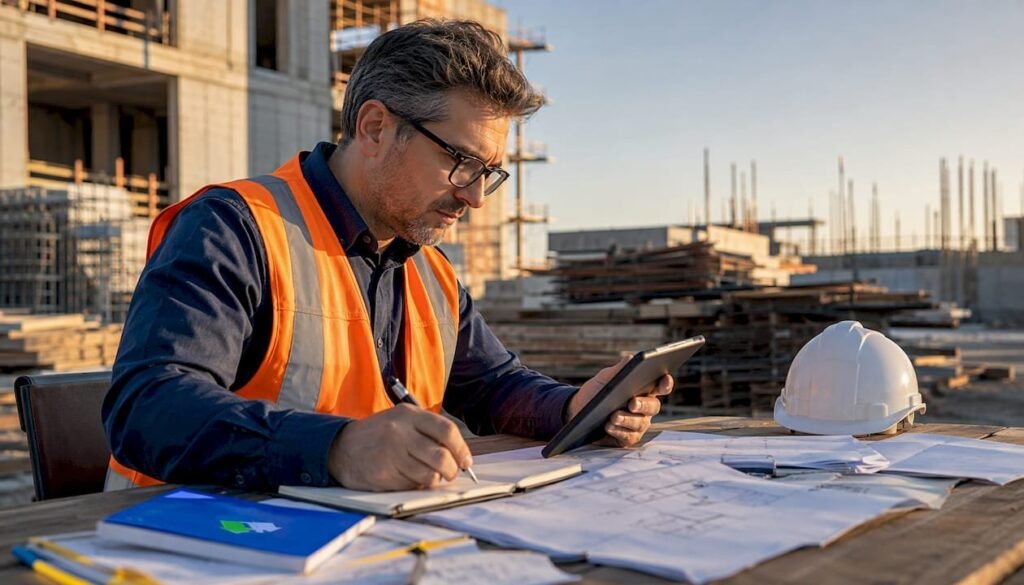
Artificial intelligence applied to construction sites automates safety checks, progress monitoring and resource planning. It is not a promise for the future: Italian construction companies are already using it to reduce delays, identify risks before they become accidents, and keep costs and materials under control.
To get started right away, take three practical actions:
- Identify a priority use case with a measurable goal: reduce near misses, shorten delivery times, or improve quality control on a specific project.
- Collect the data already available: existing video feeds, historical schedules, safety reports, and data from environmental sensors already installed.
- Launch a 6–12-week pilot project (POC) on a single construction site or process, with KPIs defined before work begins.
One piece of advice: don’t start with the technology. Start with the data you already have and a problem that is costing you money or causing accidents. A model trained on generic data produces irrelevant alerts; one calibrated to your sites really works.
For governance, keep three references close at hand from the scoping stage: the GDPR for processing workers’ data, INAIL guidelines on construction-site safety, and platforms such as Edil-up for centralized project management and progress monitoring. BIM remains the natural integration point for any predictive-planning solution.

Table of contents
- What is AI applied to construction sites and what components does it involve?
- Where AI delivers concrete value: construction-site use cases
- What concrete benefits can you expect from AI on a construction site?
- How is AI implemented on a construction site: steps, timelines and costs
- How does the technology architecture of an AI construction-site system work?
- Evidence of effectiveness: what the data shows and how Edil-up supports adoption
- Regulations and privacy for AI on construction sites in Italy: GDPR, video surveillance and INAIL
- What risks and limitations should you know before adopting AI on a construction site?
- Key points
- The approach we recommend first: Edil-up’s perspective
- Edil-up: the platform for managing your construction site while adopting AI
- Useful sources and regulatory references for further reading
What is AI applied to construction sites and what components does it involve?
Artificial intelligence for construction sites is not software that replaces the site manager. It is a set of technologies that analyse data in real time, recognise patterns and generate alerts or forecasts on which the human team makes decisions. The difference from traditional automation is this: an automated system follows fixed rules; an AI system learns from data and improves its forecasts over time.
The technology components relevant to a construction site are:
- Computer vision: cameras connected to visual-recognition models that detect failure to use PPE, risky behaviour and physical progress of the works.
- IoT sensors: devices measuring temperature, humidity, vibrations, gases, and the location of workers and vehicles. They generate the data stream on which machine-learning models operate.
- Edge computing: local processing on the device or on a gateway at the site, for applications requiring a response in milliseconds (real-time safety alerts) or where connectivity is unstable.
- Cloud and machine learning: model training, analysis of large volumes of historical data, predictive scheduling and centralised reporting.
- 4D BIM and digital twin: integration of the building information model with time-based and sensor data to compare planned and actual progress.
- APIs and ERP integrations: connection between the AI platform and company management systems to synchronise material orders, human resources and schedules.
Edge vs cloud: when to choose which. If the application requires latency below one second (fall detection, PPE alerts) or the site has limited connectivity, processing should take place at the edge. For predictive analysis of historical data, reporting or training new models, the cloud is the natural choice.
Four terms to know when speaking with suppliers without falling behind: POC (a time-limited pilot project to validate the solution), trained model (an algorithm calibrated on real data), inference (applying the model to new data in production), and labelled dataset (manually annotated data used to train the model to recognise specific situations).
Where AI delivers concrete value: construction-site use cases
There is no shortage of use cases. The point is to choose the right one for your business, not adopt everything at once.
Safety and surveillance with computer vision. Cameras connected to deep-learning models automatically detect the absence of a hard hat, harness or high-visibility vest, and flag risky behaviour such as entering restricted areas. The nesea Build Safety AI platform normalises and correlates environmental, spatial and behavioural data to build a dynamic risk model, shifting safety management from reactive to predictive. Required data: real-time video feeds and construction-site plans.
Progress monitoring with 4D BIM. Periodic photos and videos are compared with the BIM model to calculate the gap between planned and actual progress. The operational result is a weekly report showing the completion percentage by area and an automated estimate of delay.
Predictive scheduling. Algorithms analyse historical weather, supply and subcontractor-performance data to generate accurate schedules and reduce delays. Required data: at least 12–24 months of history from similar sites.
Predictive maintenance. Vibration and thermal sensors on heavy machinery (cranes, excavators, concrete mixers) detect anomalies before failure. Maintenance can be scheduled at the least critical time for the site, rather than after equipment has stopped.
Materials inventory and tracking. RFID readers, QR tags and computer vision monitor materials entering, leaving and moving around the site. This reduces over-ordering waste and prevents stoppages caused by missing components.
Drone inspections. Drones carry out repeatable thermal and structural inspections of façades, roofs and hard-to-access areas, producing updated orthophotos and 3D models. Inspection times are drastically reduced compared with the manual method.
Training and multilingual translation. Digital avatars and offline technical-translation tools support training for foreign workers directly on site, with content adapted to their role and language. This is useful for sites with international teams.
| Use case | Required data | Operational output |
|---|---|---|
| Safety / PPE | Video feeds, site plans | Real-time alerts, risk map |
| 4D BIM progress | Periodic photos, BIM model | Variance report, delay estimate |
| Predictive scheduling | Weather, supply and subcontractor history | Updated schedule |
| Predictive maintenance | Vibration/thermal sensor data | Early failure warnings |
| Materials inventory | RFID/QR tags, video | Real-time tracking |
| Drone inspections | Periodic flights | Orthophotos, 3D models |
For small companies, the most effective starting point is safety (computer vision for PPE) or progress monitoring: the data is often already available, and ROI can be measured within a few weeks. Large companies with multiple simultaneous sites benefit most from predictive scheduling and predictive maintenance across equipment fleets.
What concrete benefits can you expect from AI on a construction site?
The benefits can be measured across five dimensions. Not all are activated in the first POC, but all can be achieved with sufficient data and appropriate governance.
- Safety: fewer accidents through early detection of risky behaviour and dangerous environmental conditions, before an incident occurs.
- Delivery times: centralised project management combined with digital tools can reduce delivery times by up to 20%, according to Edil-up data.
- Execution quality: automatic comparison between actual progress and the BIM model identifies discrepancies before they require costly rework.
- Materials optimisation: precise tracking reduces over-ordering and waste, directly affecting procurement costs.
- Sustainability: digitising construction processes reduces physical waste and the site’s overall environmental impact.
Key data: centralised, digitised project management can reduce delivery times by up to 20% (source: Edil-up).
Results vary significantly according to three factors: the quality and quantity of available data, the scale of the site (a project with 50 workers and one with 500 have different needs), and project governance—that is, who is responsible for data, alerts and decisions. A well-structured POC on a real site is the most reliable way to estimate the specific ROI for your business.
How is AI implemented on a construction site: steps, timelines and costs
An AI project on a construction site is not purchased like management software. It requires discovery, data collection, training and testing before going into production. Here is the operational sequence.
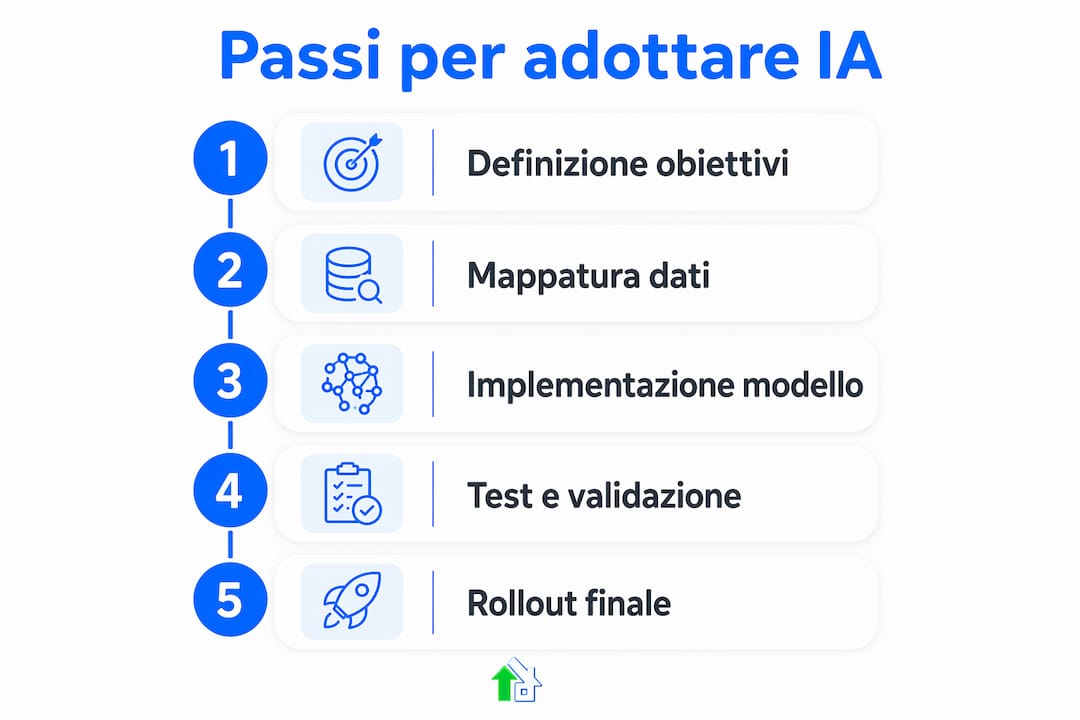
1. Define the measurable objective. First: what problem do you want to solve and how will success be measured? Examples: reduce near misses by 30% in six months, cut average delivery delay by two weeks, or eliminate unplanned equipment downtime.
2. Map existing data. Inventory active video feeds, historical schedules, safety reports and sensor data. The more labelled data you have, the better the model will be.
3. Define governance. Who manages the data? Who validates alerts? Who decides when to intervene? Without governance, even the best model produces ignored alerts.
4. Choose the technology partner. Assess construction-sector experience, integration capabilities with BIM and existing management systems, post-deployment support and GDPR compliance.
5. Launch the POC. Indicative timeline for a pilot project on one construction site:
- Discovery and scoping phase: 2–4 weeks
- Data collection and cleaning: 2–6 weeks
- Model training and testing: 4–8 weeks
- Pilot deployment and validation: 4–8 weeks
Total: 12–26 weeks, varying according to the complexity of the use case and the quality of available data.
6. Measure and decide on rollout. Compare KPIs before and after the POC. If results are positive, plan expansion to other sites with a scaling plan.
Regarding costs, the main factors are sensors and hardware (cameras, IoT, drones), connectivity, software licences, integration with BIM and ERP, and staff training costs. A POC for a single use case costs very little compared with a rollout across ten sites; requesting detailed quotes from several suppliers is the right way to estimate the actual investment.
One piece of advice: involve the responsible person for prevention and protection (RSPP) and forepersons from the scoping stage. They are the ones who validate alerts in the field and can identify false positives. Their involvement reduces resistance and improves the quality of labelled data.
How does the technology architecture of an AI construction-site system work?
An AI system for construction sites is not a single product: it is an architecture of components that communicate with one another. Understanding it helps you ask suppliers the right questions and avoid expensive integrations later.
The main components are:
- Sensors and wearables: measure environmental parameters (gases, temperature, noise) and physiological parameters (heart rate, the worker’s GPS position).
- Computer-vision cameras: feed visual-recognition models for safety and progress monitoring.
- Drones: collect visual and thermal data over large or difficult-to-access areas.
- Edge devices and gateways: process data locally for low-latency applications and filter and compress data before sending it to the cloud.
- Cloud ML and data lake: store historical data, train models and host centralised reporting.
- BIM/4D APIs: connect the building information model with real-time operational data. Graphisoft Archicad, for example, integrates AI features directly into the BIM workflow to support design and verification.
- ERP/management-system integration: synchronises material orders, human resources and schedules with data produced by the AI system.
| Component | Main function | Edge or cloud? |
|---|---|---|
| CV cameras | PPE detection, progress monitoring | Edge (alerts) / Cloud (analysis) |
| IoT sensors | Environmental and equipment monitoring | Edge |
| Drones | Inspections, orthophotos, inventory | Cloud (post-flight processing) |
| Gateway | Data filtering and transmission | Edge |
| Cloud ML | Model training, reporting | Cloud |
| BIM APIs | Design-model integration | Cloud |
Minimum data-quality requirements. Computer-vision models require images of at least 1080p with good lighting; predictive-scheduling models need at least 12 months of history from comparable sites. Sparse or unlabelled data produces unreliable models.
Data governance. Define from the outset who may access the data, how long it is retained, how workers’ personal data is anonymised, and which data-processing agreements (DPAs) are signed with suppliers. These choices affect both GDPR compliance and model quality over time.
Evidence of effectiveness: what the data shows and how Edil-up supports adoption
The strongest evidence comes from real applications, not marketing promises. Three operational examples:
- Predictive safety: the nesea Build Safety AI platform demonstrates how integrating IoT, computer vision and a digital twin can automatically detect PPE and build a dynamic risk model, moving from reactive incident management to predictive management.
- Construction-drawing analysis and PPE monitoring: solutions such as those described by AMS Web show how AI can automate construction-drawing analysis, support multilingual training and monitor the use of protective equipment, with measurable effects on time and quality.
- Scheduling and supply chain: predictive-scheduling algorithms analyse historical weather, supply and subcontractor data to reduce delays, with verifiable results on sites that have adopted these solutions.
Edil-up supports this adoption phase with document-management, progress-monitoring and inter-company communication tools. Centralised project management combined with the platform’s digital tools can reduce delivery times by up to 20%. The platform also makes it easier to find specialist expertise for a POC through its marketplace of professionals and companies in the sector.
Regulations and privacy for AI on construction sites in Italy: GDPR, video surveillance and INAIL
Introducing cameras, sensors and data analysis on a construction site means processing workers’ personal data. In Italy, this activates specific obligations that must be managed before the first system is switched on.
Essential regulatory points:
- The GDPR (EU Regulation 2016/679) requires a legal basis for processing workers’ data. For workplace safety, the basis is often a legal obligation (art. 6, lett. c) or legitimate interest, but it must be documented on a case-by-case basis.
- Workers must receive clear information about what data is collected, for what purpose and how long it is retained.
- The processing must be entered in the company’s record of processing activities.
- For high-risk processing (behavioural profiling, systematic monitoring), a data protection impact assessment (DPIA) is mandatory.
Video surveillance on construction sites. Installing cameras for workplace-safety purposes is regulated by art. 4 of the Workers’ Statute (L. 300/1970), which requires a trade-union agreement or, in its absence, authorisation from the Labour Inspectorate. The safety purpose (accident prevention, PPE detection) is distinct from monitoring work activity: AI systems must be configured for the former, not the latter. INAIL and the Ministry of Labour provide updated guidance on these obligations.
Practical guidance for the POC:
- Draft the site-specific privacy notice before launch.
- Check whether a DPIA is required and, if so, complete it before deployment.
- Sign a data-processing agreement (DPA) with each technology supplier.
- Configure systems to anonymise data wherever possible (for example, automatic blurring of faces in video feeds not intended for identification).
- Define a retention policy: operational data must not be kept longer than necessary for the stated purpose.
Tools such as edilizia.live integrate semantic searches of national and regional regulations, including DPR 380/2001, NTC 2018 and D.Lgs. 81/08, and can support verification of regulatory requirements during scoping.
| Requirement | Regulatory reference | When |
|---|---|---|
| Worker privacy notice | GDPR | Before launch |
| Record of processing activities | GDPR art. 30 | Before launch |
| DPIA | GDPR | If processing is high-risk |
| Trade-union agreement / authorisation | L. 300/1970, art. 4 | Before camera installation |
| DPA with suppliers | GDPR | Before contract |
What risks and limitations should you know before adopting AI on a construction site?
AI on construction sites works, but it is not infallible. Understanding its limitations prevents unrealistic expectations and poor decisions.
Technical limitations:
- Computer-vision models degrade in poor lighting, heavy dust or fog. A system trained on sites under standard conditions may produce many false positives in dusty environments or with variable artificial lighting.
- Machine-learning models require sufficient quantities of labelled data. Without a dataset representative of your sites, forecasts are unreliable. Customising the model with company data is the factor that has the greatest impact on reducing false positives.
- Performance deteriorates over time if the model is not periodically retrained on new data.
Operational risks:
- Alert fatigue: too many alerts lead to desensitisation. Workers and managers stop responding. Alert thresholds must be calibrated carefully and adjusted over time.
- Information overload: a system that reports on everything does not help anyone decide anything. A few clear KPIs are better than overloaded dashboards.
- Decision-making responsibility: AI flags an issue, but the decision remains human. Defining who is responsible for each type of alert is an organisational, not technical, prerequisite.
Good practices:
- Test the system in real scenarios before go-live, including adverse weather and night shifts.
- Involve operators in validating alerts: they know whether a signal is relevant.
- Plan model-retraining sessions every 6–12 months, or after significant changes on the site.
- Document the models in use: version, training data and configured thresholds. This transparency is useful both for internal governance and any regulatory checks.
Key points
AI for construction sites delivers measurable results only when it starts with a concrete problem, sufficient data is available and governance is managed from the outset.
| Point | Details |
|---|---|
| Choose a measurable use case | PPE safety or progress monitoring are the most effective starting points for companies of every size. |
| Launch a structured POC | A 12–26-week pilot on a real construction site is the most reliable way to estimate ROI. |
| Integrate with BIM and management systems | Integration with the BIM model and company ERP multiplies the value of the data collected. |
| Manage GDPR and Italian regulations | The privacy notice, processing register, DPIA and trade-union agreement for cameras must be completed before launch. |
| Edil-up for management and monitoring | The platform supports progress monitoring and communication between companies, with delivery times reduced by up to 20%. |
The approach we recommend first: Edil-up’s perspective
There is one mistake I see repeatedly: construction companies approach artificial intelligence looking for “the AI platform for construction sites” as if it were an off-the-shelf product. It is not. It is a journey that begins with a simple question: what problem is costing me the most in terms of time, money or safety?
The answer determines everything else: which data to collect, which model to train and which integration to build. Companies that achieve concrete results are not necessarily those with the largest budget. They are the ones that have defined a measurable objective before signing any contract with a technology supplier.
The second mistake is underestimating the governance phase. An AI system that generates unmanaged alerts, or collects data without a retention policy, creates more problems than it solves. Involving the RSPP, forepersons and IT manager from scoping onward is not an organisational detail: it is the condition for the model to receive quality data and for alerts to be taken seriously.
Edil-up supports this process by providing progress-monitoring, document-management and inter-company communication tools. The platform is also the gateway to finding specialist partners and expertise for an AI project: technicians, trainers and integrators. You do not need to build everything from scratch.
Edil-up: the platform for managing your construction site while adopting AI
Anyone considering adopting artificial intelligence on a construction site needs a solid digital foundation before choosing an AI model. Without organised data, smooth communication between the companies involved and centralised progress monitoring, any AI system is working on fragile foundations.
Edil-up solves exactly this: document management, project-progress monitoring, direct communication between companies and access to a network of industry professionals. Digitising the site with Edil-up reduces delivery times by up to 20% and generates measurable environmental savings, with one tree planted for every active subscription. For anyone who wants to start structuring site data and build the foundation for an AI POC, the practical next step is to explore the available plans or contact the team directly. See the plans at edil-up.com/pricing or write to edil-up.com/contatti for a direct discussion.
Useful sources and regulatory references for further reading
Italian regulatory references:
- GDPR (EU Regulation 2016/679): official text and guidance from the Italian Data Protection Authority on video surveillance and workers’ data processing.
- D.Lgs. 81/2008 (Consolidated Safety Act): employers’ and RSPP’s obligations, including provisions on surveillance and prevention.
- L. 300/1970, art. 4 (Workers’ Statute): regulates the installation of audiovisual systems and other tools for remote monitoring.
- INAIL: publishes guidelines and technical materials on safety at construction sites, including guidance on monitoring technologies.
- Ministry of Labour and Social Policies: circulars and measures on remote monitoring and trade-union agreements for video surveillance.
Technical resources and further reading:
- nesea Build Safety AI: predictive-safety platform with IoT, computer vision and digital twin technology for construction sites.
- AMS Web: AI for construction: overview of AI features applied to training, construction-drawing analysis and PPE monitoring.
- ProntoProfessionista: AI on construction sites: article on predictive scheduling, supply chain and risk prevention.
- Graphisoft AI Solutions: AI integration into the BIM workflow with Archicad.
- edilizia.live: AI assistant for construction professionals with semantic searches of national and regional regulations.
- Drone-flyview: industrial inspections with drones: technical guide to integrating drones for structural inspections and progress monitoring.
Relevant Edil-up pages:
- Digitising the construction sector: the strategic value of digitisation and sustainability initiatives.
- Centralised project management: how centralisation reduces delivery times by up to 20%.
- Digital tools for construction sites: overview of digital tools for more efficient management.
- Edil-up contacts: to request information or start a discussion about your project.
How to use these sources in the project. Before launching the POC, check with the Italian Data Protection Authority and the Labour Inspectorate with territorial jurisdiction whether specific regional restrictions apply to video surveillance on construction sites. Regional regulations may add requirements to the national framework, particularly for public construction sites or protected areas.
Recommended
- Work schedule: practical guide for construction professionals
- How to build a network of contacts in the construction sector – Edil-up – Sustainable construction for the future
- Digitising the construction sector: how to prepare for the future – Edil-up – Sustainable construction for the future
- The benefits of centralised project management – Edil-up – Sustainable construction for the future