To onboard a new construction-site collaborator compliantly, before they start work you must verify and file: general, specific and equipment-training certificates; the fitness-for-duty assessment issued by the occupational physician; a signed receipt confirming PPE delivery; and registration in the personnel file, with a badge or signature in the attendance log. Everything else comes later.
Action checklist for the first entry:
- Personal documents: copies of valid training certificates, a current medical fitness assessment, and an identity document
- Training: verify that the collaborator has completed the 16-hour first-entry course or, if already trained, that the five-year refresher is current
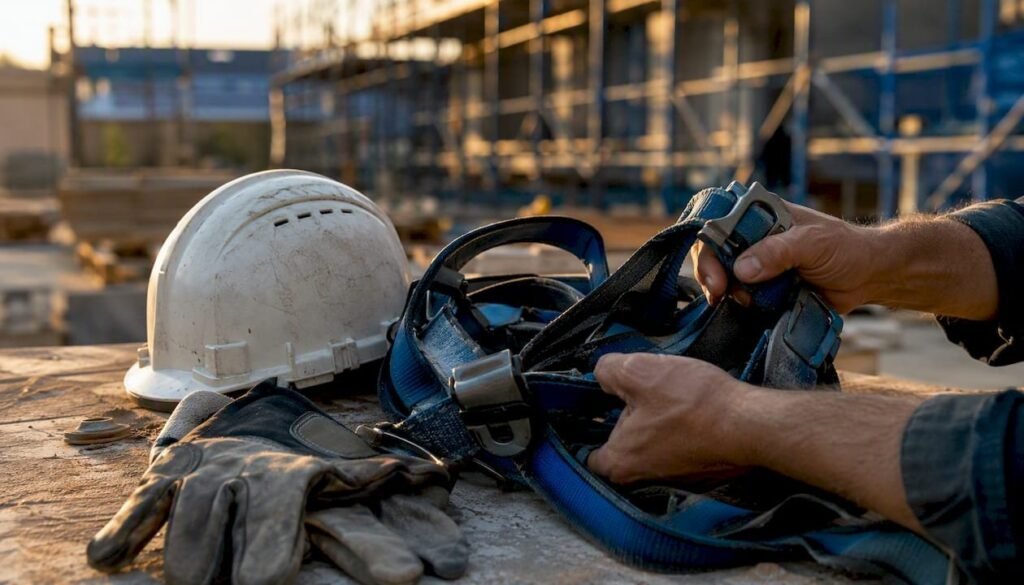
- PPE: physical delivery of personal protective equipment with a signed receipt
- Registration: open or update the digital personnel file; sign the attendance log or record the badge
- Fitness verified: the occupational physician’s assessment must match the assigned job, not be generic
Key points
Compliant construction-site onboarding requires verified documents, traceable training and an active process before first entry—not afterward.
| Point | Details |
|---|---|
| Documents before access | Certificates, fitness assessment and signed PPE receipt must be filed before the collaborator enters the site. |
| Mandatory training | 16-hour first-entry course for newly hired construction workers; five-year 6-hour refresher; specific training of up to 16 hours for high risk. |
| Credit-based license | From 1 October 2024, a minimum threshold of 15 out of 100 credits is required to operate on temporary and mobile construction sites (D.L. 19/2024). |
| Expiry tracker with notifications | Set automatic alerts at least 60 days in advance for DURC, certificates, medical examinations and the credit-based licence. |
| Edil-up for traceability | The platform centralises personnel files, expiry tracking and attendance, reducing the risk of missing documents during an inspection. |
Contents
- What documents should be requested from each collaborator before site access?
- Mandatory construction training: what is really required and how to document it
- How to manage medical fitness, PPE and practical training on site
- What documentation obligations does the company have for each site?
- How does the construction-site onboarding process work, step by step?
- How to assess subcontractors’ technical and professional suitability
- How to digitise personnel files and expiry tracking to withstand an inspection
- What mistakes do companies make during onboarding, and what do they risk during an inspection?
- Why construction-site onboarding is more than a bureaucratic obligation
- The real problem with construction-site onboarding is not bureaucracy
- Edil-up for construction-site onboarding and compliance management
- Sources
What documents should be requested from each collaborator before site access?
Mandatory construction-site documents fall into two groups: those for the individual worker and those for their company.
Worker documents:
- General training certificate (with duration specified by the Accordo Stato-Regioni 21/12/2011)
- Specific high-risk training certificate (up to 16 hours)
- 16-hour first-entry course certificate (for newly hired construction workers)
- Fitness-for-specific-duty assessment (occupational physician)
- Signed PPE delivery receipt
- Certificates for specific equipment (PLE, cranes, scaffolding, where applicable)
- Valid identity document
Company documents:
- Valid DURC according to the deadlines established by law
- POS (Piano Operativo di Sicurezza) consistent with the site PSC
- Updated CCIAA company registration extract
- Preliminary notice (for sites subject to this requirement)
- Credit-based licence under current legislation
For each collaborator, the personnel file must contain copies of all these documents, with the verification date and the responsible person’s signature. Verification is more than collection: checking the issue date, the accredited issuing body and consistency between the declared job and the training received makes the difference during an inspection.
| Document | Issued by | Validity | What to verify |
|---|---|---|---|
| General training certificate | Accredited body | Renewal every 5 years | Date, body, signature |
| Specific training certificate | Accredited body | Renewal every 5 years | Consistency with job |
| 16-hour first-entry course | Accredited construction body | Six-hour five-year refresher | Legal and technical modules |
| Medical fitness assessment | Occupational physician | Frequency based on job | Specific job |
| DURC | INPS/INAIL/Cassa Edile | 120 days | Issue date |
| Credit-based licence | MIT/INL | Updated score | Minimum threshold of 15 credits |
Mandatory construction training: what is really required and how to document it
The training framework for construction workers is based on the Accordo Stato-Regioni of 21/12/2011 and D.Lgs. 81/2008. There are three modules:
- General training: 4 hours, valid for all sectors, also deliverable through FAD (distance learning) with a mandatory final test
- Specific high-risk training: up to 16 hours, mandatory for construction; the practical portion must take place in person
- 16-hour first-entry course: for newly hired construction workers, covering a legal and a technical-practical module; it requires a six-hour five-year refresher
Periodic refreshers are required every five years for general and specific training; first aid and fire prevention follow their own deadlines (three years for first aid, and variable fire-prevention deadlines depending on risk level). Training must be delivered by bodies accredited by the Region or recognised joint bodies; the final test is a minimum requirement for certificate validity.
How to document compliance:
- Course attendance register with participant signatures
- Copy of the certificate bearing the issuing body’s stamp
- Final-test report with result
- Updated expiry tracker showing the next refresher date
A tip: use FAD for the general portion (4 hours) and focus in-person resources on the technical-practical portion: save time without losing compliance, and preventive training before employment is now established practice.
How to manage medical fitness, PPE and practical training on site
A fitness assessment is not a generic document to collect just once. The occupational physician issues it for a specific job: if a worker changes role or moves to a site with different risks, a new assessment is required. Always file the latest version in the personnel file.
PPE delivery register:
- Delivery date
- Type and model of equipment (hard hat, harness, footwear, gloves, goggles)
- Worker’s signature acknowledging receipt
- Use and maintenance instructions attached or signed separately
- Planned replacement date or wear condition
For specific equipment such as PLE (mobile elevating work platforms), cranes, scaffolding and fall-arrest devices, practical training is legally mandatory and must be documented with a report signed by the instructor and worker. Providing the manual is not enough: there must be proof that training took place.
Practical training checklist:
- Training date and location
- Specific equipment (make, model, plate/serial number)
- Instructor’s name and qualifications
- Worker’s signature
- Result (fit/not fit, with notes)
What documentation obligations does the company have for each site?
Title IV of D.Lgs. 81/2008 regulates temporary and mobile construction sites and establishes precise obligations for executing companies. The employer cannot delegate without limits: final responsibility remains theirs even when document management is assigned to an outside consultant.
Site documents to keep updated:
- POS (Piano Operativo di Sicurezza): it must be site-specific, not a generic template
- PSC (Piano di Sicurezza e Coordinamento): prepared by the design coordinator; the POS must be consistent with it
- DURC for the company and subcontractors (120-day validity)
- Preliminary notice to the ASL and competent DTL (for sites subject to the requirement)
- ITP (Idoneità Tecnico-Professionale) for the companies involved
Credit-based licence (D.L. 19/2024): from 1 October 2024, companies and self-employed workers operating on temporary and mobile construction sites must hold a credit-based licence issued by the Ispettorato Nazionale del Lavoro. The minimum operating score is 15 out of 100 credits. The licence takes into account training, investments in safety, absence of violations and social-security compliance. A company that falls below the threshold cannot access the site.
Art. 96 of D.Lgs. 81/08 lists the specific obligations of executing companies: fencing, internal traffic routes, safe material storage, organisational measures and preparation of the POS. Violations are subject to both criminal and administrative penalties.
How does the construction-site onboarding process work, step by step?
An effective operational workflow has five sequential phases. Do not skip the prechecks: a collaborator who enters a site without verified documents exposes the company to immediate penalties.
- Request documents before access: send the collaborator—or subcontracting company—the list of required documents at least 48 hours before first entry. Use a standard form with a list and checkboxes.
- Document verification: check validity, consistency with the job and completeness. File a digital copy in the personnel file. If anything is missing, block access until it is supplied.
- Preventive training: verify that mandatory training is complete before employment. If modules are missing, arrange the session before the first day.
- First day: briefing and PPE delivery: explain site-specific risks, emergency procedures, layout and internal rules. Deliver PPE and obtain the signed receipt. Record attendance.
- Personnel-file and expiry-tracker registration: enter all expiry dates—training, DURC, medical examination and credit-based licence—into an expiry tracker with automatic notifications. Assign an internal owner for each type of expiry.
Minimum templates to have ready:
- Pre-access document request form (list with checkboxes)
- PPE delivery receipt (with worker’s signature)
- Training/briefing report (with signatures and date)
- Collaborator expiry tracker (document date, expiry, responsible person)
A tip: integrate e-learning for general modules before the first day: the worker arrives already trained in the theory, while the in-person briefing focuses on your site’s specific risks.
How to assess subcontractors’ technical and professional suitability
Bringing in outside companies or self-employed workers requires a more structured review than onboarding an individual employee. ITP is not a formality: an unsuitable subcontractor exposes the commissioning company to joint liability.
Minimum documents to request from every subcontractor:
- Updated CCIAA company registration extract (consistency between declared activity and work to be performed)
- Current DURC
- DVR (Documento di Valutazione dei Rischi) or standardised procedure for self-employed workers
- Training certificates for assigned personnel
- Site-specific POS, consistent with the PSC
- Credit-based licence with verifiable score
- Verify that the company purpose in the CCIAA extract matches the requested work.
- Check that the DURC has not expired on the access date.
- Compare the subcontractor’s POS with the PSC: measures must be compatible, not contradictory.
- Assess references on sites of similar complexity and type.
Warning signs not to ignore:
- Expired DURC or contribution irregularities
- Generic POS, not specific to the site in question
- Personnel training not current or delivered by non-accredited bodies
- Credit-based licence below the threshold or missing
- Mismatch between declared work and CCIAA activities
Merely supplying materials does not always exempt a supplier from checks: if the supplier physically works on site with its own workers, even just for unloading and positioning, coordination and ITP verification obligations apply.
How to digitise personnel files and expiry tracking to withstand an inspection
A digital personnel file must be accessible on site in real time, not only in the office. During an ASL or INL inspection, the responsible person must be able to show the documents within minutes, not days.
Minimum elements of the digital file:
- Worker details with job and start date
- Scanned copies of all certificates with expiry dates
- Medical fitness assessment (latest version)
- Signed PPE receipts
- Training and practical-training reports
- Attendance register with time log
The attendance register must withstand challenge: electronic badges or digital signatures with timestamps are preferable to paper signatures, which can be backdated. A centralised document-control system reduces verification times and lowers the risk of disputes during an inspection.
Set automatic notifications at least 60 days in advance for: DURC expiry, training-certificate renewal, periodic medical examination and credit-based-licence update. Always keep an essential paper backup on site for immediate checks, even if primary management is digital. Digitisation of the construction sector does not eliminate paper: it makes it Plan B, not Plan A.

What mistakes do companies make during onboarding, and what do they risk during an inspection?
The most common mistakes are not the obvious ones. They are the details: a DURC expired by three days, a training certificate from a non-accredited body, or a POS copied from another site without adaptation.
Recurring mistakes:
- DURC expired when the subcontractor accesses the site
- Training certificates not current (missed five-year refresher)
- Training not traceable: no course attendance register, no report
- Generic POS, not site-specific and inconsistent with the PSC
- Generic medical fitness assessment or one referring to a different job
- Credit-based licence not verified before access
The penalties under D.Lgs. 81/2008 are real. Art. 96 penalises failures by executing companies; Arts. 157 and 159 provide criminal and administrative penalties for failure to provide training and documentation. A site shutdown ordered by the INL has direct and indirect costs far exceeding those of orderly document management.
Rapid inspection response plan:
- Keep an essential paper file on site (certificates, DURC, POS, fitness assessments)
- Designate a single contact for relations with inspectors
- Do not obstruct the inspection: show available documents and immediately state what is missing
- Contact the labour consultant or RSPP immediately for technical support
Why construction-site onboarding is more than a bureaucratic obligation
Site safety is not a cost to minimise: it is the condition that allows work to continue. An untrained or undocumented collaborator is not only a regulatory risk. It is a site that may be shut down on inspection day, with consequences for schedules, reputation and future contracts. Final responsibility always remains with the employer, even when operational management is assigned to a supervisor or outside consultant.
Documentary and training compliance cannot be separated from productivity. A company that manages collaborator onboarding through a structured process reduces incidents, keeps sites operating and builds a reputation that matters in public tenders and negotiations with private clients. Edil-up supports this process with digital tools for document management and expiry tracking, designed for people who work on site every day.
The real problem with construction-site onboarding is not bureaucracy
Most guides on onboarding construction-site collaborators treat it as a paperwork problem: collecting documents, filling out forms and filing certificates. That is a partial reading, and it leads to partial solutions.
The real problem is that many companies manage onboarding reactively: they collect documents when an inspection arrives, update training when a certificate expires, and deliver PPE when someone asks for it. This approach works until nothing happens. When something does happen, the employer discovers that delegating to a consultant does not protect them, that a generic POS does not withstand an inspector’s review, and that a DURC expired by a week can shut down the site.
The solution is not more paperwork. It is a process that starts before the collaborator enters the site, with systematic checks and assigned responsibilities. Digital tools help, but only if the process exists. An automatic expiry tracker applied to a disorganised process solves nothing: it accelerates the chaos.
Those managing sites with changing crews and frequent subcontractors need a system, not an archive. The difference is that the system warns you beforehand, not afterwards.
Edil-up for construction-site onboarding and compliance management
Managing new collaborators with Excel spreadsheets and shared folders works up to a point. When there is more than one site, crews change often and subcontractors multiply, the risk of missing a deadline or forgetting a document becomes real.

Edil-up gives construction companies a centralised digital environment for construction-site document management: a digital personnel file for every collaborator, expiry tracking with automatic notifications for DURC, certificates and medical examinations, templates for POS and training reports, and an integrated attendance register. Everything is accessible from the site, not only from the office.
For companies that want to structure their onboarding process without building it from scratch, Edil-up provides the tools to do so immediately. Access the platform at Edil-up and see which features integrate with your current workflow.
Sources
The sections of this guide are based on verified primary sources and operational guides. In the event of an inspection or dispute, these references support the company’s position.
- Mandatory construction-site documents (Edafos)
- Training obligations for construction-site workers (TuttoSicurezza)
- 16-hour first-entry course in construction (COID)
- Obligations of the executing company (PuntoSicuro)