
The digital construction site log is the electronic document that replaces the traditional paper sheet for recording attendance, activities, deliveries, incidents and photographic evidence with timestamps and GPS tracking. It meets the objectivity and reliability requirements set out in D.Lgs. 81/2008 on workplace safety, addresses the time-tracking obligations provided for by D.Lgs. 66/2003, and produces an audit trail that INAIL and the Labour Inspectorate can consult at any time. According to Edil-up data, digital site management can reduce delivery times by up to 20%.
In brief: every digital log must contain at least three minimum pieces of information for each access: the operator’s identity, entry and exit times, and georeferenced location. Everything else, from certified photos to the foreman’s notes, adds evidentiary value. If you want to get started immediately, the most direct route is to activate a plan with Edil-up and run a pilot test on a single site.
- Verified identity (name, role, badge ID)
- Time with certified timestamp and GPS
- Workplace with perimeter geofencing
Contents
- What a digital construction site log must contain
- Why digitising the log really pays off
- Which regulatory requirements to check before going live
- How to implement the log in six practical steps
- What to look for in the software and how Edil-up responds
- What results to expect after adoption
- Quick template for the log’s daily entry
- Key points
- Sustainable digitisation: a choice worth more than efficiency
- Edil-up for your construction site: where to start
- Useful sources and reference regulations
What a digital construction site log must contain
A well-structured log is not merely an attendance list: it is the site’s operational memory. Essential daily fields cover the date and relevant site, the operator’s name and role, entry and exit times with a digital signature or clock-in, a description of the activity performed, material deliveries with the supplier and transport document, any incidents or near misses, georeferenced photos, and the site manager’s notes.
For sites of medium complexity or subject to public reporting requirements, it is advisable to add advanced fields:
- Operator badge ID or tax code
- Contract code or job reference
- Reference to the SAL (Stato Avanzamento Lavori) and the Giornale dei Lavori
- PDF attachments or submissions via PEC
When exporting, the evidentiary value of certified photos with a certain date and non-modifiability according to forensic standards is decisive during inspections. The most useful formats remain the digitally signed PDF, the CSV with an integrated audit trail and packages for compliant substitute preservation.
Why digitising the log really pays off
The paper log has three structural flaws that digital tools solve at their root: forged signatures, illegible sheets and no remote access. A coordinator who has to check attendance during an emergency cannot wait until returning to the office.
Up to a 20% reduction in delivery times is the result documented by Edil-up for sites adopting centralised document management.
The benefits occur at three levels:
Operational: real-time access to site data, integration with project-management tools, more accurate attendance monitoring and faster emergency response.

Financial: fewer errors in site accounts, faster reporting to clients and works directors, and lower costs associated with disputes and inspections.
Environmental: eliminating paper is only the starting point. Edil-up calculates the CO2 savings associated with each digitised project and plants trees for every active subscription, turning an operational choice into a measurable contribution to sustainability.
Which regulatory requirements to check before going live
Before activating any system, it is advisable to carry out a structured review. Here is the operational checklist:
- D.Lgs. 81/2008: the system must ensure real-time knowledge of who is present on the site; a georeferenced GPS clock-in system with geofencing between 50 and 200 metres meets this requirement.
- D.Lgs. 66/2003: time tracking must be objective, reliable and accessible; documenting how the software guarantees these characteristics is part of the compliance process.
- GDPR: collecting biometric or location data requires a legal basis (contract or legitimate interest), information for workers, data minimisation and a defined retention policy. The software provider must act as data processor under a written agreement.
- Digital signature and evidentiary value: timestamps and georeferencing of photos must be certified to carry weight in judicial or inspection proceedings.
- Authentication and backup: access using named credentials, automatic backup, change logging and profile management for subcontractors.
- Document integration: the digital log supports, but does not replace, mandatory signed records such as the official Giornale dei Lavori or DURC.
Some regions have developed dedicated public tools: the Regione Toscana platform for site attendance, for example, allows access through SPID or CNS and is integrated with the formal invitation processes of the RUP or DRC.
Advice: before going live, ask the provider for a written statement explaining how the system meets the requirements of D.Lgs. 81/2008 and the GDPR. It will be useful in the event of an inspection.
This article provides general information and does not replace advice from a legal or employment professional for your company’s specific circumstances.
How to implement the log in six practical steps
- Needs assessment: map active sites, the number of operators and subcontractors, and documents already in use (Giornale dei Lavori, SAL). Identify gaps.
- Set the perimeter: configure geofencing for each site (recommended radius: 50–200 metres) and define user profiles for employees, subcontractors and coordinators.
- Team onboarding: train site managers in a two- to three-hour session. Most mobile-first systems require less than an hour for daily operations.
- Integration with existing documents: link the log to the Giornale dei Lavori and site accounts to avoid duplicate entries.
- Pilot test: run it on one site for a week. Measure clock-in adoption and the average time per entry.
- Full roll-out: extend it to the other sites over the following two to four weeks, with an ongoing training plan for new starters.
In terms of cost, the prevailing model is SaaS, with an annual subscription based on the number of users or sites. Always assess the total cost of ownership: subscription, onboarding, technical support and training hours. KPIs to monitor after going live include clock-in quality, efficiency in daily recording and accuracy in site accounts.
What to look for in the software and how Edil-up responds
Not all online construction documentation software offers the same level of reliability. Critical features to check include:
- Clock-in with certified timestamp and GPS
- Immutable audit trail and change logging
- Profile management for subcontractors with delegated access
- Integration with ERP, Giornale dei Lavori and SAL
- Compliant export (signed PDF, CSV, substitute preservation)
- Data encryption, automatic backup and role management
- Mobile-first interface with real-time notifications
- Automatic reporting for coordinators and works directors
Edil-up meets these criteria within a platform designed for the digitisation of the construction sector as a whole: document management, project monitoring, direct communication between companies and environmental-impact calculations. Companies communicate directly on the platform, reducing information loss across untracked channels. Environmental savings calculations are integrated, not a decorative add-on.
What results to expect after adoption
The metrics to observe during the first 90 days are fourfold: clock-in adoption (target: above 95%), average time per daily entry, reduction in site-accounting errors and time saved preparing documents for inspections.
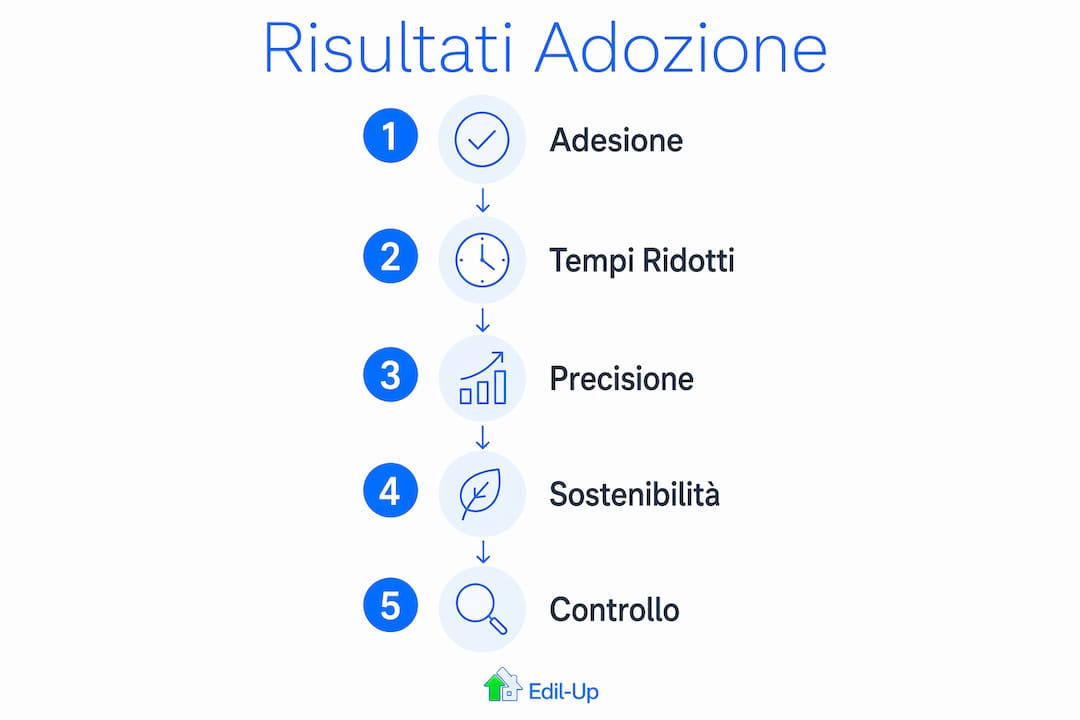
Edil-up reports a reduction in delivery times of up to 20% for sites adopting centralised management. To measure this result in your organisation, compare average delivery times during the three months before adoption with those during the three months after. Gather structured feedback from the team at 30, 60 and 90 days: operational resistance almost always appears during the first 30 days and is resolved through configuration adjustments, not further training.
Quick template for the log’s daily entry
Every day, every site. This is the minimum structure to replicate:
- Date and site: date, address, contract code
- Personnel present: name, role, entry/exit time, digital signature or GPS clock-in
- Daily activity: brief description of work completed by phase
- Materials delivered: supplier, transport document, quantity
- Certified photographs: at least two or three georeferenced photos with timestamps for each relevant phase
- Events and incidents: description, people involved, measures taken
- Foreman’s notes: operational observations, issues, requests to the coordinator
- Reference to the Giornale dei Lavori: corresponding page number or entry
For inspection submissions, export the log as a digitally signed PDF and retain a CSV copy with an audit trail for at least five years. Systems that support digital certification of documents with a certain date also allow submission via PEC, adding another level of certainty regarding the production date. A downloadable template in .xlsx or .csv format is available directly on the Edil-up platform after registration.
Key points
The digital construction site log with an audit trail and GPS is the most reliable form of documentation for meeting D.Lgs. 81/2008, GDPR and inspection requirements, with measurable operational benefits as early as the first 90 days.
| Point | Details |
|---|---|
| Mandatory minimum requirements | Identity, time with timestamp and GPS location for every site access. |
| Regulatory compliance | Check D.Lgs. 81/2008, D.Lgs. 66/2003 and the GDPR before going live, with written documentation from the provider. |
| Gradual implementation | Pilot test on one site for a week, followed by roll-out over two to four weeks with ongoing training. |
| Expected results | Up to a 20% reduction in delivery times and fewer accounting errors during the first 90 days. |
| Edil-up as a solution | Platform with document management, communication between companies, environmental savings calculations and a Plus subscription for sites. |
Sustainable digitisation: a choice worth more than efficiency
Anyone who works on a construction site knows that paper is never truly neutral: it gets lost, wet or is difficult to read, and it is never where it needs to be when the inspector asks for it. But reducing the issue to “more convenient bureaucracy” would be a mistake in perspective.
The real advantage of the digital log is the quality of the evidence it produces, as illustrated by the approach of digital byggeledelse i moderne byggeprosjekter. An audit trail with timestamps and GPS is not merely more practical: in the event of an accident, dispute or litigation, it is the difference between a defensible and a vulnerable position. Companies that understand this stop treating the log as a formality and start using it as an active risk-management tool.
On the environmental front, the argument is often underestimated in construction. Yet eliminating paper from an average site is not symbolic: it is a concrete reduction in resource consumption, multiplied across every site and every year. Edil-up has chosen to make these savings measurable and link them to genuine offsetting initiatives, such as planting trees for every active subscription. This is not marketing: it is a way to put a number on a choice that would otherwise remain invisible.
The most difficult cultural change is not technical. It is convincing a 55-year-old site manager that clocking in with a phone is more reliable than the sheet he has always used. Involving the team from the pilot stage, measuring results and showing the data after 30 days is the only approach that truly works.
Edil-up for your construction site: where to start
Anyone managing construction sites in Italy knows that the distance between “I want to digitise” and “I have digitised” is often a matter of practical tools, not intentions. Edil-up offers a complete platform with a Plus subscription that includes document management, activity tracking, direct communication between companies and calculation of projects’ environmental impact.
The recommended process is simple: activate an account, configure a pilot site and measure the results in 30 days. The pricing plan is structured for companies of every size, from a sole tradesperson to a construction company with multiple active sites. For every active subscription, Edil-up plants trees as part of its environmental offsetting programme. Consult the construction digitisation guide to learn how to prepare your company for the digital transition and contact the team for a tailored demo.
Useful sources and reference regulations
- D.Lgs. 81/2008 (Consolidated Occupational Safety Act): obligation to know who is present on site and ensure safe conditions. Available at normattiva.it.
- D.Lgs. 66/2003 (Working Time): objectivity, reliability and accessibility requirements for time recording.
- INAIL (inail.it): forms, insurance obligations and construction-site safety guidelines.
- Ispettorato Nazionale del Lavoro (ispettorato.gov.it): circulars and operational guidance for site inspections.
- Regione Toscana, Registro Presenze Cantiere (presenzecantiere.regione.toscana.it): example of a regional public tool with SPID/CNS access.
- Garante per la Protezione dei Dati Personali (garanteprivacy.it): GDPR guidance for processing workers’ data.
- Edil-up, internal resources:
- Benefits of centralised management: operational and environmental metrics.
- Construction digitisation guide: a practical roadmap for the digital transition.
- Updates and practical cases: regulatory and operational insights.
To prepare the documents to show during an inspection, print or export the log as a signed PDF, retain the CSV with the audit trail and keep the specific regulatory reference at hand (D.Lgs. 81/2008, art. 18), which requires employers to verify attendance. An orderly digital file is worth more than any verbal explanation.
Recommended
- News – Edil-up – Sustainable construction for the future
- The benefits of centralised project management – Edil-up – Sustainable construction for the future
- How to build a network of contacts in construction – Edil-up – Sustainable construction for the future
- Digitising the construction sector: how to prepare for the future – Edil-up – Sustainable construction for the future