
Construction-site document management is the organised system for collecting, updating, storing and making accessible all the technical, administrative and safety documents required by Italian regulations. This is not secondary bureaucracy: a site without up-to-date documentation exposes the employer, client and safety coordinator during execution (CSE) to work stoppages, penalties and criminal liability. D.Lgs 81/08 establishes the mandatory framework, while bodies such as the National Labour Inspectorate (INL) and the ASL verify on site the consistency between what has been declared and what is actually present.
The real turning point in recent years has been digitisation: platforms compliant with AgID guidelines replace physical folders with electronic archives equipped with digital signatures, version control and automated approval workflows. The result is not just order, but certifiable traceability in the event of an inspection.
A tip: Before starting any construction site, appoint an internal documentation manager. One person who knows where every document is worth more than ten well-labelled folders with no one responsible for them.
Contents
- What documents are mandatory on an Italian construction site?
- Why basic cloud storage is not enough for regulatory compliance
- What risks arise from incomplete or expired documentation?
- How to build an effective document procedure on a construction site
- How Edil-up supports document management on Italian construction sites
- Edil-up: the platform for more organised and compliant construction sites
- Key points
What documents are mandatory on an Italian construction site?
On a temporary or mobile construction site, numerous safety documents must be managed, updated and made available in the event of an inspection. Grouping them by category helps clarify who is responsible for them and how often they must be checked.
Safety documents:
- Safety and Coordination Plan (PSC), prepared by the coordinator for the design phase (CSP)
- Operational Safety Plan (POS), prepared by each executing company
- Plan for the Assembly, Use and Dismantling of Scaffolding (PiMUS)
- Single Document for the Assessment of Interference Risks (DUVRI)
- Coordination and safety meeting minutes
- Workers’ training certificates and medical fitness certificates
Administrative documents:
- DURC (Single Document of Contribution Compliance), valid for 120 days
- Preliminary notification to the ASL and ITL
- Subcontracting agreements and authorisations
Technical documents:
- Detailed design and approved variations
- Certifications for materials and equipment
- Maintenance logs and test certificates
The PSC and POS are not static documents: they must be constantly updated in line with the evolution of the site to maintain their preventive effectiveness. A PSC prepared at the start of the works and never reviewed is, in practice, a useless document.
— National Council of Engineers, CNI Circular no. 209/2024
According to the UNI/PdR practice currently under public consultation, archiving should be structured by client, lead contractor, executing companies, self-employed workers and coordinators, with differentiated access permissions and complete traceability of changes.
Why basic cloud storage is not enough for regulatory compliance
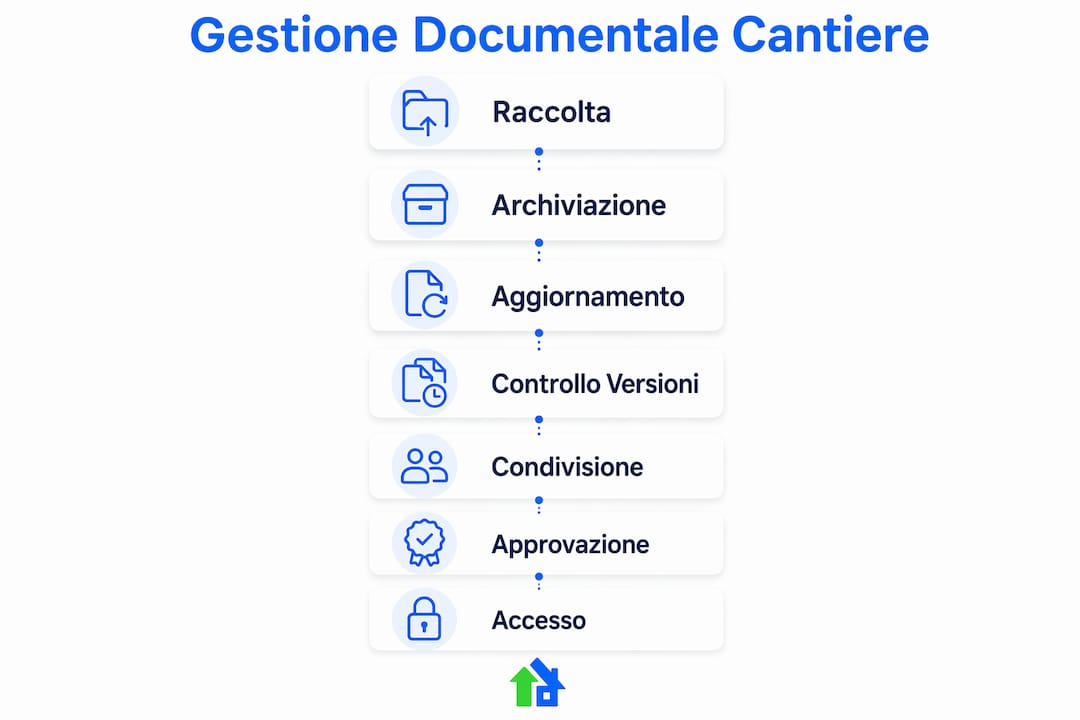
Many construction sites have already abandoned physical folders in favour of generic file-sharing services. It is a step forward, but not enough. The difference between storage and document management is substantial: a cloud archive does not guarantee version control, does not manage approval workflows and does not produce the traceability required during an INL inspection. That is why it is important to rely on a SaaS platform specifically designed for construction.

SaaS platforms dedicated to construction offer functions that basic storage cannot replicate:
| Function | Generic cloud archive | Dedicated document platform |
|---|---|---|
| Version control | Partial or unavailable | Complete, with change history |
| Compliant digital signature | No | Yes, AgID-compliant |
| Substitute preservation | No | Yes, legally valid for ten years |
| Automatic deadline tracker | No | Yes, with push notifications |
| Approval workflows | No | Configurable by role |
| Mobile access on site | Limited | Optimised for smartphones |
Digital platforms enable real-time access and reduce the risk of using obsolete document versions, an error that can have serious consequences during an inspection. Proper digital preservation guarantees authenticity, readability, integrity and retrievability: four requirements that the INL verifies in practice.
Among the solutions available in Italy, Edil-up takes a broader approach: in addition to document management, it integrates project monitoring, communication between companies and sustainability tools in a single platform.
What risks arise from incomplete or expired documentation?
The short answer: immediate suspension of the works. Failure to present a valid DURC or expired certificates is enough for the INL to order a site shutdown, with all the resulting costs, contractual penalties and reputational damage.
Responsibility is divided among several parties. The CSE is responsible for consistency between the PSC and the POSs of executing companies. The company’s employer is responsible for the completeness of the POS and the certificates of their employees. The client, often underestimated, has direct obligations regarding verification of the DURC and appointment of coordinators.
D.Lgs 159/2025, which updated certain provisions on workplace safety, strengthened the INL’s inspection powers and increased penalties for documentation irregularities. Ignoring these updates is not an option for anyone managing sites with multiple executing companies.
A tip: Set up a document-deadline calendar separate from the works schedule. DURC deadlines, training certificates and medical examinations follow their own timing and must be monitored independently of the site’s physical progress.
How to build an effective document procedure on a construction site
A robust document procedure is built before the site opens, not during construction. Here are the steps that make the difference between an orderly archive and a truly effective system.
- Collect documentation in advance. Request all necessary documentation from each executing company and subcontractor before they enter the site. A proactive approach that includes weekly consistency checks dramatically reduces surprises during inspections.
- Centralise everything on a digital platform. Provide a single access point for all documents, with role-based permissions. The CSE sees everything; the site manager of the executing company accesses only their own documents.
- Automatic deadline tracking with notifications. Every document has an expiry date. The system must provide sufficient advance warning, not alert users the day before.
- Documented approval workflows. Every change to the PSC or POS must follow a tracked workflow: proposal, review, approval and distribution. Without this, in the event of an incident it is impossible to reconstruct who knew what and when.
- Ongoing staff training. The document procedure works only if the people responsible for uploading documents know how to do it and why it matters. A training session at the start of the site, with periodic updates, is the minimum.
- Data backup and security. Digital documents must be saved on redundant infrastructure. Losing an updated POS because of a technical failure is a real problem, not a remote possibility.
- Integration with project management and accounting. Integrating document management with project management reduces time and duplicate processes: authorisation of a variation automatically generates a revision of the related technical document.
- Structured stakeholder communication. The client, CSE, executing companies and suppliers must receive document updates automatically, not through manual emails that get lost in inboxes. Communication in construction projects is more effective when it is integrated with the document system.
- Long-term archiving. Construction-site documents must be retained for years after the works are completed. AgID-compliant substitute preservation ensures that a digital document has the same legal value as the paper original for the entire period required by law.
A tip: For subcontractors, create a digital entry checklist: no one enters the site until all required documents have been uploaded and approved in the system. It is a simple rule that significantly reduces documentation problems with third-party companies.
How Edil-up supports document management on Italian construction sites
Edil-up was created to address a concrete problem in Italy’s construction sector: fragmentation. Documents in email, updates via WhatsApp, DURC in a desktop folder and a printed POS on site. Edil-up centralises everything in a platform designed for companies and professionals managing sites with multiple parties involved.
The platform allows users to organise documentation by project, assign role-based access permissions and track every change. Companies that adopt integrated digital tools for site management can record a significant reduction in delivery times, according to data reported by Edil-up.
Edil-up is not just an archive: it is the connection point between companies working on the same site. Document management becomes part of a broader operational workflow that includes progress monitoring, direct communication and the search for collaborators.
Relevant document-management features include:
- Uploading and organising documents by construction site and company
- Automatic notifications of document deadlines
- Real-time project progress monitoring
- Direct communication between companies involved on the site
- Integrated job postings for finding qualified collaborators
- Calculation of the environmental savings generated by digitisation, with trees planted for each active subscription
This last point distinguishes Edil-up from many purely administrative solutions: reducing environmental impact through digitisation is not a marketing claim but a measurable figure calculated by the platform for each project.
A tip: Use Edil-up for networking with other companies as well. Finding a reliable subcontractor whose documentation is already compliant is much easier when working within a network of verified professionals.
Edil-up: the platform for more organised and compliant construction sites
Anyone managing construction sites in Italy knows that documentation absorbs a disproportionate amount of time and attention compared with the value it produces when handled poorly. Edil-up changes this equation: instead of chasing missing documents and forgotten deadlines, you work within a system that automatically alerts, tracks and archives.
The platform is designed for construction companies, tradespeople, technicians and professional firms that want to stop wasting time on bureaucracy and focus on the work. The Plus subscription provides access to complete project management, structured documentation and communication tools between companies. For those who want to understand where to start, Edil-up’s guide to digitising the construction sector is the most direct starting point. Access the platform at edil-up.com/ and check which plan suits the size of your site.
Key points
Construction-site document management requires a structured digital system with version control, approval workflows and AgID-compliant preservation to ensure regulatory compliance and operational safety.
| Point | Details |
|---|---|
| Mandatory documents | An Italian construction site must manage numerous safety documents, including the PSC, POS, PiMUS, DURC and training certificates. |
| Continuous updating | The PSC and POS must be updated whenever the site changes, not merely prepared when the works begin. |
| Digital preservation | AgID-compliant substitute preservation gives digital documents ten-year legal validity. |
| Non-compliance risks | An expired DURC or missing certificates can lead the INL to suspend the works immediately. |
| Edil-up | Centralises documentation, project monitoring and communication between companies, with a significant reduction in delivery times. |
Recommended
- Works schedule: a practical guide for construction professionals
- How to post job listings in the construction sector – Edil-up – Sustainable construction for the future
- Optimising communication in construction projects – Edil-up – Sustainable construction for the future
- 5 digital tools for managing construction sites more efficiently – Edil-up – Sustainable construction for the future