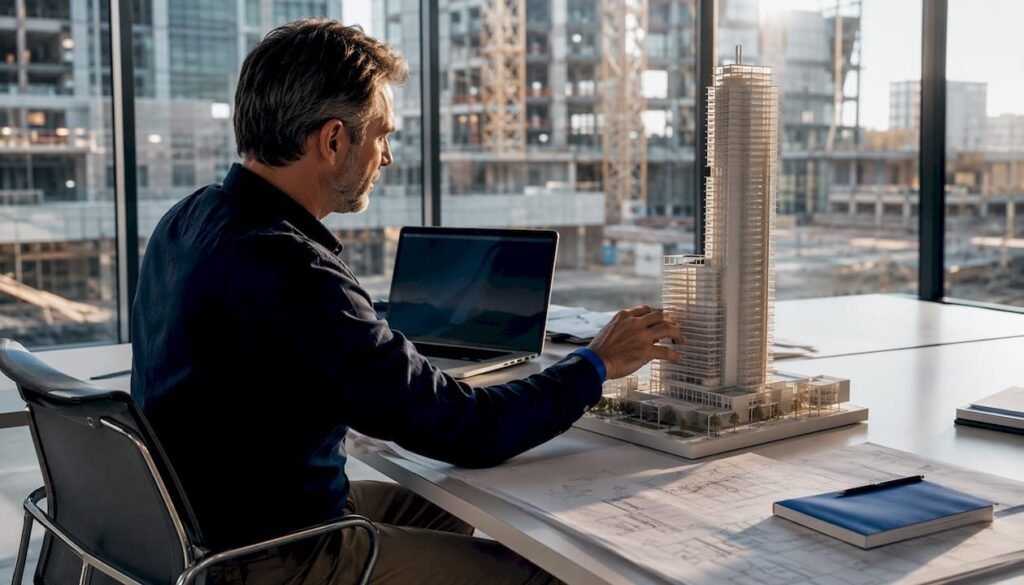
What is a digital twin and why is it changing construction?
A digital twin is a dynamic, real-time replica of a physical asset: in construction, this means having a precise, georeferenced digital copy of a building, construction site or infrastructure, continuously updated by IoT sensors, laser scans and software platforms. It is not a static model to consult once, but a living system that reflects what is physically happening at every moment.
Applications cover the entire life cycle of the building:
- Design: simulation of design scenarios to assess energy efficiency, costs and functionality before the first stone is laid
- Construction: monitoring progress with data from drones, sensors and laser scans, with immediate detection of deviations from the design
- Operations: continuous monitoring of systems, predictive analysis of consumption and maintenance planning
- Maintenance: identification of structural or energy anomalies before they become visible problems
One point should be clarified immediately: the Digital One-Stop Model for Construction (MUDE), used in Piedmont and other Italian regions, is a document platform for digitally submitting building applications to public authorities. It has nothing to do with a digital twin. Confusing the two is a common mistake that slows technology adoption.
How does a digital twin work on a construction site?
Its operation is based on a continuous, two-way flow of data. IoT sensors installed in a building or on a construction site collect information on temperature, humidity, structural loads, energy consumption and construction progress. This data feeds the digital model, which processes it and returns analyses, forecasts and operational alerts. Two-way data flow is precisely what distinguishes a digital twin from any other model: the system does not merely receive information; it uses it to update the replica and suggest actions.
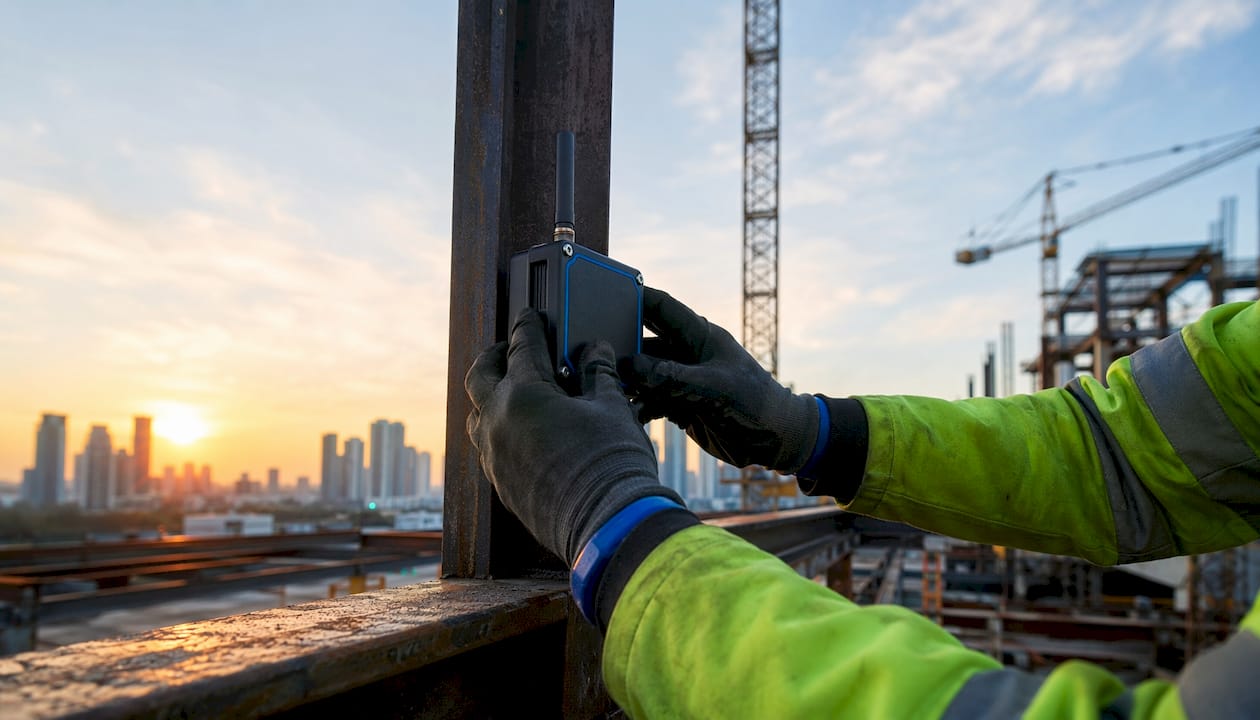
The main enabling technologies are IoT sensors and wireless networks, 3D laser scans for the geometric foundation, drones for photogrammetric surveying, software platforms such as Azure Digital Twins, Autodesk Tandem and Bentley iTwin, and artificial intelligence systems for predictive analysis. In Italy, integration with BIM is the most common starting point for those looking to adopt this technology.
Tip: Before purchasing sensors or software licences, map the critical systems in the building or on the construction site. A digital twin that monitors everything indiscriminately creates noise, not useful information.
Digital twin vs BIM: differences and synergies in a construction project
BIM and a digital twin are not the same thing, but they complement each other naturally. BIM describes what a building is; the digital twin describes what that building is doing now. This apparently simple distinction has profound operational implications.

| Aspect | BIM | Digital twin |
|---|---|---|
| Model type | Static, a snapshot of the design | Dynamic, updated in real time |
| Data source | Design documents, manual inputs | IoT sensors, building management systems |
| Update frequency | Occasional (renovations) | Continuous |
| Main phase | Design and construction | Operations and maintenance |
| Typical users | Architects, engineers, contractors | Facility managers, asset managers |
| Typical software | Revit, ArchiCAD, Navisworks | Azure Digital Twins, Autodesk Tandem, Bentley iTwin |
BIM provides the geometric and information structure on which the digital twin rests. Without BIM, a sensor detecting 24°C in a room does not know which room it belongs to, which system serves it, or how to interpret that data. With BIM as its foundation, every data point gains context. For Italian professionals, the practical sequence is: BIM first, then the digital twin when the building enters operation. To learn more about BIM’s role in the building life cycle, this guide for professionals provides useful context.
What tangible benefits does a digital twin bring to Italian companies?
Operational benefits are measurable and concern five main areas:
- Cost savings: the digital twin enables accurate estimates of where to reduce spending and where additional investment is needed, while keeping budgets on target
- Design efficiency: teams collaborate remotely on an always-updated model, without searching for information across multiple sources or waiting for periodic reports
- Risk reduction: an accurate representation of the building makes it possible to identify design defects or system malfunctions before they cause costly delays
- Safety: continuous monitoring of structural and environmental parameters reduces accidents on construction sites
- Sustainability: real-time analysis of energy consumption enables targeted measures to reduce environmental impact
Edil-up, for example, reports delivery-time reductions of up to 20% for companies adopting centralised digital construction-site management tools. The platform also calculates the environmental savings generated by digitised projects, linking operational management to tangible sustainability.
How to implement a digital twin in a construction project
Implementation does not require starting from scratch with a complete BIM model. A modular approach that begins with critical systems and scales gradually produces more defensible returns on investment and more sustainable data management.
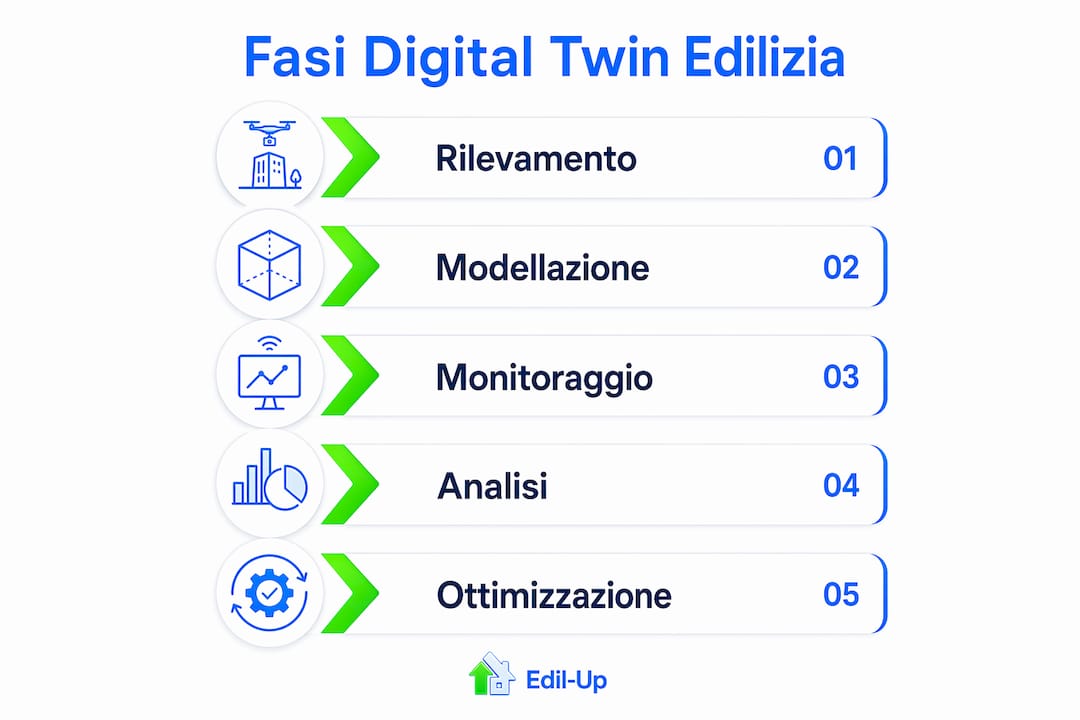
- Data acquisition and geometric foundation: carry out 3D laser scans of the existing building or construction site to create the reference point cloud
- Creation or updating of the BIM model: convert the scan into an as-built BIM model, which becomes the foundation of the digital twin
- Selection of systems to monitor: identify the systems and critical areas where IoT sensors should be installed (structure, HVAC, energy consumption)
- Software-platform integration: connect the BIM model to a digital-twin platform and configure data flows from the sensors
- Monitoring and predictive analysis: start continuous monitoring and set alerts for anomalies; use historical data for maintenance forecasts
- Team training: involve site managers and facility managers from the outset to overcome the cultural resistance slowing adoption in Italy
The most common challenge in Italy is not technical; it is cultural. Many professionals see a digital twin as an unnecessary expense because of a lack of understanding of its synergies with BIM and its tangible operational returns. Starting with a pilot project on a specific system, with measurable results within a few months, is the most effective way to convince even the most sceptical stakeholders.
Tip: Do not wait until you have a perfect BIM model to get started. A partial model focused on critical systems is already far more valuable than no digital twin at all.
Italian digital-twin solutions: Digital Teams Srl and Edil-up
The Italian market already includes specialised companies supporting the adoption of digital twins in construction.
Digital Teams Srl is an Italian company offering consultancy and technology solutions for implementing digital twins on construction sites and in construction projects. Its services cover requirements analysis, software-platform selection, integration with existing BIM systems and technical-team training. For companies approaching this technology for the first time, specialised consultancy significantly reduces the risk of poorly directed investments.
Edil-up addresses construction digitalisation from an operational and sustainable perspective. The platform connects companies and professionals in the sector, manages construction sites, documents and communications in a single digital environment, and promotes sustainable practices with tools for calculating and reducing environmental impact. For every active subscription, Edil-up plants trees, linking digitalisation to a tangible environmental commitment.
Specific benefits for Italian companies using Edil-up include shorter delivery times, centralised document management, direct communication between companies and real-time monitoring of construction progress. The platform is designed for companies of every size, with an affordable annual subscription model that also suits smaller businesses.
Regulations and compliance for digital twins in Italy
Italian regulations do not yet provide specific rules dedicated to digital twins in construction, but several existing provisions directly apply to their adoption. Decreto Ministeriale 560/2017 and the subsequent DM 312/2021 make BIM mandatory for public procurement above certain thresholds, creating the information foundation on which a digital twin is built. Companies working on public contracts must therefore already have BIM models compliant with IFC standards, which represent the natural starting point for a digital twin.
Regarding data protection, the GDPR applies whenever sensors collect data relating to natural persons, such as access-control systems or construction-site cameras. The UNI EN ISO 19650 standard governs information management throughout the construction life cycle and provides the most relevant methodological framework for those seeking to structure a digital twin’s data flows correctly. buildingSMART Italia is the national reference organisation for open interoperability standards, such as IFC and BCF, which ensure compatibility between different platforms.
Real-world digital-twin cases in construction
The best-documented case in Italy is that of the Municipality of Florence, which developed an urban digital twin funded by PON Metro 2014-2020 and REACT-EU funds. The system integrates LIDAR surveys, drones, road-based laser scanners and multispectral analysis to manage public green spaces, mobility, historic assets and energy sustainability. Machine Learning identifies territorial objects and supports the Piano del Verde with automated estimates of private green areas. A project on this scale demonstrates that the technology already works today; it is not a theoretical exercise.
Internationally, academic studies published in peer-reviewed journals confirm that BIM–digital-twin integration improves energy design, reduces costs and lowers environmental impact in construction. For medium-sized Italian construction sites, the most immediate applications concern structural monitoring, HVAC-system management and energy-consumption control during operation.
How much does adopting a digital twin cost, and when is the investment recovered?
Costs vary considerably according to building complexity and the level of integration selected. BIM modelling of an existing building typically costs between 1 and 7 dollars per square foot (a figure referring to the North American market), while adding a digital-twin platform with sensors and IoT integration brings the initial cost to between 5 and 25 dollars per square foot, plus recurring data-management and software-licence costs. In Italy, prices vary according to local providers and project complexity.
Return on investment comes primarily from three areas: energy savings through continuous consumption monitoring; lower maintenance costs through predictive maintenance that prevents sudden failures; and reduced operating costs because fewer physical inspections are required. A modular approach that starts with the systems having the greatest impact on costs makes it possible to justify the investment within the first years of operation. For companies seeking to understand how to prepare for digitalisation without starting from scratch, Edil-up offers accessible tools even for those at the early stages of the journey.
What obstacles are still slowing adoption in Italy?
The main barrier is not technological. Cultural resistance, the perception of digital twins as an unnecessary expense and a lack of in-house expertise are the obstacles most often cited by Italian professionals. Added to this is the sector’s fragmentation: many Italian construction companies are small or medium-sized businesses with limited resources for technology investments.
On the technical side, challenges concern the quality of the initial data (an incomplete or outdated BIM model produces an unreliable digital twin), interoperability between different platforms and the cost of maintaining sensors over time. Cybersecurity management is an emerging issue: a network-connected system is exposed to risks unknown to a traditional construction site. Finally, the shortage of professionals trained in these technologies in Italy is slowing adoption even among companies willing to invest. Digital construction-site management can be a practical first step towards these tools without immediately taking on the complexity of a complete digital twin.
Key points
Digital twins in construction transform building management from reactive to predictive, delivering measurable benefits in cost, safety and sustainability throughout the life cycle.
| Point | Details |
|---|---|
| BIM as the foundation | The digital twin is built on the BIM model: without a geometric foundation, sensor data loses context and usefulness. |
| Modular approach | Starting with critical systems rather than a complete model makes the investment easier to manage and returns faster. |
| Florence case | The Municipality of Florence implemented an urban digital twin with PON Metro funding, demonstrating feasibility in Italy. |
| Reference regulations | DM 560/2017 and 312/2021 make BIM mandatory for public procurement, creating the foundation for digital twins. |
| Cultural resistance | The main challenge in Italy is perceiving a digital twin as an unnecessary expense, not the technology itself. |
Edil-up supports Italian companies and professionals in digitalising construction sites, from document management to project monitoring, with a constant focus on sustainability. Discover how to begin digitalising your construction site or contact the team at edil-up.com/.