
The construction schedule is the document that defines the sequence, duration and dependencies of all activities on a construction site, coordinating time, resources and costs in a single operational framework. In public works, it is required by law under D.Lgs. 36/2023 and must form an integral part of the detailed design. Even in private works, anyone who forgoes this tool faces delays, uncontrolled costs and avoidable disputes. This guide takes construction professionals and managers through methodologies, common mistakes and digital tools for practical, effective planning.
What is a construction schedule and why is it mandatory?
The construction schedule, also known as the works programme or time plan, is the technical document that organises every project phase in a logical, chronological sequence. Article 40 of D.P.R. 207/2010 defines its minimum contents: work phases, durations, forecast costs and allocated resources. D.Lgs. 81/2008 adds a further obligation, requiring the Safety and Coordination Plan (PSC) to be integrated with the site’s work sequences.
A schedule integrated with the PSC improves the management of interfaces between activities and reduces the risk of disputes. This means planning is not merely a bureaucratic requirement: it is an active control tool that protects the client, contractor and works director.

The distinction between a static document and a living tool is what separates well-managed sites from those that accumulate delays. A schedule updated in real time makes it possible to intervene before a local problem becomes a general stoppage.
Which tools and methods should be used to plan the works?
The Gantt chart
The Gantt chart is the most widely used graphical representation for planning construction works. It shows each activity as a horizontal bar on a timeline, with duration, sequence and progress status visible at a glance. Critical activities are highlighted in red, making site monitoring immediate.
The Gantt chart is not just a graphic: it is the shared reference point for the works director, contractor and client. Updating it regularly turns a project document into an operational communication tool.
The Work Breakdown Structure (WBS)
The WBS breaks the project down into manageable phases, activities and sub-activities. Each ideal activity lasts between 1 and 10 working days: this level of detail makes it possible to estimate durations realistically and assign responsibilities precisely. Without a well-constructed WBS, the Gantt chart risks becoming an approximate representation rather than a control tool.
The critical path
The critical path is the sequence of activities that determines the minimum project duration. Any delay to a critical activity directly affects the final completion date. Non-critical activities, on the other hand, have a flexibility margin (float) that allows the works to be reorganised without compromising deadlines.
Understanding the critical path changes how a site is managed. Additional resources should be concentrated on critical activities: adding resources to non-critical activities does not reduce the project’s overall duration.
Digital tools compared
| Type of tool | Main features | Suitable for |
|---|---|---|
| Specialised desktop software | Advanced Gantt, critical path, resource management | Large sites and public contracts |
| Collaborative web platforms | Real-time updates, team sharing | Sites involving multiple parties |
| Structured spreadsheets | Basic planning, low cost | Small works and quick estimates |
| Mobile construction-site apps | Progress monitoring, photos, notes | Forepersons and site-based directors |
Tip: Before choosing a digital tool, check that it supports PDF export and sharing with the client. Document transparency is part of service quality.
How to build a construction schedule step by step
An effective schedule starts with accurate data collection, not a back-of-the-envelope estimate. These are the practical steps to follow.
- Collect project information. Obtain drawings, the bill of quantities, specifications and operational constraints (site access, working hours, seasonality).
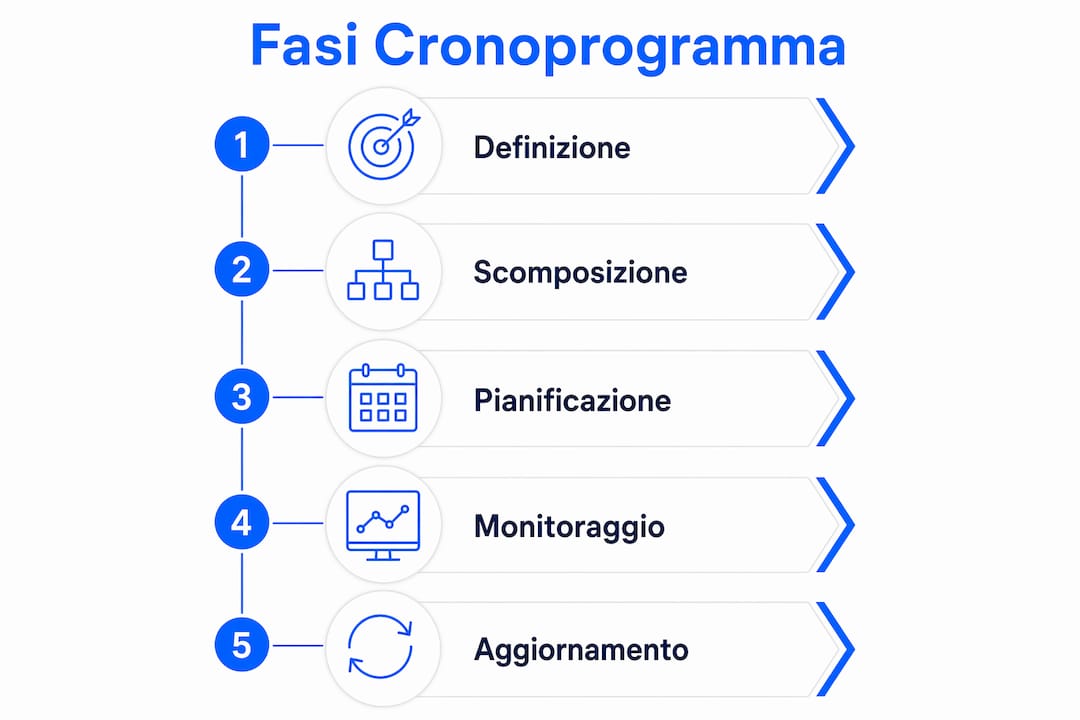
- Break the project into phases and activities using the WBS. Divide the project into major phases (demolition, structures, building services, finishes) and then into elementary activities with estimable durations.
- Estimate durations. Use historical data from similar sites, average labour productivity and technical data sheets for materials. Avoid unverified optimistic estimates.
- Define logical dependencies. Establish which activities must finish before others can begin (finish-to-start), which can overlap and which are independent.
- Identify the critical path. Calculate the float for each activity and identify the sequence without a margin. This becomes the main focus during execution.
- Assign resources. Check that labour, equipment and materials will be available within the planned time windows. An activity planned without available resources is a scheduled delay.
- Insert milestones. Define intermediate control points: structural completion, envelope closure, systems testing, key handover. Milestones make progress measurable and communicable to the client.
Tip: Include the client’s decision deadlines in the schedule as well: material approvals, finish selections and site inspections. Unmet client decision deadlines are among the most frequent causes of delay in mid-to-high-end refurbishments.
One frequently overlooked step is checking procurement times. Bespoke windows and doors, technical furnishings and special finishes can have production times exceeding 8–12 weeks. Including these lead times in the schedule from the design stage is the difference between on-time handover and a site standing idle while waiting for materials.
How to monitor and update the construction schedule during the works
Active monitoring is the stage that distinguishes a good project manager from someone who merely produces documents. The schedule must be updated in real time to reflect changes and delays, rather than remaining a static document signed during the design phase.
The most effective monitoring techniques include:
- Weekly progress meetings with the people responsible for each work package, to identify deviations before they become critical.
- Updating the Gantt chart after every significant change, recording the revision date and the reason for the deviation.
- Comparing planned and actual progress, expressed as a percentage of completion for each activity.
- Checking the updated critical path, because a delay to a non-critical activity can become critical if it consumes all its float.
- Transparent communication with the client, through periodic reports showing the site’s actual status and the corrective actions under way.
When a delay occurs, the most effective recovery strategies are parallelising compatible activities and reallocating resources from the non-critical path to the critical path. Simply adding working hours without analysing the critical path creates additional costs without recovering time. The digitalisation of the construction sector has made platforms available that automatically update the Gantt chart as activities change, reducing the risk of working with obsolete data.
Tip: Assign responsibility for updating the schedule to one person only. Splitting this function among several people creates different versions in circulation and decisions based on misaligned data.
Common mistakes in managing a construction schedule
Some mistakes recur on almost every site that accumulates delays. Recognising them early is the fastest way to avoid them.
- Underestimating procurement times. Failure to coordinate with the lead times of non-standard materials causes delays that cannot be recovered. Windows and doors, bespoke furnishings and special finishes must be ordered before the site reaches the phase in which they are needed.
- Failing to include the client’s decision deadlines. Every approval, material choice or inspection requested from the client has a time window. If it is not in the schedule, it is not managed.
- Intervening on non-critical activities to shorten the programme. Adding resources where they are not needed does not change the handover date. Only activities on the critical path determine the final duration.
- Treating the schedule as an immutable document. A plan that is not updated is of no use to anyone. Rigidity is the main cause of deviations not being identified in time.
- Fragmenting responsibility among too many people. When no one has an overall view, each subcontractor optimises their own segment at the expense of the project.
“True success comes from real-time updating and proactive strategies such as parallelising activities, not simply extending the Gantt chart.”
A single point of contact with an integrated view of the site, coordinating works, procurement and decision deadlines, structurally reduces the risk of delay. Centralised project management is not a luxury: it is the condition for maintaining control over complex sites.
Key points
An effective construction schedule requires a detailed WBS, identification of the critical path and continuous updating to maintain control over time, costs and resources.
| Point | Details |
|---|---|
| Regulatory requirement | D.Lgs. 36/2023 and D.P.R. 207/2010 make the construction schedule mandatory for public works. |
| Critical path | Only critical activities determine the final duration: concentrate additional resources there. |
| Continuous updating | Update the Gantt chart after every significant change to avoid decisions based on obsolete data. |
| Material lead times | Plan orders for non-standard materials well in advance to avoid delays that cannot be recovered. |
| Single responsibility | Assign schedule management and updating to one person to maintain consistency. |
The construction schedule as a quality tool, not just a control tool
I have seen well-designed sites turn into disputes for one reason alone: the schedule was prepared once and then forgotten in a drawer. Works planning is not a box-ticking exercise; it is the language a professional uses to communicate reliability to the client.
What has convinced me over time is that delays rarely arise from technical unforeseen events. They arise from decisions not made in time, materials ordered late and subcontractors who did not know what the person next to them was doing. An updated, shared schedule eliminates these blind spots.
Sustainability comes into play here in a very practical way. A site that meets its deadlines consumes less energy, generates less material waste and reduces unplanned transport. Good planning is not only economic efficiency: it is a reduction in environmental impact. Digital platforms that integrate activity monitoring and communication between the parties involved make this level of control accessible even to medium-sized sites, not only large contractors.
My standing advice is this: treat the schedule as a living document. Update it every week, share it with everyone involved on site and use it as the basis for every decision. Those who do so reduce delays, improve margins and build a strong reputation over time.
— Edil
Edil-up for digital construction schedule management
Managing a site with fragmented tools means wasting time reconciling data that should already be aligned. Edil-up is the platform that centralises site management, activity monitoring and communication between the companies involved in a single digital environment.

With Edil-up, construction professionals reduce handover times by up to 20% thanks to an integrated view of the project. The platform also calculates the environmental savings generated by digitalised projects and plants one tree for every active subscription. For anyone wishing to take digital site management to a higher level of control and sustainability, Edil-up provides the tools to do so. Discover the available plans at edil-up.com/pricing and start planning systematically.
Frequently asked questions
What is a construction schedule in the building industry?
The construction schedule is the technical document defining the sequence, duration and dependencies of all activities on a site. In public works, it is required by law under D.Lgs. 36/2023.
What is the difference between a Gantt chart and a construction schedule?
The Gantt chart is the graphical representation of the construction schedule. The schedule is the complete document, also including resources, costs and logical dependencies between activities.
How is the critical path identified?
The critical path is the sequence of activities with no flexibility margin (zero float). It is calculated by adding the durations of the activities connected by the longest dependency from the start to the end of the project.
How often should the construction schedule be updated?
The schedule should be updated whenever a significant change occurs and, in any event, weekly while the works are under way. Timely updating makes it possible to activate recovery strategies before the delay becomes irrecoverable.
Which mistakes cause the most delays on construction sites?
The most frequent delays result from failing to plan procurement times for non-standard materials and failing to include the client’s decision deadlines in the schedule.
Recommended
- News – Edil-up – Sustainable construction for the future
- Companies – Edil-up – Sustainable construction for the future
- Eco – Edil-up – Sustainable construction for the future
- Pricing – Edil-up – Sustainable construction for the future