
Construction progress monitoring is the operational process that transforms site surveys, documents and digital data into a verifiable, up-to-date Stato Avanzamento Lavori (SAL). If the SAL does not reflect actual measurements, it is not an accounting document: it is an estimate, and estimates generate disputes. Three actions to take immediately:
- Verify the latest SAL against actual surveys: compare the quantities recorded with those actually measured on site. Any discrepancy must be resolved before the next payment certificate.
- Start collecting georeferenced photos and digital daily reports: every activity must be documented with dated and signed images linked to the site location. Without this evidence, the measurements remain open to dispute.
- Appoint those responsible for subsequent checks: who surveys, who verifies, who signs the SAL. Undefined roles mean data is not collected.
Digitising surveys, with digitally signed photographic reports, reduces disputes and speeds up payments. This is not a marketing promise: it is the direct consequence of having incontrovertible evidence when the certificate is issued.
Contents
- What is the SAL and how does it connect to project monitoring?
- Why construction progress control is worth more than you might think
- What are the operational monitoring stages, from survey to SAL signature?
- Which KPIs should be measured to keep the SAL under control?
- Which tools and technologies make monitoring genuinely effective?
- How do you start monitoring on a construction site: checklists and operational templates
- Which recurring errors hold up the SAL and how can they be avoided?
- Quick checklist of best practices to follow on site
- Real case: how a digital platform improves SAL quality
- Key points to take straight to the site
- How construction progress monitoring will evolve in the coming years
- Edil-up for digital site monitoring
- Useful sources and technical and regulatory references in Italy
- Edil’s point of view
What is the SAL and how does it connect to project monitoring?
The SAL is the document that certifies how much has actually been completed on site and makes it possible to calculate the amounts accrued by the contractor. It does not show what is planned, but what has been done: this distinction is the foundation of all construction accounting.
The operational flow is precise: site survey → entry in the measurement book → transcription into the accounting register → issue of the SAL → payment certificate. Skipping a step or reversing the order creates discrepancies that always emerge, usually at the worst possible moment.
Quick glossary for site managers:
- Measurement book: the primary document in which the site manager (or their delegate) records the quantities measured for each activity.
- Accounting register: collects and totals the data from the measurement book; it is the basis of the SAL.
- Accrued amount: the total value of the activities completed and recorded up to that point.
- Lump sum vs measured contract: under lump-sum contracts, the consideration is fixed for the entire work; under measured contracts, payment is based on the quantities actually completed, measured and verified.
The SAL must be based on actual measurements and surveys), not on planned work that has not yet been completed. Art. 194 of DPR 207/2010 governs the method and function of the SAL in public-works accounting, establishing minimum content and signature requirements.
Why construction progress control is worth more than you might think
The SAL is not a bureaucratic formality. According to Unione Ingegneri, it is the main tool for managing a site’s finances: poor management translates directly into disputes and financial variances. Anyone who treats it as a formality discovers the cost when the first dispute over the payment certificate arrives.
The benefits of rigorous monitoring are tangible:
- Timely payments: an accurate, well-documented SAL reduces the client’s approval time because it leaves no room for objections about quantities.
- Visibility of variances: comparing accrued value with planned value makes it possible to identify delays or cost overruns before they become impossible to recover.
- Dispute prevention: sound SAL management improves transparency between client and contractor and reduces the likelihood of financial disputes.
Key figure: Automated validation solutions claim reporting-time reductions of up to 80% by automating the verification of quantities against site evidence.
The risks of poor management are the mirror image: discrepancies between the measurement book and accounting register, delays in issuing certificates, and disputes that block payments for weeks or months. On an average construction site, every week’s delay in the certificate has a real financial cost for the contractor.
Advice: Integrating the digitally signed daily report with the automatic update of the accounting register eliminates manual double entry, the main source of discrepancies in SALs.

What are the operational monitoring stages, from survey to SAL signature?
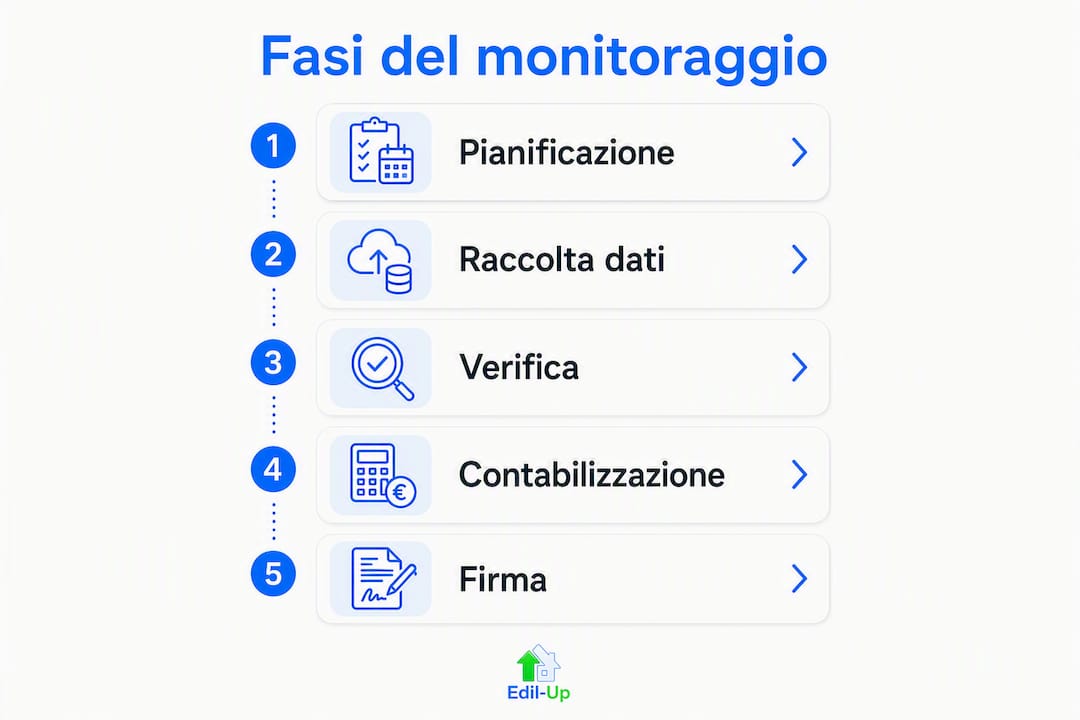
The process consists of five distinct stages. Carrying them out in the correct order is not simply a matter of method: it is what makes the SAL defensible in the event of a dispute.
Stage 1: planning. Before work starts, define the survey frequency (weekly, fortnightly or monthly depending on complexity), contractual milestones and those responsible. Who surveys, who verifies, who signs: every role must have a name.
Stage 2: site data collection. Daily reports, georeferenced photos and direct measurements. Where the project provides for it, data can come from BIM models or point clouds generated through photogrammetry. Images organised by date and location improve evidence traceability and make the joint review much faster.
Stage 3: verification and joint review. The recorded measurements are shared with the executing contractor. Any disputes are resolved at this stage, not after the SAL has been signed. A scheduled joint review reduces approval times.
Stage 4: accounting and preparation of the SAL. The verified data moves from the measurement book to the accounting register. The SAL is prepared and the payment certificate issued.
Stage 5: signature, archiving and version control. The document digitally signed by all parties is archived with version control. Every subsequent change must be tracked.
| Stage | Main activity | Typical responsible party | Output |
|---|---|---|---|
| Planning | Define frequency, milestones and roles | Site manager / PM | Monitoring plan |
| Data collection | Daily reports, photos, measurements, BIM | Site foreman / Technician | Updated measurement book |
| Verification | Joint review with contractor | Site manager | Validated and signed measurements |
| Accounting | Accounting register, SAL preparation | Accounting manager | SAL issued |
| Signature and archive | Digital signature, version control | All parties | Payment certificate |
Which KPIs should be measured to keep the SAL under control?
A SAL without KPIs is a static document. KPIs turn monitoring into a predictive tool: they flag variances before they become problems.

| KPI | How it is calculated | Alert threshold |
|---|---|---|
| Completion percentage by activity | Completed quantity compared with planned quantity | Variance > 10% against the schedule |
| Accrued value (€) | Sum of the activities recorded during the period | Below the planned value for the period |
| Time variance | Days late compared with the schedule | More than 5 days on critical activities |
| Non-conformities per inspection | Number of findings with deviations / total inspections | More than 1 non-conformity per 10 inspections |
| Cost variance (%) | Percentage difference between actual and planned cost | Above +5% requires immediate analysis |
EVM (Earned Value Management) in its basic form compares planned value with accrued value: if accrued value is lower than planned value, the site is behind the progress budget. You do not need an enterprise platform to apply it: the data from the accounting register and a spreadsheet updated for each SAL are enough.
For site meetings, three KPIs are enough: completion percentage for critical activities, accrued value for the period and number of open non-conformities. Everything else is further analysis for those managing the accounts.
Which tools and technologies make monitoring genuinely effective?
Technology cannot fix a poorly defined process. But a well-defined process with the right tools becomes scalable and defensible. The main categories are:
- Apps for digital daily reports: enable completion on site, immediate digital signature and automatic data upload. They eliminate manual transfer to a spreadsheet.
- Document management with version control: centralises the measurement book, SALs and certificates in a single archive accessible to all authorised parties. Structured document management reduces the risk of working on obsolete versions.
- Photogrammetry and drones: useful for large sites or complex geometries. They generate point clouds that can be compared with the BIM model to verify completed quantities.
- BIM models: when integrated with monitoring, they make it possible to associate each activity with a model element and automatically update recorded quantities.
- Time-lapse cameras: document visual site progress with georeferenced images organised by date, useful both for joint review and communication with the client.
- AI quantity validation: artificial-intelligence solutions automate verification of quantities from photographic and documentary evidence, freeing the team from manual entry.
What to look for in site SAL software: native integration with the accounting register, support for the measurement book, compliant digital signature, photo georeferencing and a configurable KPI dashboard. The choice of the right software also depends on scalability and interoperability with systems already in use.
Advice: Start with the essential modules: digital daily report, signed photos and KPI dashboard. Enable complex integrations (BIM, drones, AI) only after the basic process works reliably.
For anyone also assessing incentives available for digitisation, the Piano Transizione 5.0 provides tax benefits that may cover part of the investment in digital platforms and tools for the construction site.
How do you start monitoring on a construction site: checklists and operational templates
The first week determines whether the process will take hold or remain on paper. Here is the minimum operational sequence.
| Day | Activity | Who |
|---|---|---|
| 1 | Define roles: who surveys, who verifies, who signs | PM / Site manager |
| 1–2 | Configure the platform: daily-report templates, access rights and document folders | PM / IT manager |
| 2–3 | Train the team to complete daily reports and upload photos | Site foreman |
| 3–4 | First data collection: daily report + georeferenced photos for every active activity | Site technician |
| 5 | First check: compare recorded measurements with the work schedule | Site manager |
| — | First progress meeting: present KPIs and identify variances | PM + team |
Minimum fields for an effective digital daily report: date and time, operator’s name, activity completed, measured quantity (with unit), attached georeferenced photo, digital signature and notes on anomalies or variations.
Minimum fields for the SAL template: sequential number, reference period, list of activities with quantities and amounts, total accrued value, comparison with the previous SAL, and the signatures of the site manager and contractor.
The recommended frequency depends on complexity: simple sites can work with monthly SALs; sites with several contractors, frequent variations or closely spaced contractual deadlines require a fortnightly schedule. Integrating the SAL with invoicing means that each approved payment certificate automatically generates the basis for the invoice: less waiting, fewer errors and faster payments. Centralised project management makes this connection much more direct.
Which recurring errors hold up the SAL and how can they be avoided?
Problems in site monitoring recur in the same places. Recognising them in advance is already half the solution.
- Fragmented data: paper daily reports, photos on personal phones and measurements in separate spreadsheets. The solution is a single digital collection point accessible from the site.
- Measurements not verified before accounting: entering unvalidated data in the accounting register produces disputable SALs. The survey → verification → accounting sequence is non-negotiable.
- Delays in recording: every day’s delay in completing the daily report increases the risk of forgetting details or no longer being able to georeference photos correctly. Recording must take place on the same day as the survey.
- Undefined responsibilities: if nobody knows who must sign the daily report, nobody signs it. Every document must have an appointed owner.
To reduce disputes, three tools are particularly effective: scheduled joint reviews (not improvised ones), a change log for every contract variation, and systematic backup of photographic evidence. A signed daily report that automatically updates progress avoids data duplication and reduces accounting errors.
Advice: Linking signed daily reports to automatic SAL updates is the single automation with the greatest impact on construction-accounting quality. Those who do it stop reconciling data at the end of the month.
Quick checklist of best practices to follow on site
This table works as an operational reminder to print and keep on site or upload to the management platform.
| Item | Frequency | Operational notes |
|---|---|---|
| Completed and signed daily report | Every working day | Digital signature mandatory; no retroactive entry beyond 24 hours |
| Georeferenced photos for every activity | Every survey | At least 2 photos per activity; date and GPS position visible |
| Measurement book update | Every survey | Verified quantities only; no unconfirmed estimate |
| Accrued vs planned comparison | Every SAL | Variance > 10% requires an explanatory note |
| Joint review with contractor | Before SAL signature | Scheduled, not improvised |
| Progress meeting | Weekly or fortnightly | KPIs presented: completion, accrued value and open non-conformities |
| Photographic-evidence backup | Automatic, every upload | Archive with version control; access limited to authorised roles |
| Signature check on all documents | Before issuing the certificate | A SAL without complete signatures is not valid for payment |
Synchronising the measurement book and accounting register, with digital signatures for activities, keeps the SAL updated without duplicate manual entry.
Real case: how a digital platform improves SAL quality
Context: a medium-sized construction company active on residential and commercial sites managed monitoring with paper daily reports, photos on personal devices and SALs prepared manually at the end of each month. The three main problems were measurements not reconciled between the measurement book and register, average delays of 8–10 days in issuing payment certificates, and frequent disputes over recorded quantities.
Actions taken: adoption of a digital platform for collecting daily reports with integrated digital signature, activation of a real-time KPI dashboard, and connection between approved daily reports and the accounting register.
| Indicator | Before implementation | After implementation |
|---|---|---|
| Average days to issue certificate | 8–10 days | 3–4 days |
| Measurements reconciled on the first attempt | a moderate proportion | a high proportion |
| Disputes per SAL | some regular disputes | a reduced number of disputes |
| Time to complete daily report | extended time on paper | significantly reduced time digitally |
Operational notes for replicating the case: a three-stage rollout works well. First week: platform configuration and team training (maximum 2 hours). Second week: parallel collection (paper + digital) to validate the process. From the third SAL cycle: digital only, with KPI checks at every progress meeting. Cloud solutions centralise operational data and enable continuous comparison between the planned project and actual status.
Key points to take straight to the site
Construction progress monitoring produces reliable SALs only when actual measurements, defined responsibilities and digital tools work together systematically.
| Point | Details |
|---|---|
| Non-negotiable operational sequence | Survey → verification → accounting: reversing the order produces disputable SALs. |
| Minimum KPIs to monitor | Completion percentage, accrued value and open non-conformities for each SAL period. |
| Digitisation as a priority | Signed digital daily report + georeferenced photos is the minimum combination for reducing disputes. |
| Roles defined before starting | Who surveys, who verifies, who signs: without assigned names, data is not collected. |
| Edil-up as a starting point | Edil-up provides document management, digital daily reports and KPI dashboards to start monitoring without complex infrastructure. |
How construction progress monitoring will evolve in the coming years
The integration of artificial intelligence and site monitoring is no longer a future prospect: it is already operational in some organisations. AI automatically validates quantities by comparing photographic evidence with the project model, reducing the time spent on manual reconciliation. The next step is IoT connectivity: sensors on machinery and structures that feed progress data in real time, without anyone having to complete a daily report.
BIM interoperability will become a de facto standard. Those managing complex sites without an updated BIM model will find it increasingly difficult to justify recorded quantities to clients who are increasingly demanding traceability.
For project managers, preparation requires two concrete steps: train the team to use data, not just complete documents, and test a pilot on a medium-sized site before extending the process across the organisation. Those who wait for the technology to be “mature” are already falling behind. The digitisation of the construction sector is advancing at a pace that rewards those who start with a simple process and refine it over time, not those who wait for the perfect solution.
Edil-up for digital site monitoring
Anyone who has read this guide already knows what is needed: signed digital daily reports, georeferenced photos, KPI dashboards and a document workflow connecting the survey to the payment certificate without duplicate manual entry.
Edil-up makes all this available in one platform designed for construction companies and professionals. Document management with version control, digital daily reports with integrated signatures, a progress-control dashboard and networking tools between companies are available with an annual subscription, with no infrastructure to install. Companies adopting Edil-up improve delivery times, with a direct impact on liquidity and the quality of issued SALs. Those who want to get started can see the available options on the pricing and plans page. Anyone who prefers to understand how to structure the digitisation process first can start with the guide to construction digitisation.
Useful sources and technical and regulatory references in Italy
| Resource | Type | Practical use |
|---|---|---|
| Art. 194 DPR 207/2010 | Regulation | Minimum SAL requirements for public works; take it to the site for the first check |
| Wikipedia: Stato avanzamento lavori) | Technical reference | SAL definition and operating principles; useful for aligning the team on terminology |
| Unione Ingegneri: SAL and financial management | Professional guide | SAL’s accounting role and dispute reduction; recommended reading for site managers |
| OPERO: SAL and construction sites | Operational guide | Best practices for synchronising the measurement book, accounting register and digital signature |
| Edil-up: construction-site document management | Internal resource | How to organise documents, version control and access for the SAL workflow |
| Edil-up: construction-site management software | Internal resource | Software-selection criteria; useful before assessing market solutions |
| Edil-up: communication in projects | Internal resource | Communication processes and responsibilities in monitoring |
Edil’s point of view
Construction progress monitoring is one of those topics where the gap between theory and practice is enormous. Guides explain the correct flow: survey, measurement book, register, SAL, certificate. But on site, the problem is not failing to know the sequence. It is that the sequence always breaks at the same point: between the survey and the recording.
A site foreman who returns at the end of the day with measurements in their head and photos on a personal phone is not negligent. They are simply working in a system that does not support them. The paper daily report that reaches the office three days later, the photo without georeferencing, the measurement written on a sheet nobody knows the whereabouts of: these are not individual errors, but process defects.
The real breakthrough is not adopting a more sophisticated tool. It is reducing the distance between the survey and the recording to zero. When the daily report is completed on site, signed on site and automatically updates the register, the SAL stops being a monthly reconciliation and becomes a continuous reflection of site reality.
Anyone managing complex sites knows that disputes rarely arise from bad faith. They arise from missing evidence, unverified measurements and documents nobody knows how to find. Digitising the survey process is not a technological luxury: it is the most direct response to this problem.