
The practical alternatives to Cantiereinrete for Italian companies and professionals are, in order: Edil-up as the recommended choice for those seeking integrated construction-site management, networking, and a focus on sustainability; followed by specialized solutions for AI-powered cost control, remote monitoring with GDPR compliance, and document management with BIM workflows. The choice depends on three concrete variables: integration with the Sistema di Interscambio (SDI) for electronic invoicing, compliance with D.Lgs. 81/2008 on safety, and the availability of support in Italian.
Quick shortlist:
- Edil-up — recommended for SMBs and professional firms seeking construction-site management, job postings, networking among companies, and measurement of environmental savings. Annual Plus subscription plan, training, and support in Italian.
- Cost-control/AI solution (category) — for general contractors with a strong need for margin forecasting, automatic SAL reports, and alerts for budget overruns.
- Remote monitoring and HSE solution (category) — for sites with stringent safety and traceability requirements, with automatic face blurring and certified evidence retention.
- Document management/BIM and SAL (category) — for construction managers and technical firms working in BIM environments and requiring certifiable SAL generation.
Choose Edil-up if your priority is an Italian platform that combines site operations, professional networking, and measurable environmental commitment. Consider the other categories if you have highly specific needs for advanced financial control, certified video surveillance, or native BIM integration.
Table of contents
- Quick comparison: what does each platform do?
- Why are companies looking for alternatives to Cantiereinrete?
- What features should software for the Italian market have?
- Alternative profiles: what does each solution offer?
- How to choose: a five-step process and questions to ask
- How we selected and compared the alternatives
- AI, IoT, and sustainability: where is construction-site management heading?
- Key points
- Choosing Edil-up is about more than features
- Edil-up: site management, networking, and sustainability in one platform
- Useful resources for further reading
Quick comparison: what does each platform do?
| Solution | Ideal for | Key features | License model | Support and localization | Mobile app | Integrations | Demo/Trial |
|---|---|---|---|---|---|---|---|
| Edil-up | Construction SMBs, tradespeople, professional firms | Site management, job postings, networking, document management, eco-sustainability | Annual SaaS, Plus plan | Italian, local support, GDPR | Yes | Accounting, construction marketplace | Yes |
| Cost-control platform (AI) | General contractors, companies focused on margins | Margin forecasting, automatic SAL reports, AI budget alerts, subcontractor analysis | Per-user/per-project subscription | Technical support, EU hosting | Yes | ERP, accounting | Demo on request |
| Remote monitoring/HSE platform | Sites with stringent HSE requirements | Face/license-plate blurring, timestamping, access management | Subscription + sensor hardware | Technical support, GDPR-compliant | Yes | Access systems, IoT alerts | Demo on request |
| Document management/BIM and SAL platform | Construction managers, technical firms | BIM workflows, SAL generation, data import/export, document management | Per-project or per-user license | Technical support, varying localization | Partial | BIM authoring, accounting management systems | Trial available |
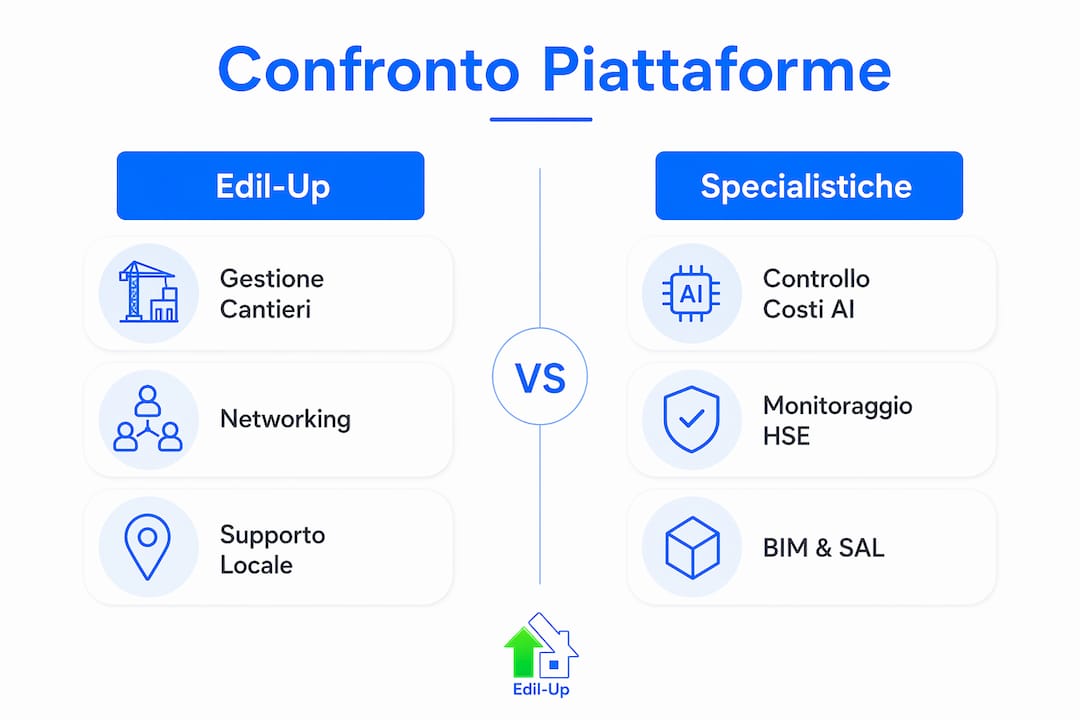
Notes on availability in Italy: Edil-up was created for the Italian market. The other categories include solutions available in Italy, but complete localization (interface, support, regulatory compliance) must be verified case by case before signing a contract.
Why are companies looking for alternatives to Cantiereinrete?
Cantiereinrete is an Italian platform that integrates sensors and management modules for traceability and safety on construction sites. It works well for those who need 24/7 environmental monitoring and traceability. But it is not the right answer for everyone.
The reasons companies look for platforms similar to Cantiereinrete are often these:
- Missing or limited SDI/electronic-invoicing integration: those issuing invoices to public or private clients need a native SDI workflow, not a manual export to a separate management system.
- SAL management that cannot be certified: progress reports must be traceable and shareable with construction management. If the platform does not generate structured SALs, the work shifts to Excel spreadsheets.
- Incomplete compliance with D.Lgs. 81/2008: safety document management (DVR, POS, DUVRI, worker training) requires dedicated modules, not shared folders.
- HSE monitoring without certified evidence: for sites subject to inspections, photographic or video evidence must have a timestamp and a verifiable chain of custody.
- BIM needs not covered: technical firms and construction managers working with IFC models need a direct link between the model and document management.
- Real-time cost control: companies with several active sites at the same time cannot wait for the monthly report to find out whether a subcontractor is exceeding the budget.
- Support and training in Italian: software that responds in English or has non-localized documentation slows adoption, especially among SMBs.
Concrete scenario 1: a small-to-medium-sized construction company manages several sites at the same time. It needs progress reports shareable with the client, timesheets for its workers, and integrated electronic invoicing. Cantiereinrete covers traceability, but not the complete document cycle.
Concrete scenario 2: a general contractor with multiple subcontractors wants to know in real time whether the costs of a lot are exceeding the estimate. A proactive alert system is needed, not a weekly report.
One piece of advice: before evaluating any alternative, list the three processes that currently cost you the most time or cause the most errors. That list is your selection criterion—not the features listed in vendor brochures.
What features should software for the Italian market have?
The checklist below applies to any evaluation, regardless of the platform. Use it as a filter before requesting a demo.
Regulatory and operational requirements:
- Native SDI integration for electronic invoicing (XML/FatturaPA format)
- HSE module with document management compliant with D.Lgs. 81/2008 (DVR, POS, DUVRI, training register)
- SAL generation and signing with version traceability
- Timesheets and attendance management with payroll export
- Certified retention of photos and videos with timestamping (relevant to GDPR and disputes)
- BIM integration or IFC import/export for technical firms and construction managers
Technical and integration requirements:
- Native connectors or documented APIs to accounting management systems (e.g., Zucchetti, TeamSystem, SAP)
- Offline-capable mobile app for the site manager (not just viewing, but data entry)
- Hosting in Europe with explicit data-retention policies
- Documented GDPR compliance, not merely a statement
Support requirements:
- Support in Italian with response times defined contractually
- Onboarding training included or available at a transparent cost
- Documentation and video tutorials in Italian
One piece of advice: to verify actual SDI integration, ask the vendor for a live demonstration of sending a test invoice to the Sistema di Interscambio. If they cannot show it in the demo, they will not do it in production either.
For SMBs with limited budgets, it is better to have working SALs, timesheets, and electronic invoicing than an unused BIM module. General contractors with more than 20 active sites, on the other hand, cannot give up real-time cost control and ERP integrations.
Alternative profiles: what does each solution offer?
Edil-up: the Italian platform for construction sites and networking
Edil-up is built for the Italian market and covers a broader scope than a simple construction-site management system. The platform combines centralized project management, job postings, networking among companies, document management, and tools to measure and reduce the environmental impact of digitalized construction sites. For every active subscription, Edil-up plants trees, making sustainability a measurable element rather than merely a stated commitment.
The subscription model is annual SaaS with a Plus plan for companies and professionals. Training and support are in Italian. Edil-up reports a reduction in delivery times of up to 20% thanks to improved coordination among the parties involved in the project.
Strengths: Italian platform, integrated networking, job postings, measurable sustainability, local support.
Limitations: less focused on advanced AI cost control or certified video surveillance than specialized solutions.
Ideal for: construction SMBs, tradespeople, professional firms, suppliers, and resellers wanting a single solution to manage sites and build relationships in the sector.
Demo/trial: available.

Cost-control and margin-forecasting solution (AI category)
Platforms in this category, such as those offering AI features for real-time cost control, stand out for their ability to compare actual costs with estimates, generate margin forecasts, and send automatic alerts when a subcontractor or cost item exceeds the threshold. Some integrate an AI agent that monitors financial progress without manual intervention.
Strengths: proactive forecasting of overruns, automatic SAL reports, subcontractor analysis.
Limitations: generally higher cost, learning curve for those without structured cost-control processes.
Ideal for: general contractors with multiple active sites, companies under strong margin pressure.
Demo/trial: on request, often with a guided session.
Remote monitoring and HSE solution (category)
These platforms focus on the certified retention of photographic and video evidence, with automatic blurring of faces, license plates, and sensitive areas to comply with GDPR without sacrificing traceability. Timestamping evidence reduces disputes in the event of accidents or inspections. Granular access management makes it possible to define who can see what, a requirement often underestimated in public tenders.
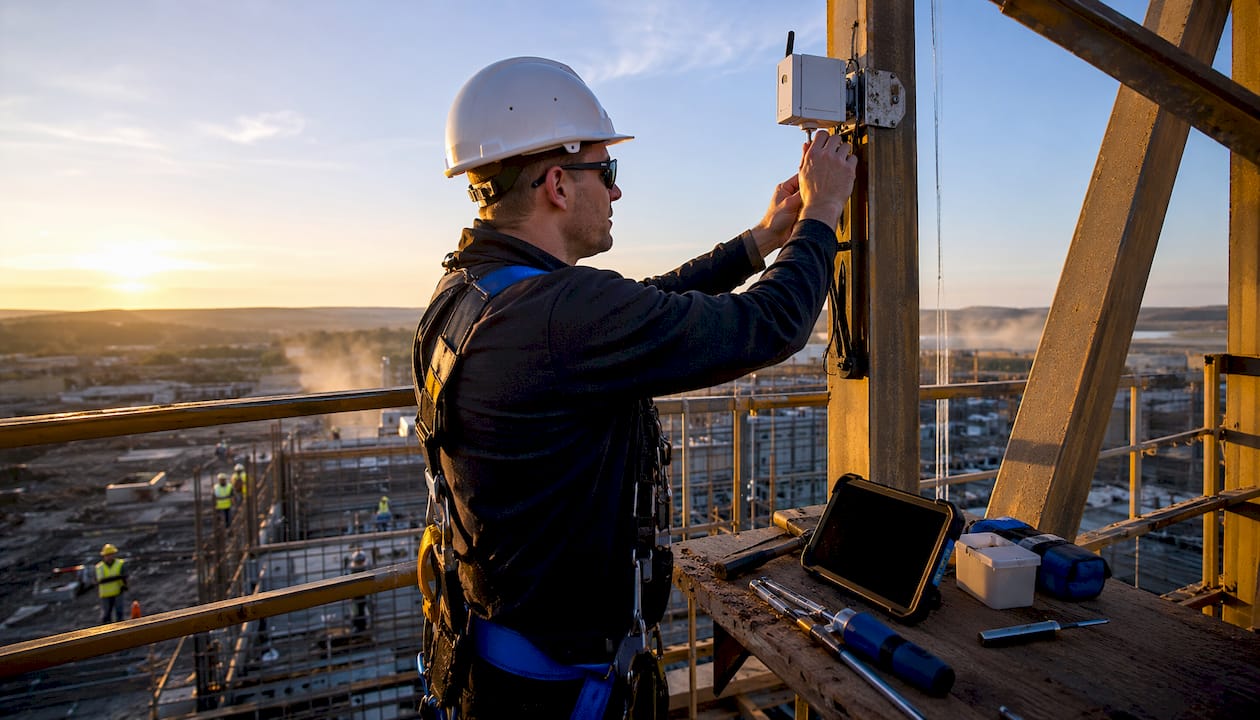
Tools in this category are often IoT-plus-software platforms: they require technical specifications on sensor-data processing, retention policies, and access controls to ensure GDPR compliance without turning the construction site into an undeclared video-surveillance system.
Strengths: native GDPR compliance, certified evidence, fewer disputes.
Limitations: additional hardware is required (sensors, cameras), with a higher total cost than software-only solutions.
Ideal for: sites with stringent HSE requirements, public contracts with strict traceability requirements.
Demo/trial: on request.
Document management, BIM, and SAL solution (category)
For technical firms and construction managers operating in BIM environments, the priority is a direct link between the digital model and document management. These platforms allow users to import and export IFC files, generate model-linked SALs, and share documents with clients and subcontractors in a structured way. Integration with accounting management systems is often available through APIs, but must be verified case by case.
Strengths: native BIM workflows, certifiable SAL generation, structured document management.
Limitations: variable Italian localization, support not always available in Italian, per-project cost may be high for SMBs.
Ideal for: design firms, construction managers, companies with clients requiring mandatory BIM.
Demo/trial: trial available on some platforms.
How to choose: a five-step process and questions to ask
The decision-making process
- Define non-negotiable requirements. Write down the three processes that currently cost you the most time or cause the most errors. Add the mandatory regulatory requirements for your type of site (D.Lgs. 81/2008, SDI, BIM if required by the client).
- Select three candidates. Use this article’s shortlist as a starting point. Immediately exclude anyone without support in Italian or unable to show a demo with real data.
- Test with a real dataset. Ask for a trial or demo using your data: an ongoing site, a real invoice, an existing HSE document. Vendors who refuse rarely improve after signing.
- Assess integrations and complete TCO. Software cost is only one part. Also calculate implementation time, data migration, training, accounting integrations, and, if necessary, hardware for sensors or mobile devices. To assess total cost of ownership correctly, consider all these elements together, not just the annual fee.
- Calculate implementation times. For an SMB with few users, a well-managed implementation typically takes a few weeks. For an enterprise company with ERP integrations and complex data migration, it may take several months. Ask the vendor for a written project plan before signing.
Questions to ask the supplier
- “How do you manage integration with the Sistema di Interscambio? Can you show me a test submission in the demo?”
- “Where is the data hosted? Do you have documented GDPR or ISO 27001 certifications?”
- “Which accounting management systems do you support natively, and which through APIs?”
- “What happens to my data if I decide not to renew the subscription?”
- “Does the plan include initial training, or is it charged separately?”
Red flags not to ignore
- No demo using the customer’s real data.
- Support available only in English or with no guaranteed response times.
- “Available” integrations with no technical specifications.
- Contract clauses that limit data export at the end of the contract.
How we selected and compared the alternatives
The solutions included in this comparison meet all four inclusion criteria: availability in the Italian market, at least partial support in Italian, features relevant to at least one of the key requirements (SDI, SAL, HSE, BIM), and a verifiable trial or demo option.
The factors weighted in the evaluation were, in order: localization and compliance with Italian regulations, functional completeness relative to market requirements, quality of support and training, pricing model and contractual flexibility, and integrations with accounting and BIM systems.
Reliability signals verified:
- Availability of demos or trials with real data
- Documented GDPR compliance (not merely stated on the website)
- Hosting in Europe with explicit retention policies
- Technical certifications where available (e.g., ISO 27001, CSA STAR)
- Support and training available in Italian
A note on limitations: this comparison is based on publicly available information and vendor statements. Features and prices may change. Before making any decision, test the platform with your real data. To find actual construction sites on which to test a management system, the public construction-site consultation portal allows filtering by region, province, and type of project.
AI, IoT, and sustainability: where is construction-site management heading?
Artificial intelligence in construction is no longer a promise for the future. Platforms in the cost-control category are already using AI to shift monitoring from passive recording to proactive forecasting of financial and progress-related issues. The practical difference is significant: instead of discovering at the end of the month that a lot has gone over budget, you receive an alert while the risk can still be managed.
On the HSE front, integrating IoT sensors for environmental monitoring (gas, dust, temperature) and lone-worker detection is becoming a requirement in more structured public tenders. The guidelines for deploying industrial safety systems indicate that hardware selection must be coordinated with the software platform from the outset, rather than added later.
Operational trends to monitor:
- AI for margin forecasting and overrun alerts: reduces surprises at the end of a project.
- Automatic blurring in site footage: makes it possible to use visual evidence without violating GDPR.
- Measurement of the environmental savings from digitalization: becoming an evaluation criterion in tenders with ESG requirements.
Edil-up already translates some of these trends into operational features: the digitalization of the construction sector it proposes includes measuring the environmental savings generated by digitalized projects, a figure that can be used in communications with clients attentive to sustainability. For companies bidding on tenders with ESG criteria, having a measurable figure for reduced environmental impact is not a marginal detail.
Key points
Edil-up is the recommended choice for Italian SMBs and professionals seeking an integrated platform for construction sites, networking, and measurable sustainability, with support in Italian and an annual SaaS model.
| Point | Details |
|---|---|
| Recommended alternative | Edil-up covers site management, networking, document management, and sustainability with support in Italian. |
| Advanced cost control | AI platforms for margin forecasting are ideal for general contractors with multiple active sites. |
| HSE and remote monitoring | Choose solutions with automatic blurring and timestamping for sites with stringent GDPR requirements. |
| Complete TCO | Calculate subscription, implementation, training, and integrations: the real cost often exceeds the subscription alone. |
| Edil-up as the first step | Request a demo with your data at edil-up.com/pricing before assessing more complex solutions. |
Choosing Edil-up is about more than features
People looking for alternatives to Cantiereinrete often start with a specific problem: a missing integration, a report that does not generate automatically, or support that responds in English. But choosing a construction-site management platform has consequences beyond the immediate problem.
Edil-up convinces me for a reason that does not appear in comparison tables: it is built with a vision of the Italian construction sector that includes networking among companies as a native feature, not an add-on. The ability to build a network of contacts in construction directly from the platform changes how a company finds collaborators, subcontractors, and opportunities. It is not a generic social network adapted to construction; it is a tool designed for people who work on construction sites every day.
The sustainability commitment, with measurement of environmental savings and tree planting for every active subscription, is not greenwashing. It is a measurable figure that some companies are already using in communications with clients that have ESG requirements. For those participating in public tenders with environmental criteria, having that number available is worth more than it may seem.
Solutions specialized in AI cost control or remote HSE monitoring are excellent tools for highly specific needs. But for most Italian SMBs, the priority is having a platform that works, speaks Italian, and grows with the company. Edil-up addresses that priority.
Edil-up: site management, networking, and sustainability in one platform
Anyone who has read this far already has a clear picture of the available options. Edil-up offers something specialized solutions do not: an Italian platform that combines site operations, professional networking among companies, and concrete measurement of environmental impact. You do not have to choose between efficiency and sustainability.
The annual Plus subscription includes site management, job postings, project monitoring, and tools for calculating the environmental savings generated by digitalization. Training and support are in Italian. For every active subscription, Edil-up plants trees: a measurable commitment, not a statement of intent.
To get started, review the plans and prices or request a personalized demo directly from the contact page. You can also learn more about the benefits of centralized project management before deciding.
Useful resources for further reading
For anyone who wants to go beyond the comparison and verify regulatory requirements, tools, and trial options:
- Digitalization of the construction sector: how to prepare — Edil-up’s positioning and operational benefits in the context of digital transformation.
- Benefits of centralized project management — operational benefits and practical use cases for construction SMBs.
- 5 digital tools for managing construction sites — practical overview of tools complementary to the platform.
- Online construction-site portal — public consultation of Italian construction sites by region and type of project, useful for testing a management system with real data.
- HSE and first-aid requirements on construction sites — practical guide to operational safety requirements for those assessing HSE modules.
- Credit-based license and D.Lgs. 81/2008 — regulatory updates on construction-site safety, useful for verifying the document requirements the platform must support.
Recommended
- Partner – Cementeria Costantinopoli – Edil-up – The sustainable construction of the future
- News – Edil-up – The sustainable construction of the future
- Eco – Edil-up – The sustainable construction of the future
- The benefits of centralized project management – Edil-up – The sustainable construction of the future